

Adm. Daryl Caudle uses his first long-form interview as Chief of Naval Operations to shift the conversation from a single, headline number of ships to a clearer picture of what the Navy must be able to do. He acknowledges the long-running debate over fleet size and the studies and mandates that produce targets like 355 or 381 ships. But he also points to a hard reality: for a long time, the Navy’s shipbuilding rate and decommissioning rate stay roughly equal, holding the fleet at about 300 ships. Because he does not expect that fundamental math to change during his tenure, he argues the most productive focus is not the absolute number of hulls, but the readiness and capability of the Navy the country actually fields.
Caudle describes the Navy he wants as one that meets global demands despite those constraints. He emphasizes protecting sea lines of communication, commerce, and the world’s chokepoints. He talks about being ready to execute prompt and sustained combat operations against the most stressing operational plans. And he stresses sustainability—fielding a Navy that is ready, but also able to stay ready. In his view, the “right mix” matters: high-end combat ships, high-end aircraft, and unmanned autonomous vehicles working together to deliver the lethality required to win.
He also frames the Navy’s purpose as part of a larger team. Adversaries “get a vote,” he says, shaping what the Navy must be able to do. Combatant commanders “get a vote,” because they carry operational risk and define what they need. And the joint force, allies, and partners matter, because he wants a Navy that integrates effectively across services and with coalition partners, then sustains that integration through real readiness.
When asked about the “delta” between today’s Navy and that vision of an ideal Navy, Caudle turns to priorities. He organizes his approach around three themes: the foundry, the fleet, and the way the Navy fights. The foundry, as he explains it, includes infrastructure, material readiness, and people—the total force of sailors, civilians, contractors, and the broader support network. In his telling, this is where the fundamentals live: the bases and shipyards, the supply system, the parts and maintenance that keep ships operating, and the people who make naval power possible.
From the start, Caudle places people at the center. He says he is “apologetically” focused on putting sailors first, and he connects that approach to how major companies think: they put their people at the center of problem sets because it strengthens every other line of effort. That philosophy drives the message he sends to the fleet in his first formal communication as CNO—what he calls “CNO Note 1”—titled “Sailors First.”
In the interview, Caudle highlights one directive from that note that he says matters immediately: “no sailor will live afloat.” He explains why the issue sits near the top of his leadership agenda. Sailors report to a ship and spend at least half of their first assignment aboard it, but he does not want them to be forced to remain on the ship when they return to port. He calls the practice antiquated and argues sailors should live and work in different places. He makes the point personal, imagining himself as a young 18-year-old: he wants a place to build relationships, sit with friends, and decompress—something separate from the platform where he works.
He adds that, structurally, the practice is especially unfair for young surface sailors. Other communities—aviation, submarines, information warfare—do not live on the platform where they work every day, he notes, and he believes surface sailors deserve the same separation. He paints a simple 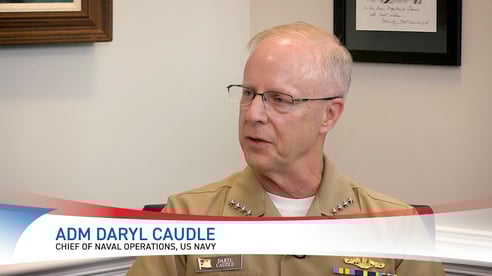 picture: after an eight- or nine-month deployment, a sailor returns to Norfolk or San Diego and realizes their home is still the ship. “It’s just not right,” he says.
Caudle describes active progress and a clear end state. He says roughly 7,000 sailors remain in the situation, and about 2,500 have already been moved off ships. He credits Congress for expanded authorities that allow housing allowances to reach more junior enlisted sailors when needed. He says the Navy is working to get sailors into housing, with a strong emphasis on quality, and he is not stopping until the number reaches zero. He also acknowledges the effort is not uniform everywhere. In some locations—especially overseas—the ability to move sailors ashore is more complicated, but he says he is pursuing the goal anyway and wants sailors listening to know the commitment applies to them, too.
That “Sailors First” emphasis shapes how he talks about issues that might not sound like “tip of the spear” topics—galley facilities, uniforms, sea-bag policies, free Wi-Fi, and administrative processes. Caudle explains why these appear in his first message: he views the Navy through the lens of a “kill chain,” and at the beginning of that chain—and throughout it—he sees people. Removing friction from sailors’ lives is not cosmetic to him; it is foundational to performance.
His example is modern connectivity. He argues sailors should be able to log into Wi-Fi and get a cell signal, especially in shipyards or barracks. He compares the standard to a college visit: if his daughters walked into a dorm and could not see Wi-Fi, he would not want them to stay there. In his view, sailors deserve the same basic expectation.
Caudle also ties “Sailors First” to resilience and warfighting. He says the Navy asks sailors to go into harm’s way and conduct lethal operations. If leaders want sailors to be warriors, he argues, they should treat them like world-class athletes—focusing on how they are fed, how toughness and resilience are built, what kit they receive, where they live, and how frictionless it is to get to work with the right tools and training. In return, he expects execution and accountability, with authority pushed down to sailors.
Looking ahead, Caudle previews how his messages build on each other. He describes “CNO Note 2” as focused heavily on the foundry, including steps to improve maintenance by strengthening shore intermediate maintenance activities—places where sailors can deepen technical skill and keep ships repaired, supporting self-sufficiency at sea. He says “CNO Note 3” will be about the fleet: how the Navy fights through fleet design, command and control, and how he delivers response options for national leaders through prioritization and budgeting.
Finally, Caudle does not shy away from the industrial realities behind readiness. He says the hardest problems sit in the defense industrial base—shipbuilding, ship repair, munitions production, and the underlying workforce challenges. He points to what he views as unacceptable attrition in new construction and ongoing recruiting and retention issues in that workforce. He argues the nation must broaden how it brings people into the trades, connect vocational training to the shipyard pipeline, build experience, and, above all, foster a palpable sense of urgency. He wants a culture that is “offended” by being a day late on the critical path, because in his view the stakes are high. For Caudle, the “ideal Navy” is ultimately one where the capabilities already paid for are delivered on time—and are ready to operate when the nation needs them.
You can watch the full interview here