

Original Broadcast Date: 03/01/2026
Presented by ServiceNow & Carahsoft
The Treasury Department is scaling one of the federal government’s most powerful fraud-fighting tools, and the results are accelerating. In his interview on Fed Gov Today, Justin Marsico, Assistant Commissioner at the Bureau of the Fiscal Service, outlines how Treasury’s Do Not Pay program is expanding its reach, increasing usage, and delivering record-breaking results in the fight against improper payments and suspected fraud.
At its core, Do Not Pay is both a data hub and an analytics platform. Marsico describes it as a collection of 23 data sources paired with risk analytics. Together, they help federal agencies and states identify whether recipients, beneficiaries, or awardees may present a high risk of improper payments or fraud — either before payments are made or after funds have already gone out the door.
The program’s mission centers on three actions: prevent, detect, and recover. Preventing improper payments before they happen is the top priority. Detecting issues quickly follows close behind. And when necessary, Treasury works to recover funds. Marsico emphasizes that this framework drives the bureau’s strategy and measurement approach.
The numbers from fiscal year 2025 tell a striking story. Treasury calculates that its improper payment and fraud prevention work — including Do Not Pay and related programs — reaches $11.7 billion for the year. That figure represents a 63 percent increase over fiscal year 2024, when the total stood at $7.2 billion. It is also the highest amount ever reported by the program.
Several factors drive that growth. One is increased usage. Marsico reports that in FY25, agencies and states ping Do Not Pay data sources and analytics 614 million times. That includes API calls, searches through the user interface, and bulk file screenings. The 614 million screenings represent roughly double the volume from the prior year. More agencies are integrating Do Not Pay into their processes, and existing users are screening more transactions.
Driving usage is not accidental. Marsico explains that his office begins with the scale of the problem. Government-wide improper payments exceed $150 billion annually, according to reported totals. Separately, GAO estimates that the government loses between $200 billion and $500 billion per year to fraud. With losses at that scale, solutions must operate at scale as well.
Treasury focuses on two primary strategies. The first is increasing adoption and usage of Do Not Pay across agencies. The bureau works with the Office of Management and Budget to streamline access so agencies can integrate the tool more easily. The second strategy involves strengthening the data itself — ensuring the program has sufficient and authoritative data sources to address the root causes of improper payments and fraud.
One area where Do Not Pay demonstrates strong coverage is death data. Marsico notes that the system currently includes seven data sources related to death records. If an agency makes a payment to a deceased individual, he explains, there are generally only two possible explanations: the payment is legally required, such as a savings bond paid to an estate, or the agency is not using Do Not Pay effectively.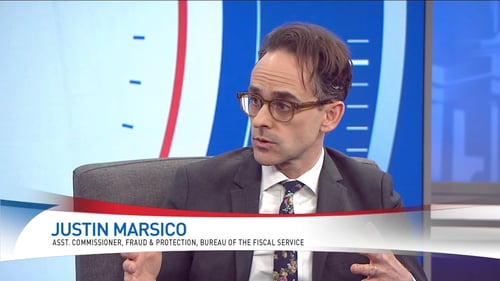
A major milestone strengthens this capability even further. Congress grants Treasury permanent access to the Social Security Administration’s Death Master File after a successful three-year pilot program. During the pilot, Treasury works in partnership with SSA and demonstrates hundreds of millions of dollars in prevented fraud and improper payments. The new legislation provides permanent authority for Treasury to use this authoritative death data going forward.
Marsico makes clear that this achievement is not the end of the story. Other data gaps remain. One example involves Social Security numbers. Treasury seeks broader authority to use SSA’s Numident file — the authoritative record of issued Social Security numbers — to verify whether SSNs submitted on payment files are legitimate. Synthetic Social Security numbers remain a common fraud tactic. Access to authoritative verification would allow Treasury to detect when an SSN is invalid or unissued.
While Treasury is in the process of designating the Numident data source within Do Not Pay, statutory restrictions limit how fully it can be used across all programs and payments. Marsico expresses hope that Congress will grant additional authority so Treasury can screen any Social Security number present in payment data to confirm authenticity.
Throughout the discussion, Marsico returns to scale and impact. The program’s expansion is not merely about adding data sources; it is about matching the magnitude of the fraud and improper payment challenge. With 614 million screenings conducted in FY25 and record savings achieved, Treasury demonstrates how centralized data analytics, strong interagency collaboration, and legislative support can work together to protect taxpayer dollars.
Do Not Pay continues to evolve as both a preventive shield and a detection engine. By expanding data access, increasing agency participation, and refining analytics, Treasury positions the program to address improper payments proactively. The results, measured in billions of dollars, underscore a clear message: when the right data meets the right scale, fraud prevention becomes significantly more powerful.