

Original Broadcast Date: 02/01/2026
Sponsored by CGI Federal
Autonomous and unmanned systems are moving from experimentation to operational reality across the U.S. Navy, and 2026 is shaping up to be a pivotal year in that transformation. On Fed Gov Today, Captain Sarah Rice, Executive Officer of the U.S. Naval Research Laboratory (NRL), explains how the Navy’s research enterprise is accelerating autonomy and artificial intelligence to give warfighters better information, faster decision-making, and a decisive edge in complex environments.
At NRL, Rice says the focus is on delivering the science and foundational research that enables autonomous capabilities across the fleet. Rather than treating autonomy and AI as interchangeable concepts, she draws a clear distinction between the two. Autonomy allows systems to act without constant human control, while artificial intelligence enables those systems to learn, adapt, and handle greater complexity. Together, they allow machines to take on tasks that demand speed and scale, freeing humans to focus on judgment and command.
Rice emphasizes that the Navy’s goal is not to replace people, but to make AI and autonomy true partners in decision-making. Information superiority, she explains, depends on getting the right information to humans at speed. Autonomous systems powered by AI can process vast amounts of data and operate in environments that are difficult or dangerous for people, ensuring decision-makers have the insights they need when it matters most.
A central theme of Rice’s work is what she calls domain-centric AI. She explains that operating environments matter deeply, whether the mission takes place at sea, under the ocean, in the air, or in space. Each domain has unique physics, constraints, and challenges, and those realities must be built into autonomous systems from the very beginning. Developing an algorithm first and attempting to adapt it later is not sufficient. Instead, researchers design autonomy with domain knowledge embedded at every stage.
This approach becomes even more important when systems operate across multiple domains. Rice notes that the Navy has long understood that undersea operations differ fundamentally from air or surface missions. By grounding AI development in a deep understanding of these environments, NRL ensures technologies can transition from research concepts into practical tools for the fleet.
Rice points to recent advances as proof of how quickly this technology is evolving. She highlights a successful test of a reinforcement learning algorithm aboard the International Space Station through the Astrobee program. In that demonstration, a robotic system learns by interacting with its environment rather than relying solely on pre-programmed instructions. The project moves from development to deployment in just a few months, far faster than traditional timelines, and works successfully on its first attempt in space—a notoriously challenging environment.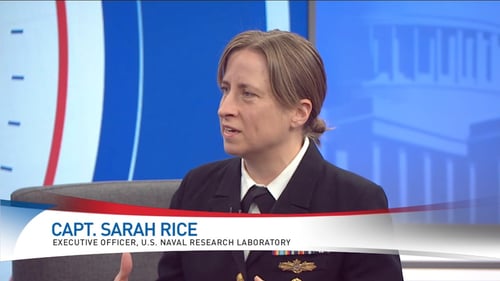
For Rice, this success shows what is possible when AI is trusted to learn and adapt in real time. If these methods work in space, she says, they can also be applied to other contested or difficult operating environments where the Navy operates.
Partnerships play a critical role in making this progress possible. Rice describes close collaboration with industry and academia as essential to the Navy’s research mission. Academia contributes new ideas and theoretical advances, while industry helps scale those ideas and make them producible. NRL serves as a bridge between discovery and application, ensuring innovations can transition to real-world use.
Deciding which ideas to pursue is not always straightforward. Rice explains that the path from science to application is rarely linear. NRL uses rigorous internal discussion and evaluation—sometimes likened to “shark tanks”—to test whether concepts are ready to move forward or need to be rethought. Some of the most successful innovations, she notes, are those that find unexpected applications beyond their original intent.
Throughout this process, feedback from the warfighter remains essential. Rice emphasizes listening not only to operators in the field, but also to a broader set of voices that understand the full operational picture. The Navy’s science and technology leaders stay embedded with fleets around the world, maintaining constant communication to ensure research efforts align with real needs.
Drawing on her own operational experience, Rice underscores the importance of partnership and communication. Navy operations, she says, succeed because of the combined efforts of thousands of people behind the scenes. Her approach to autonomy and AI reflects that same mindset: building systems that support warfighters, strengthen collaboration, and ensure the Navy remains ready to operate wherever and whenever it is called.