

Original Broadcast Date: 03/29/2026
Presented by HII Mission Technologies
The Department of Veterans Affairs is rethinking one of the most fundamental elements of government operations: records management. But instead of treating records as static documents stored for compliance, the agency is actively transforming them into dynamic data assets that power transparency, privacy, and decision-making.
Moya Hill, chief FOIA, privacy, and records officer in the Office of Acquisition, Logistics and Construction at VA, describes this shift as a reframing of how the agency views information governance. At the center of that transformation is a simple but powerful idea: records management is the foundation for everything else.
Traditionally, records programs have focused on retention schedules and compliance requirements. Those elements still matter, but Hill explains that VA is now using them as a strategic framework. Records schedules and file plans are not just administrative tools—they are what enable FOIA officers to find and release information and allow privacy officers to protect sensitive data appropriately.
This creates a natural tension between access and protection. FOIA officers are responsible for releasing information to the public, while privacy officers must ensure that sensitive data is not exposed. Hill emphasizes that this is not a conflict to eliminate, but a balance to manage. The key to making it work is collaboration.
Rather than operating in silos, FOIA and privacy teams must work closely together, alongside records managers, to ensure the right outcomes. When those groups communicate effectively, they can reduce errors, avoid unnecessary risks, and improve both transparency and data protection. Without that collaboration, mistakes are far more likely to occur.
To support this shift, VA is embedding governance principles across the entire information lifecycle—from the moment data is created to when it is ultimately disposed of. Hill points to the agency’s use of an information governance framework that integrates records management, FOIA, and privacy requirements into every stage of that lifecycle.
This proactive approach helps the agency avoid common challenges, such as FOIA backlogs or increased privacy risks. By ensuring that information is properly governed from the start, VA can manage its data more efficiently and reduce downstream issues that often arise when governance is applied too late.
At the same time, the environment in which records are created and stored is rapidly evolving. The days of paper files and physical storage are largely gone, replaced by digital platforms like SharePoint, Microsoft Teams, and shared drives. While these tools increase accessibility and collaboration, they also add complexity.
Hill acknowledges that the sheer volume and variety of communication channels present new challenges for records management. Information is being created and shared across multiple platforms, making it harder to track, manage, and secure. That makes it even more important to have strong governance practices in place.
Despite these challenges, the digital shift also creates new opportunities. With the right systems, agencies can make information more accessible while still protecting sensitive data. For VA, that balance is especially important given its mission to serve veterans, who rely on both transparency and privacy.
Looking ahead, Hill sees artificial intelligence as a key enabler of this transformation. However, she is clear that AI is not a solution on its own—it must be applied thoughtfully within a strong governance framework.
AI has the potential to assist in several critical areas, including improving access to information, enhancing data protection, and supporting records management processes. For example, AI tools can help determine how long records should be retained, when they should be disposed of, and how they align with National Archives and Records Administration guidelines.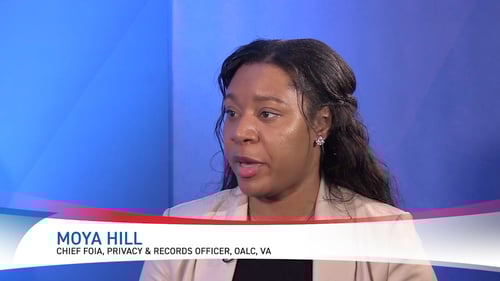
These capabilities could significantly reduce the manual burden on records, FOIA, and privacy professionals, allowing them to focus on higher-value work. At the same time, AI can improve consistency and accountability, ensuring that records are handled correctly across the organization.
Still, Hill emphasizes that technology alone is not enough. Success depends on how well agencies integrate these tools into their broader governance strategies. AI should support the mission, not drive it.
Another critical piece of the puzzle is partnership with IT teams. As records management becomes increasingly digital, collaboration with IT is essential to ensure that systems are secure, accessible, and aligned with governance requirements. IT plays a key role in enabling both transparency and protection, making it a vital partner in this effort.
Ultimately, VA’s approach reflects a broader shift happening across government. Records are no longer just something to store—they are a strategic asset that can improve mission outcomes when managed effectively.
By treating records as data, embedding governance throughout the lifecycle, and leveraging emerging technologies like AI, VA is building a more modern, responsive, and accountable system. It is a model that not only addresses today’s challenges but also positions the agency for the future.
And at its core, the goal remains clear: to better serve veterans by ensuring that their information is both accessible when it should be and protected when it must be.