

Original Broadcast: 01/11/2026
The Coast Guard is undertaking what it describes as the most significant operational transformation since the introduction of aviation, and autonomy sits at the center of that shift. In a conversation on Fed Gov Today with Francis Rose, Anthony Antognoli, the Coast Guard’s first Program Executive Officer for Robotics and Autonomous Systems, explains how the service is standing up a new organization to deliver unmanned and AI-enabled capabilities across its missions.
Antognoli begins by grounding the effort in the Coast Guard’s operating reality. The service is responsible for an extraordinarily complex maritime environment, covering roughly 4.5 million square nautical miles. When airspace above and the maritime domain below the surface are included, the operational volume becomes even larger. At the same time, demand for Coast Guard missions continues to increase, while fiscal and staffing resources remain constrained. Autonomy, he says, is how the service plans to meet those challenges.
The new Robotics and Autonomous Systems portfolio is a core element of Force Design 2028, the Coast Guard’s strategy for becoming a more agile, capable, and responsible force. Antognoli explains that the stand-up of a dedicated PEO transforms how the service develops and fields capability. For the first time, the Coast Guard has a single, centralized office responsible for the full life cycle of autonomous systems, from refining requirements and prototyping to initial fielding, sustainment, maintenance, and repair.
That structure enables faster delivery of capability to operators. Antognoli emphasizes rapid iteration with the people who actually use the systems. Feedback from operators informs improvements during prototyping and shapes procurement decisions, ensuring the technology being fielded delivers real operational value. This life-cycle approach also allows the Coast Guard to learn continuously as systems are deployed, rather than waiting years for updates.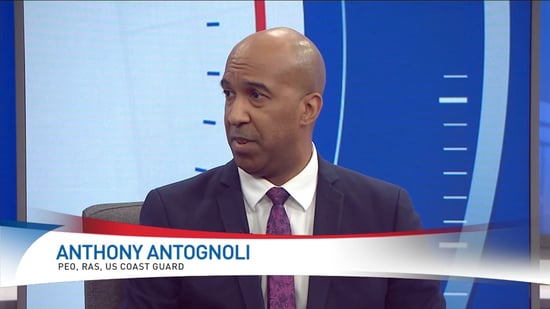
The capabilities under the portfolio span all domains. Antognoli describes underwater unmanned systems, surface platforms, and expanded use of unmanned aerial vehicles. These systems incorporate artificial intelligence and advanced sensors that can detect threats and people in distress without relying solely on human identification. By integrating sensors and software across platforms, the Coast Guard creates what he describes as a dynamic constellation that expands the operator’s field of view.
That expanded awareness directly affects mission execution. Autonomous systems extend the amount of time assets can remain on scene and provide operators with more decision space. Instead of replacing people, the technology enhances human judgment by delivering more timely and comprehensive information.
Antognoli also highlights how the new office aligns with the Pentagon’s portfolio management approach. While the Coast Guard remains part of the Department of Homeland Security, its missions increasingly intersect with the Department of Defense. Maritime security, homeland defense, and border protection all require joint operations. Designing autonomous systems using similar acquisition and management structures ensures interoperability with DoD systems and enables seamless integration into the joint force.
Interoperability is not an afterthought. Antognoli explains that Coast Guard sensors and assets are designed to feed into the same systems used by the Department of Defense. This shared architecture supports coordinated operations and reflects the reality that many missions require a whole-of-government approach.
Industry and academia play a central role in this strategy. Antognoli calls them the Coast Guard’s biggest partners, noting that industry often innovates faster than government. Companies and researchers frequently identify solutions before formal requirements exist, pushing the boundaries of what is technically possible. The Coast Guard actively invites industry and academic partners to demonstrate how emerging technologies can apply to its missions.
Evaluating innovation, Antognoli says, requires close collaboration with operators. Not every advanced capability is mission-critical, and the only way to determine value is through operational use and feedback. Iteration ensures that “cool” technology becomes practical capability.
Looking ahead, Antognoli points to near-term experimentation, including upcoming fly-offs of long-range unmanned aerial systems. Data from those systems will feed directly into operational command networks, and operators will play a key role in evaluating performance. Their input will shape future procurement decisions.
Throughout the discussion, Antognoli returns to the scale of the transformation underway. By deploying autonomy from sea floor to space, aligning with joint force structures, and centralizing life-cycle management, the Coast Guard is redefining how it operates. The goal, he says, is simple but ambitious: deliver faster, smarter capability that allows the service to meet growing demands while staying ready for everything from law enforcement to warfighting.