

Original Broadcast Date: 02/15/2026
Presented by Maximus
At WEST 2026, Admiral Darryl Caudle makes a deliberate choice in how he frames his newest guidance to the Navy. He does not call it a strategy. He does not call it a concept. He calls it “Fighting Instructions.”
That wording is intentional. Caudle explains that he wants to speak plainly to the fleet—the sailors and leaders responsible for conducting naval warfare. His goal is to provide a clear-eyed understanding of where the Navy must go to meet future threats, using the resources it is given, while never losing sight of its differentiated value to the joint force and the nation.
Throughout the document, Caudle ties ambition directly to resources. When he reviews the National Security Strategy and National Defense Strategy, he sees clear requirements: the Navy must be flexible. It must be able to mass combat power against peer adversaries while simultaneously maintaining global presence. Yet he acknowledges the fleet is not large enough to do everything in the traditional way—such as relying solely on carrier strike groups or submarines for every mission. That reality drives a need to tailor forces to specific threat environments.
The Fighting Instructions are organized around four campaign areas.
The first is battle-ready sailors. Caudle says readiness begins with mastery—ensuring sailors are trained, continuously educated, and equipped with the tools they need to perform effectively on the deck plate. But readiness goes beyond technical proficiency. Quality of service and family support are essential. When sailors feel supported and valued, they are truly ready to go into harm’s way.
He notes that the Navy is experiencing record recruiting and retention, bringing in about 10,000 more sailors than losses for two consecutive years. He credits tremendous work by the recruiting force and highlights the strength of the mission itself. When he travels and meets sailors around the world, he hears pride in their service and a desire to contribute meaningfully. They provide candid feedback on areas for improvement, and he views it as his responsibility to address those concerns.
The second campaign area focuses on building a battle-ready force. Caudle describes this as grounded in the Navy’s “foundry”—the infrastructure that enables operational success. Maintenance facilities, hangars, piers, schoolhouses, and galleys form the backbone of readiness. Without a world-class foundry, there can be no battle-ready force.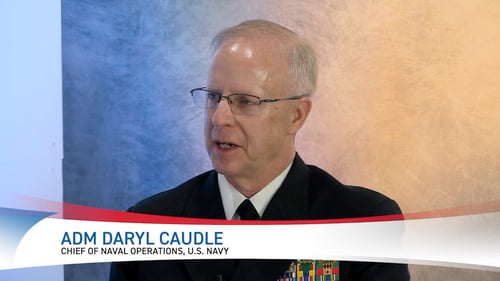
He also concentrates on combat surge readiness. Units must be able to flow out of cycle if required. Deployed forces must be maintained while forward, and those in depot must return on time. Caudle is candid about the gap between current performance and desired levels. The Navy’s combat surge readiness target is 80 percent; it currently sits about 10 percent below that goal. He also references thousands of at-sea gaps that remain, though progress is being made. The delta is clear, and so is the determination to close it.
The third campaign area addresses the battle force for today and tomorrow. This is where Caudle spends much of his time. It centers on force design—shaping a Navy that can meet emerging threats and keep pace with technological change. He emphasizes affordability, sustainability, and the ability to man, organize, and equip the fleet effectively for global demands.
He references an upcoming Force Design 2045 effort, which has not yet been released. That work aligns with a broader emphasis on shipbuilding. Revitalizing shipbuilding requires multiple shipyards, foreign partners, and a capable workforce. It is a long-term effort, but one that is essential to ensuring the Navy remains capable and relevant.
Within this effort, Caudle outlines what he calls a hedge strategy. A one-size-fits-all Navy is not the right answer. Instead, he supports a high-low mix of platforms—from aircraft carriers and submarines to additional surface combatants. This approach increases the degrees of freedom available to tailor force packages for combatant commanders. He does not want commanders to have an “all or nothing” choice or to wait for a carrier strike group to solve every problem. The Navy, he believes, can provide more flexible options.
A key enabler of that flexibility is what he calls “tailored offsets.” These are smart investments in unmanned, robotic, and autonomous systems that solve key operational problems. By pairing general-purpose forces with these tailored offsets, the Navy can “punch bigger than its current weight class.”
The fourth campaign area is global battle integration. Caudle is clear that the Navy does not fight alone. It must integrate with the joint force, allies and partners, Congress, the Office of the Secretary of Defense, and the American people. Communicating the Navy’s differentiated value—its contribution to national prosperity and security—is critical.