

Original Broadcast: 01/11/2026
As the federal government looks ahead to 2026, the Government Accountability Office is raising clear warning flags about where attention is most urgently needed. In a conversation on Fed Gov Today with Francis Rose, Jessica Lucas-Judy, Director of Strategic Initiatives at GAO, explains why four areas rise above the rest on GAO’s High Risk List and what they reveal about broader challenges across government.
Lucas-Judy notes that GAO currently tracks 38 high-risk areas, but federal disaster assistance, cybersecurity and critical infrastructure protection, human capital management, and restructuring the U.S. Postal Service stand out because of their direct impact on the public. These issues are highly visible, financially significant, and increasingly urgent. As she explains, they function as “blinking lights,” signaling risks that need attention before they escalate into full-scale crises.
Federal disaster assistance is a newly added area on the High Risk List, and Lucas-Judy emphasizes why. Disasters are becoming more frequent and more intense, with dozens of events in recent years causing more than a billion dollars each in economic damage and, tragically, hundreds of deaths. At the same time, the federal response system has grown fragmented. Roughly 30 federal agencies play roles in disaster assistance, making it difficult for people in crisis to understand where to go or how to access help.
Lucas-Judy explains that this fragmentation affects outcomes. Survivors may need support for housing, transportation, health care, and other services, yet they often face a confusing patchwork of programs and application processes. GAO highlights the need for reforms that make it easier for the public to navigate assistance, including ideas such as a single application portal that allows agencies to coordinate behind the scenes.
The High Risk List itself has been around since 1990, and Lucas-Judy describes how GAO decides when an issue belongs on it. The process focuses on areas that are vulnerable to fraud, waste, abuse, or mismanagement, or that require significant reform. GAO also looks at whether the government is well positioned to manage the risk. That includes examining leadership commitment, staffing and resources, funding stability, and how well agencies measure and monitor progress.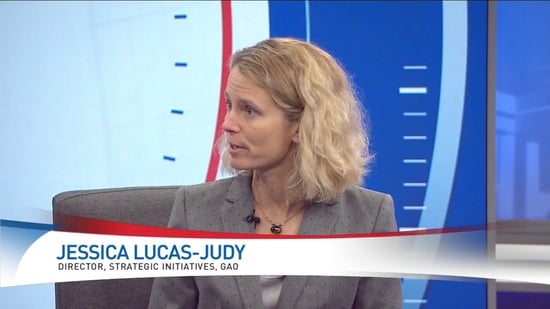
Removing an issue from the High Risk List is not easy, and Lucas-Judy says that is intentional. Areas come off the list only when agencies demonstrate sustained progress and address GAO’s recommendations. Over time, that work has delivered more than $800 billion in financial benefits and meaningful improvements in government services, underscoring why the list matters.
When asked what successful reforms have in common, Lucas-Judy points to coordination and collaboration. Many high-risk challenges cut across agencies and cannot be solved in isolation. Progress depends on clear communication among stakeholders, shared understanding of goals, and consistent engagement with Congress and the public. In many cases, a whole-of-government approach is necessary, whether through enterprise-wide solutions or coordinated efforts that align agencies toward the same outcomes.
Lucas-Judy explains that GAO does not prescribe how agencies must fix problems. Instead, its role is to identify risks and clarify the outcomes that need to be achieved. Terms like fragmentation, duplication, and overlap are useful descriptors, but GAO ultimately focuses on their effects. The key questions are whether roles and responsibilities are clear, whether objectives are well defined, and whether agencies can measure success.
The conversation also touches on leadership transition at GAO. Lucas-Judy reflects on the legacy of former Comptroller General Gene Dodaro, whose 15-year term recently concluded. She describes his deep understanding of government operations and history, as well as his role in shaping long-standing GAO efforts such as the High Risk List and the focus on the nation’s fiscal health. Dodaro’s approach, she says, leaves behind a strong foundation and a leadership team prepared to continue the work.
Looking ahead, Lucas-Judy says GAO is already thinking about what may need to be highlighted next. As a new Congress takes shape, GAO aims to help lawmakers focus on areas where risks are growing and where progress has stalled. That assessment will be guided by how agencies respond to existing recommendations and whether emerging issues show signs of becoming systemic problems.
Throughout the discussion, Lucas-Judy makes clear that the High Risk List is not about criticism for its own sake. It is a tool to drive attention, accountability, and improvement. By addressing these four priority areas now, she argues, the federal government has an opportunity to strengthen services, reduce risk, and better serve the public before challenges become even harder to manage.