

Original Broadcast Date: 12/21/25
The opening segment of Fed Gov Today focuses on the Trump administration’s new President’s Management Agenda (PMA) and what it takes to turn a government-wide vision into real, measurable results. Francis Rose is joined by two longtime management leaders, Loren DeJonge Schulman, Director at the Federation of American Scientists and former Associate Director for Performance at the Office of Management and Budget, and Margaret Weichert, adjunct professor at Georgetown University and former OMB Deputy Director for Management.
Schulman explains that PMAs are typically built from three broad categories. The first includes problems that are clearly broken and demand immediate attention. She points to past examples like security clearance breaches that required urgent, government-wide focus. The second category centers on opportunity areas tied to presidential priorities, such as improving how veterans receive benefits, how taxes are paid, or how services are delivered. The third consists of perennial management challenges that appear in almost every PMA, including workforce issues, procurement, federal data, grants management, and cybersecurity. These topics return again and again because they always offer room for improvement or transformation.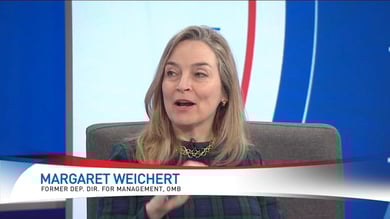
Weichert notes that the Trump approach to the PMA is somewhat different. She explains that voter trust in government and the overall state of federal operations played a significant role in shaping priorities. From her perspective, the process is more top-down, informed by what the American public does and does not trust about government and by which changes could have the greatest long-term fiscal and economic impact. She says she sees elements of that thinking reflected in the current PMA.
Both guests agree that many themes in the PMA remain consistent across administrations. Rose points out familiar ideas such as using the federal government’s buying power more effectively, shared services, fraud and waste reduction, and smarter, faster procurement. Schulman says this continuity is actually a strength. Over multiple administrations, the federal government has built better data, stronger metrics, and more experienced personnel around these issues. That institutional knowledge gives the current administration real levers to pull rather than starting from scratch.
Improper payments serve as a clear example. Schulman explains that the government learned a great deal during and after the COVID-19 period about preventing fraud upfront, managing identities, and reducing improper payments before money goes out the door. She also highlights hiring as another area where administrations can build on past experience. While each administration has different policy priorities and talent needs, there is now a strong understanding of how to surge specialized skills into government when needed. Cybersecurity, she adds, remains a constant challenge, and progress depends on avoiding confusion over roles and focusing on productive partnerships with the private sector.
A recurring theme in the conversation is accountability. Schulman stresses that successful PMAs rely on consistent metrics and administrative data that are as close to real time as possible. These metrics must include feedback loops so leaders can see whether actions are actually driving results. Just as important, she says, is having someone clearly in charge—an individual empowered to track progress, hold agencies accountable, and push for improvement when performance lags.
Weichert agrees but offers a note of caution about over-measurement. She describes a “forest and trees” problem in government, where agencies collect large volumes of data but sometimes lose sight of outcomes and real change. She argues that progress has often come in the form of small, incremental gains rather than transformative improvements. From her perspective, meaningful change requires focusing less on activity and more on impact.
Both guests emphasize the importance of institutionalizing management practices so they carry forward across administrations. Rose highlights the practice of naming responsible leaders and agencies for PMA goals on performance.gov. Schulman says this visibility matters because agencies—not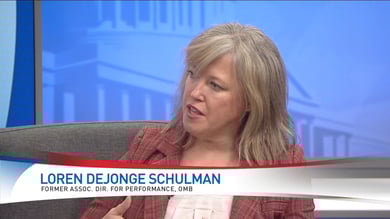 OMB—are ultimately responsible for execution. She suggests assigning deputy secretaries at major agencies to lead specific PMA priorities, allowing agencies to pilot solutions and bring their own innovation to the table.
Weichert adds that assigning ownership to specific agencies is especially effective for shared services and consolidation efforts. Clear accountability and leadership within the executive branch make it easier to negotiate challenges, including resistance that often arises from congressional or district-level concerns.
The discussion closes with a focus on Congress. Both guests stress that many management reforms cannot succeed without legislative partnership. Schulman notes that improving customer experience and enabling consolidation often requires authorities only Congress can provide. Weichert highlights the challenge of funding multi-year technology projects through annual appropriations, arguing that long-term investments are essential for real modernization.
Together, the conversation underscores that the PMA is not just a policy document. Its success depends on data, accountability, agency ownership, and sustained collaboration with Congress to move federal management from incremental improvement toward lasting transformation.