

Original Broadcast Date: 02/15/2026
Presented by Maximus
At WEST 2026, Rear Admiral Keith Hash focuses on a defining challenge for the Navy: how to achieve true “unmanned dominance” in a force that is rapidly expanding in scale and complexity.
The Navy is no longer experimenting with a handful of unmanned platforms. It now operates hundreds, potentially approaching thousands, of unmanned vehicles. That growth brings opportunity—but also significant integration challenges. For Hash, the core issue is interoperability.
There are many entrants eager to deliver unmanned capabilities to the Navy. The service publishes standards and expectations that outline how systems should connect, communicate, and operate within the broader force. But, as Hash explains, interpretation matters. Different companies may read the same standard differently, and when their systems arrive for integration, they must function seamlessly alongside other unmanned platforms, manned aircraft, ships, and command-and-control systems.
Creating environments where that integration can be tested effectively is essential. Hash stresses the need for realistic and safe testing spaces—both in the air and at sea—where industry partners can bring their products and validate how they operate within a larger ecosystem. Close collaboration ensures those standards are interpreted correctly and refined as needed.
The concept of “unmanned dominance” itself is straightforward in principle. The Navy does not want to enter a fair fight. It seeks to deter adversaries by presenting overwhelming capability, and if conflict occurs, to ensure the adversary loses. Whether systems are manned or unmanned is secondary. What matters is dominance.
That dominance must extend across contested environments. Future conflicts may involve kinetic threats, cyber attacks, electronic warfare, or other non-kinetic disruptions. Unmanned platforms must be hardened to operate effectively under those conditions. They must also function as part of a team. No single platform operates alone. Unmanned systems need to understand their role within a larger formation that includes other unmanned assets, manned platforms providing command and control, and supporting forces across domains.
Hash underscores that this level of integration requires a strong partnership between government and industry. He has seen throughout his acquisition career that simply handing requirements to a contractor and waiting for a finished product does not work. Successful programs involve iterative collaboration. Government teams and industry partners work side by side, refining requirements, addressing interpretation issues, and solving problems as they arise.
He draws a parallel to recent infrastructure work following an earthquake, where government personnel and contractors had to collaborate closely to get the details right. The same principle applies to building advanced unmanned systems. Requirements may be thoughtfully developed, but real-world application reveals nuances that require continuous dialogue.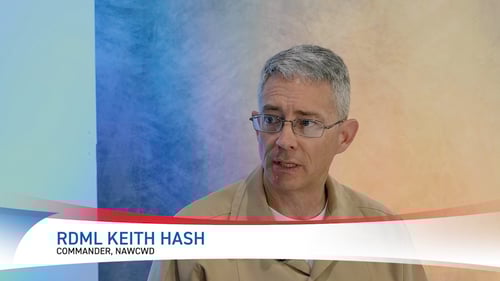
Scale adds another layer of complexity. Testing thousands of unmanned systems in physical airspace and sea space presents practical limits. While the Navy conducts periodic large-scale events with significant numbers of autonomous surface vessels—complete with opposing forces to simulate real conflict—it cannot continuously operate at that scale in the physical world.
To overcome this, Hash highlights the Navy’s increasing reliance on digital, virtual, and constructive environments. By building digital models—or digital twins—of systems, the Navy can conduct thousands or even millions of simulated runs. These simulations allow rapid iteration, early identification of issues, and collaborative problem-solving before hardware is fully fielded.
As part of this approach, the Navy is asking industry to deliver digital models alongside physical platforms. That enables earlier learning and more efficient refinement. Instead of waiting for a fully finished system, the Navy can experiment with a partially developed capability, extract lessons, and allow industry to incorporate those insights before finalizing the design.
Joint and allied integration further shapes the effort. Hash emphasizes that naval aviation and carrier air wings do not operate independently. They rely on surface ships, submarines, and expeditionary Marine Corps forces, as well as close coordination with the Air Force and other services. The Navy conducts joint test events throughout the year and includes allied partners such as Australia, Canada, and the United Kingdom in fully integrated exercises.
These events explore long-range fires, over-the-horizon effects, and the practical challenges of coordinating across services and nations. Digital collaboration environments extend that integration into laboratories and virtual spaces, where partners can combine digital representations of their systems and experiment together.
Throughout the conversation, Hash returns to a consistent theme: integration is not optional. Unmanned systems are not standalone tools. Their value depends on how well they connect—to each other, to manned platforms, to joint forces, and to allied partners. Achieving unmanned dominance requires rigorous standards, realistic testing, digital innovation, and sustained collaboration.
As the Navy scales its autonomous fleet, Hash makes clear that success will not be measured by the number of platforms alone. It will be defined by how effectively they operate together in contested environments to deliver decisive advantage.