Presented by Carahsoft
COL Kenneth Jones, Director of Science and Technology at the Marine Corps Warfighting Lab, explains that optimizing the sensor-to-shooter kill chain is a highly complex endeavor that requires fusing targetable data across multiple domains. While pulling data from a server to a screen seems simple on the civilian internet, the military deals with a "multitude of systems of various form factors," ranging from aircraft to ground satellites and forward-deployed nodes. Historically, this was complicated by vendors who wanted to sell proprietary, end-to-end packages. "The longest time, they just wanted you to buy the whole sensor, to shoot a package from them," COL Jones states, noting they wanted to sell the drone, the missile, the truck, and the software. Today, industry is being forced toward open architectures, requiring competing software and sensors to seamlessly share data across the Joint Force and with national technical means.
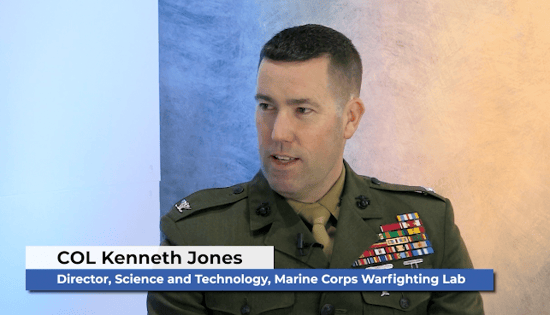 However, tapping into this rich, joint data creates a massive risk of information overload for warfighters. "You can certainly have information overload, and that's why we just want to have a singular application of some sort," COL Jones explains. Operating in bandwidth-constrained environments at the tactical edge—unlike a well-connected combatant command headquarters in a large city—means Marines cannot afford to monitor six different laptops to build a common operating picture. Through an effort known as Operation Dynamis, the Marine Corps is working to port multiple applications onto single, manageable devices. "Think about just your iPhone or your iPad. I'm able to tap into different applications on that one device," he says, ensuring actionable data reaches the shooter without overwhelming them.
Sharing data with international allies and partners introduces further complexities regarding security classifications and Cross-Domain Solutions (CDS). When operating in regions like EUCOM, forces must ensure they are securely moving data from their enclave into a partner's enclave without leaking restricted intelligence. This is a core component of Combined Joint All-Domain Command and Control (CJADC2).
Furthermore, maintaining target custody relies entirely on managing "data latency" so that information does not become "bad" or useless before reaching the gun line. Looking to the future, COL Jones envisions a system where advanced technology curates this incoming intelligence. "Someday, perhaps we get to that point where data goes from an exquisite sensor all the way down to a shooter. It's been curated. Maybe AI has helped to inform it," he says. By using machine learning to understand data latency and identify good versus bad data, targeting information can be rapidly processed and delivered to artillery or HIMARS units in seconds.
This interview appeared in the program Innovation in Government at WEST 2026