Presented by MANTECH & Carahsoft
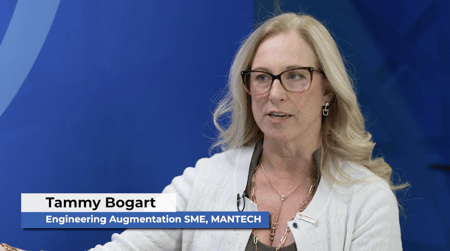
Tammy Bogart of ManTech discussed how digital twinning and all-domain simulation are transforming military testing, training, and operational planning. At Sea-Air-Space, Bogart explained that the rapid growth of distributed operations during COVID accelerated the development of virtual simulation environments capable of connecting users, systems, and platforms across multiple locations.
Bogart described all-domain simulation as the ability to create software-defined environments where air, ground, maritime, cyber, and hardware systems can all be tested simultaneously. Through digital twinning, organizations can replicate operational environments virtually and conduct testing, training, and mission rehearsal without requiring personnel or equipment to physically operate in the same location.
 The ability to simulate operational scenarios rapidly is providing enormous advantages for the Department of Defense. Bogart explained that organizations can now test software updates, hardware replacements, communications systems, and mission scenarios far more quickly than traditional methods allowed. These environments also support realistic “train like you fight” exercises that improve readiness while reducing operational costs.
One of the most important applications of this capability is supporting CJADC2 and other highly integrated operational concepts. Bogart noted that many operational failures occur at system interfaces where platforms struggle to communicate effectively. By using digital twins and systems architecture models, organizations can test interoperability and validate operational performance before systems are deployed into the field.
Artificial intelligence is further expanding these capabilities. Bogart discussed how agentic AI, predictive analysis, and large graph databases are improving the ability to identify vulnerabilities, anticipate failures, and model increasingly complex operational scenarios. She also highlighted how simulation environments are becoming valuable tools for war gaming, cyber defense testing, and predictive maintenance.
The growing flexibility of these environments means organizations can now incorporate emerging technologies much faster. Whether simulating drone swarms, cyber attacks, hardware failures, or future operational concepts, all-domain simulation is becoming a foundational capability for military modernization and mission readiness.
Key Takeaways
- Digital twinning enables faster testing, training, and operational planning.
- AI and predictive analytics are expanding simulation capabilities.
- All-domain simulation improves interoperability and mission readiness.