

Original broadcast 2/3/26
Presented by Microsoft
Jeneen Iwugo, Deputy Director of the Center for Program Integrity at the Centers for Medicare & Medicaid Services, and Nelli Babayan, AI Director, US Federal at Microsoft, focus on the operational realities of adopting AI inside an agency environment where trust, data quality, and mission urgency all matter. Their discussion emphasizes that the most effective AI adoption begins with a data foundation that supports reliable decision-making and scalable analytics.
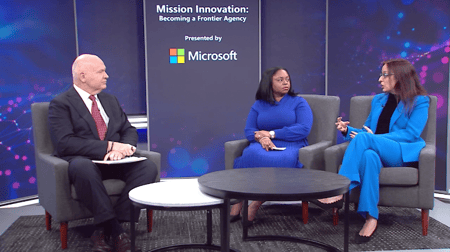 Jeneen Iwugo explains that CMS leadership has taken major steps to improve data quality and ensure strong governance practices, reinforcing a simple principle: garbage in, garbage out. She notes that without high-quality data, analytics and AI outputs cannot be trusted enough to drive mission decisions. She describes the role CMS leaders such as the Chief Information Officer and Chief Data Officer have played in ensuring that the agency has improved access to reliable data, both for internal analytics teams and for contractors supporting the work.
Iwugo shares a practical example of how CMS tested its analytic capabilities through an event called the “chili cook off.” In this effort, CMS provided a limited dataset to participants so they could test analytics approaches using real information. The outcome of the event reinforced that when CMS increases access to quality data, analytic teams produce stronger results that can be used operationally. For program integrity work, she explains, having access to a wider array of reliable datasets improves detection, strengthens decisions, and supports faster action.
Nelli Babayan addresses a challenge agencies often face: becoming so focused on cleaning and standardizing data that they delay actual use. She describes the importance of governance, data provenance, and data ontology, and she affirms that preparation is essential for secure and responsible AI. At the same time, she warns against proof-of-concept paralysis, where organizations remain stuck in pilot mode without scaling outcomes into real operations. In her view, agencies must identify high-value scenarios tied to mission outcomes and move forward by testing, learning, and expanding into production environments.
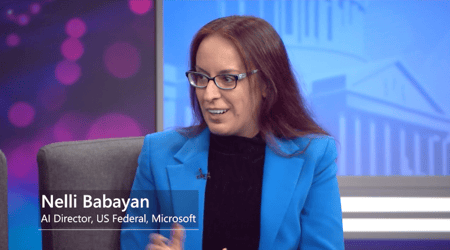 Babayan emphasizes that agencies should narrow their focus to the most meaningful use cases rather than attempting dozens or hundreds of pilots simultaneously. She notes that agencies often have lists ranging from a handful of potential use cases to hundreds, but the reality is that few organizations have the staffing or funding to run large volumes of proof-of-concept efforts. She outlines criteria for prioritization, including mission importance, feasibility, implementation time, clear success measures, and risk.
Risk, she explains, should be evaluated in multiple ways. It includes security and safety considerations, but also the risk of failing to implement AI and falling behind. She also expands the definition of return on investment, noting that ROI is not limited to financial return. ROI can include time saved, improvements in decision-making speed, and measurable improvements in service delivery for citizens.
Iwugo shares a major CMS outcome: the Center for Program Integrity achieved a 14-to-1 return on investment based on 2024 analysis. She explains that CMS processes four to five million claims per day, requiring sophisticated analytics to determine where risk is highest. By analyzing suspicious behavior, outlier patterns, dollar amounts, and claims activity, CMS identifies cases that require closer review. Some abnormalities may be legitimate, she notes, but when multiple suspicious signals accumulate, those factors indicate a high-risk provider or high-risk situation that warrants action.
The conversation explores how layered analytics serve as a force multiplier. Iwugo describes an approach where patterns are evaluated across multiple dimensions, and the combination of factors provides confidence in risk decisions. Babayan adds that successful AI adoption is not only about choosing a model, because models evolve rapidly and the most popular model today may be obsolete quickly. Instead, she argues agencies should adopt secure platforms that support multiple models, allow secure data integration, enable iteration and evaluation, and support continuous monitoring of AI deployments.
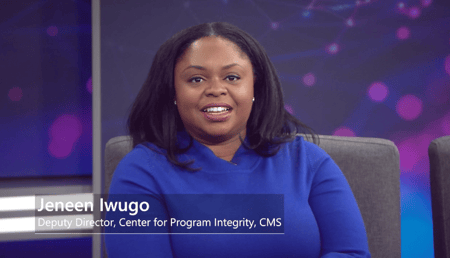 Iwugo also describes how CMS uses models in two key ways: detecting known patterns and uncovering emerging fraud schemes. She compares the model-driven approach to recommendation systems, where patterns from past cases help predict similar future behaviors. But she also notes CMS models support identification of new schemes that have not been seen before, detecting suspicious patterns emerging across different parts of the program integrity environment.
One of the most significant operational innovations discussed is the CMS fraud war room. Iwugo explains that this war room brought together law enforcement, investigators, and analytics specialists in a single environment. The team met for two hours, two days per week, and the goal was to compress what had previously been a slower, linear process into a faster cycle where high-risk cases could be reviewed, decisions could be made, and payments could be suspended when necessary.
Iwugo notes that the fraud war room initially faced skepticism, and at first the team was small because of concerns about time demands. But as the results improved, participation expanded. She explains that people began to see the war room as valuable and began suggesting additional individuals who could contribute expertise, accelerate decisions, and improve outcomes. Over time, the war room moved from being questioned as a time cost to being viewed as a high-impact operational tool.
The results were significant. Iwugo shares that the fraud war room contributed to suspending $1.8 billion in payments. She explains that this outcome validated CMS analytics, confirmed that the right people were assembled, and demonstrated that a faster, data-driven process could protect taxpayer resources effectively. She adds that the war room became a sustained effort, reflecting that CMS had created a model that was repeatable, measurable, and scalable.
Another key insight from the war room experience is that collapsing part of the process is not enough if the remaining workflow still forces output back into slow legacy procedures. Iwugo explains that earlier efforts at collaboration had not produced the same results because output was simply fed back into the traditional system, which slowed everything down again. In the war room model, CMS took on more risk and trusted analytics more directly, allowing faster decisions. She acknowledges that this approach required a mindset shift, because it involved acting earlier and with greater confidence based on layered risk factors.
The war room began as a six-week pilot and was only moderately successful at first. After the pilot period, the team gathered feedback from participants, identified who needed to be included, refined processes, and reduced red tape that slowed action. Iwugo credits this iterative improvement cycle with turning the effort into a major success, demonstrating the value of experimentation, feedback, and continuous adjustment.
Babayan adds that agencies facing overwhelming data volumes can begin with practical AI use cases such as summarization, natural language queries, and AI-enhanced search, which help teams consolidate information across structured and unstructured sources. She explains that these capabilities can reduce hours spent searching for information and help teams find relevant data more quickly, which supports both operational efficiency and decision accuracy.
Together, the discussion frames AI success as a combination of strong governance, thoughtful prioritization, scalable platforms, and process redesign. The key message is that agencies achieve meaningful outcomes when they trust quality data, define valuable use cases, and build operational models that allow faster action without sacrificing oversight.
This segment was part of the program Mission Innovation: Becoming a Frontier Agency.