

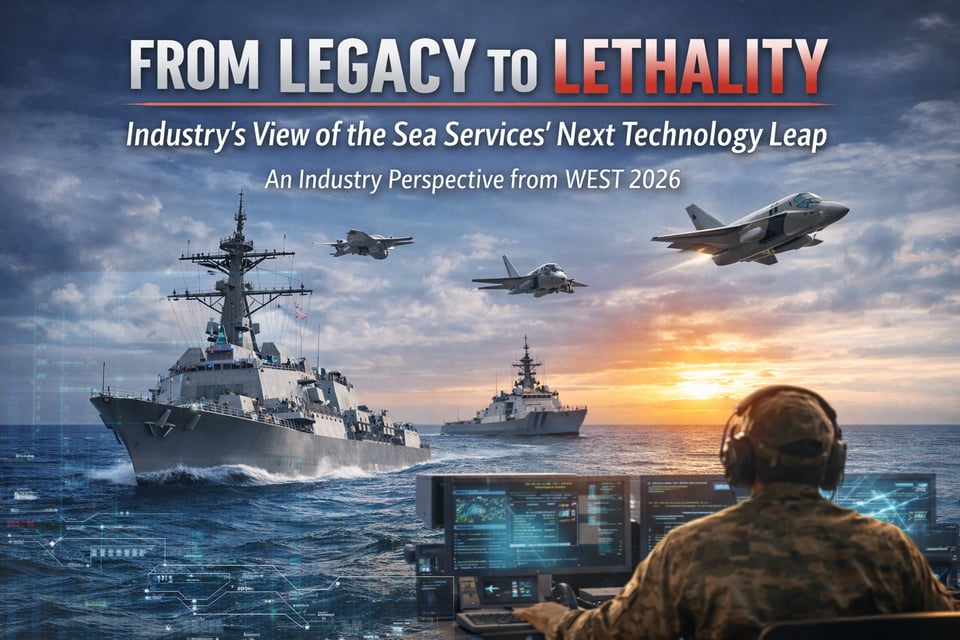
An Industry Perspective from WEST 2026
Presented by Carahsoft
At WEST 2026 in San Diego, industry leaders supporting the Navy, Marine Corps, and Coast Guard delivered a clear message: modernization is no longer theoretical. It is operational. Artificial intelligence, secure software development, data integration, robotics, and acquisition reform are converging into a broader shift that is redefining how the sea services deliver capability.
While AI dominated the conversation, executives emphasized that technology alone is not the story. The real transformation lies in how innovation is integrated into mission execution—securely, iteratively, and at speed.
Modernizing the Foundation Without Breaking It
Few challenges are more complex than modernizing legacy systems that underpin critical naval operations. Many of these systems run on decades-old architectures, written in legacy languages and deeply customized over time. They manage payroll, logistics, maintenance, and operational workflows—areas where even minor disruption is unacceptable.
 Mark Forsthoffer, Vice President of Federal Sales, Mechanical Orchard, described the core dilemma: “These systems run heartbeat operations… there is no disruption that can be tolerated.”
Modernization, he explained, often fails when agencies attempt sweeping, high-risk transitions. Instead, success comes from proving equivalence first—demonstrating that a new system performs exactly as the old one did before introducing change. That requires mapping integrations and data flows at the outset and executing incremental cutovers that preserve operational continuity.
Only after that stable foundation is established can organizations safely re-architect and innovate. Modernization, in this framing, is not a single event. It is a disciplined, phased progression that reduces risk while enabling long-term agility.
AI: Efficiency Over Hype
Artificial intelligence may be the most talked-about technology in defense, but industry leaders consistently reframed its role.
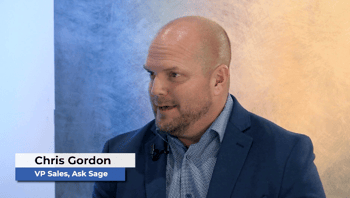 Chris Gordon, VP Sales, Ask Sage, put it simply: “AI is not the point… It’s really about efficiencies gained.”
Across the sea services, AI is delivering immediate impact in acquisition workflows, compliance tasks, document drafting, and research functions. By automating repetitive processes, AI tools free personnel to focus on decision-making and mission-critical priorities.
At the same time, human judgment remains central. As Gordon emphasized, “Human in the loop is a necessity. Humans make decisions, not machines.” AI enhances productivity, but accountability and command authority remain human responsibilities.
Ronny Fredericks, CTO, Public Sector, Nozomi Networks, underscored that AI is not entirely new—it has simply evolved. “It’s not new. It’s just 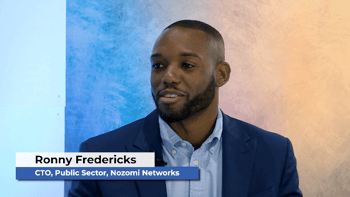 evolved,” he said, pointing to the surge in compute power and model sophistication that now allows agencies to extract meaningful insight from their own operational data.
But Fredericks also cautioned that speed must be paired with confidence. In military environments, efficiency cannot come at the expense of trust. The advantage lies in augmenting human capability—not replacing it.
From Insight to Action
The next phase of AI integration is already emerging.
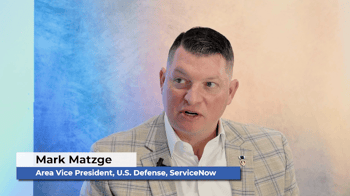 Mark Matzke, Area Vice President, U.S. Defense, ServiceNow, described a coming shift from systems that generate insight to systems that execute action. “There is going to be a leap where we move from gaining actionable insight… but then actually taking action,” he explained.
This evolution—often described as agentic workflow—means AI systems capable of automating repeatable, predictable tasks within approved parameters. That shift has implications not just for IT departments, but for leadership and operational doctrine.
“The way that you run an organization… and the operational execution is changing,” Matzke noted. Senior leaders must prepare for decision cycles where AI-driven automation is embedded into everyday processes. Creating an environment where experimentation is encouraged will be critical to staying competitive.
Securing the Software-Defined Battlefield
As weapon systems and operational capabilities become increasingly software-defined, accelerating secure software delivery is essential.
 John Savio, Vice President of Public Sector, Black Duck, highlighted the importance of early testing and precise security tooling to speed authority-to-operate decisions. “Most weapon systems and capabilities that are being deployed right now… are software based,” he said.
AI-augmented coding tools are accelerating development cycles, but they introduce new challenges. Savio warned that organizations must prepare for code volume growth and ensure testing frameworks scale accordingly. “If you’re increasing the amount of code… your testing capabilities have to scale to that volume of code,” he explained.
The future of defense software development will depend on balancing speed with rigorous validation. Rapid iteration is valuable—but only when paired with scalable, automated security processes.
Data as the Decisive Enabler
AI’s effectiveness ultimately depends on data availability and quality. For many sea service organizations, fragmented data silos remain a barrier.
 Jeremy Wilson, CTO, North America Public Sector, EDB, described the challenge as “looking at the fragmented data silos, and being able to turn those data silos into meaningful insight without having to rip out and replace existing mission systems.”
Achieving full observability across the data environment allows organizations to manage performance, optimize systems, and unlock operational value. Wilson pointed to AI-ready data platforms, edge-resilient architectures designed for disconnected environments, and platform-agnostic data fabrics as key focus areas over the next three to five years.
For forward-deployed naval forces operating in low-bandwidth, air-gapped environments, the ability to securely move and share data across security boundaries is mission critical.
Robotics, Integration, and Competitive Advantage
The conversation at WEST also extended into robotics and unmanned systems.
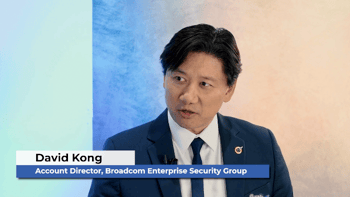 David Kong, Account Director, Broadcom Enterprise Security Group, emphasized the transformative potential of AI integration across warfighting capabilities. “I would definitely have to say, is the artificial intelligence basically integrate AI into all the existing war fighting capabilities,” Kong said, highlighting robotics and unmanned platforms as areas poised for significant advancement.
But innovation is not only about advanced platforms. It is also about usability. Sailors and Marines frequently rotate assignments and must quickly learn complex systems. AI-driven tools that simplify training and operations can provide competitive advantage through ease of use as much as through technical sophistication.
Integration Is the Multiplier
Across every discussion at WEST 2026, one principle emerged: integration determines impact.
Legacy systems must integrate with modern architectures without breaking mission continuity. AI must integrate seamlessly into workflows. Software pipelines must integrate security from the outset. Data must integrate across silos and domains. Robotics must integrate into operational frameworks.
Industry leaders were pragmatic about the challenges—but optimistic about the opportunity. By focusing less on buzzwords and more on disciplined execution—pairing speed with security and innovation with accountability—the sea services can translate modernization efforts into measurable mission advantage.
The technology is advancing rapidly. The organizations that integrate it most effectively will move fastest—and win.