

Original Broadcast Date: 03/29/2026
Presented by HII Mission Technologies
This episode of Fed Gov Today dives into how federal agencies are transforming in an era defined by data, speed, and emerging technology. At the Department of Veterans Affairs, leaders are rethinking records management by treating records as strategic data assets—foundational to transparency, privacy, and compliance. By integrating FOIA, privacy, and records management into a unified information lifecycle, the VA aims to strike a critical balance between public access and data protection while preparing for an AI-driven future. Collaboration across roles and with IT is essential to making this model work effectively.
Meanwhile, at the Pentagon, urgency is reshaping acquisition. Driven by real-world conflicts and evolving threats, defense leaders are pushing for rapid prototyping, iterative development, and direct warfighter feedback. The traditional slow, “waterfall” model is being replaced with agile approaches that prioritize speed, usability, and continuous improvement.
Finally, the Government Accountability Office highlights the growing value of data and records in mission delivery. Agencies that succeed with AI take a thoughtful, problem-first approach, while others risk failure by chasing technology without strategy. Across government, the message is clear: better data governance, smarter tools, and faster execution are no longer optional—they’re mission-critical.
From Paper to Power: How the VA Is Turning Records Into a Data Goldmine
Moya Hill of the Department of Veterans Affairs outlines a major shift in how the agency views records—not as static documents, but as powerful data assets driving information governance. At the core of this transformation is a lifecycle approach that integrates records management, FOIA, and privacy from creation to disposal. This ensures transparency for veterans while safeguarding sensitive information. Collaboration across FOIA officers, privacy officers, records managers, and IT is critical to avoiding risks like data breaches or compliance backlogs.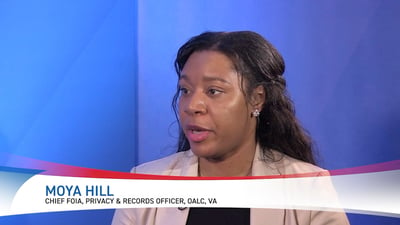
As the VA moves deeper into a digital environment—leveraging tools like SharePoint and Teams—the challenge grows to manage increasing volumes of data across multiple platforms. Hill emphasizes that emerging technologies like AI can enhance accessibility, automate retention decisions, and strengthen accountability. Ultimately, success depends on embedding governance at every stage, ensuring that data is both usable and protected in service of veterans.
Key Takeaways:
- Treating records as data assets—and managing them across their full lifecycle—is essential to balancing transparency, privacy, and compliance.
- Strong collaboration between FOIA, privacy, records, and IT teams is critical to prevent errors and ensure information is both accessible and protected.
- AI and digital tools can significantly improve records management, but only when built on a solid foundation of governance and clear retention policies.
Speed Wins Wars: Inside the Pentagon’s Race to Deliver Tech Faster Than Ever
Garry Schwartz of HII Mission Technologies highlights a major cultural shift inside the Pentagon: speed is now mission-critical. Driven by lessons from modern conflicts like Ukraine and a broader “wartime footing” mindset, the Department of Defense is rethinking how it acquires and deploys technology. Instead of long, linear development cycles, the focus is on rapid prototyping, iterative design, and continuous feedback from warfighters in the field.
This approach allows solutions to evolve in real time, ensuring they are effective, usable, and mission-ready. Industry partners are adopting agile engineering, digital modeling, and minimum viable product strategies to accelerate delivery. Crucially, warfighters are no longer passive recipients—they actively shape development through hands-on testing and feedback. The result is a faster, more adaptive acquisition system designed to outpace emerging threats while maintaining cost-effectiveness.
Key Takeaways:
- Speed in acquisition is now essential, driven by real-world conflicts and the need to outpace rapidly evolving threats.
- Agile development and rapid prototyping replace traditional slow processes, enabling faster delivery and continuous improvement.
- Direct warfighter feedback throughout development ensures systems are practical, effective, and mission-ready.
AI Isn’t Magic It’s Strategy: How Smart Agencies Turn Data Into Mission Power
Sterling Thomas of the Government Accountability Office explains that federal agencies are entering a new era where data and records are central to mission success. Rather than simply adopting AI for its hype, leading agencies are taking a deliberate, problem-first approach—using analytics and automation to improve efficiency, free up their workforce, and better serve the public. 
A key challenge is managing the explosion of data across emails, collaboration tools, and multiple platforms. Agencies that succeed are implementing strong data governance frameworks, including tagging, classification, and lifecycle management, to ensure information can be effectively used by advanced tools. Automation and AI, including natural language processing, are helping agencies organize and analyze massive datasets—but still require human oversight. Ultimately, success comes from aligning technology with mission needs, not the other way around.
Key Takeaways:
- Agencies that succeed with AI start with the problem and mission need, not the technology itself.
- Strong data governance, including tagging and lifecycle management, is essential to unlocking the value of analytics and AI.
- Automation can scale data management, but human oversight remains critical to ensure accuracy and effectiveness.