

Original Broadcast Date: 02/01/2026
Sponsored by CGI Federal
This episode of Fed Gov Today with Francis Rose explores how data, artificial intelligence, and autonomy are transforming federal operations—from financial oversight to military readiness. The program opens with David Ashley, Acting Chief Data Officer at the Treasury Department, who outlines how Treasury is implementing the Evidence Act through five focus areas: governance, cataloging, data maturity, literacy, and sharing. Ashley explains how improving metadata, data quality, and interoperability across Treasury’s many bureaus is essential to breaking down silos and enabling responsible AI use. The emphasis, he notes, is on using data to tell a clear story that helps senior leaders make better decisions.
The show then turns to financial management modernization and payment integrity. Kerry Canfield, Vice President of Product Strategy and Market Engagement at CGI Federal, discusses how agencies are using modern financial systems, prebuilt integrations, and AI tools to assess risk before payments are made—helping prevent waste, fraud, and abuse. She stresses the importance of piloting these tools within strong governance and security frameworks before scaling.
In the final segment, Captain Sarah Rice, Executive Officer of the Naval Research Laboratory, describes the Navy’s rapid expansion of autonomous and unmanned systems. She explains how domain-centric AI is enabling autonomy across sea, air, and space, positioning AI as a trusted partner to the warfighter rather than just another piece of technology.
Treasury’s Data Reset: How Governance, AI, and Literacy Are Powering Smarter Policy
In this segment of Fed Gov Today, David Ashley, Acting Chief Data Officer at the Treasury Department, breaks down how Treasury is turning the Evidence Act from a compliance exercise into a practical data transformation. Ashley explains that Treasury’s approach centers on five priorities—data governance, cataloging, maturity, literacy, and sharing—designed to help a large, federated department understand what data it has, where it lives, and how it can be used responsibly.
A major focus is building a comprehensive data catalog and assessing data maturity across Treasury’s bureaus to identify opportunities for better connection and analysis. Ashley emphasizes that data quality and metadata are foundational, especially as Treasury looks to expand the use of artificial intelligence. Rather than chasing AI as a “shiny object,” the department is developing clear use cases and guardrails to ensure value. Through enterprise coordination and a growing data literacy campaign, Treasury is working to break down silos and deliver clearer, more actionable insights to senior leaders.
Three Key Takeaways:
- Treasury is using the Evidence Act as a catalyst to strengthen data governance, cataloging, literacy, and maturity across its federated bureaus.
- High-quality data, clear metadata, and shared standards are essential foundations for breaking down silos and enabling responsible use of AI.
- The department’s focus is on turning data into actionable insight, ensuring leaders receive clear analysis with a defined “so what” and “now what.”
Stop the Payment Before It Happens: How AI Is Targeting Fraud at the Source
In this segment of Fed Gov Today, Kerry Canfield, Vice President of Product Strategy and Market Engagement at CGI Federal, explains how financial management modernization is becoming a frontline defense against waste, fraud, and abuse. Canfield connects the President’s Management Agenda and recent executive orders to a growing emphasis on payment integrity, where agencies use modern, integrated financial systems to assess risk before money goes out the door.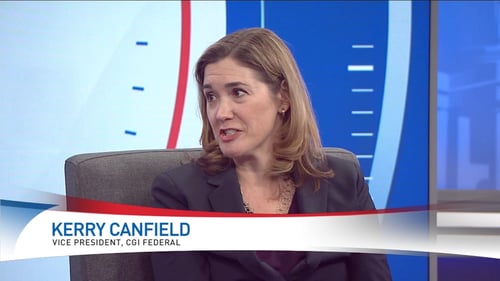
She describes how prebuilt integrations across budget, HR, procurement, and finance—along with Treasury tools like Do Not Pay—give agencies a stronger foundation to detect fraud earlier. Agencies are also piloting AI-driven tools and commercial data sources to validate payees and identify risk profiles in advance, shifting from a “pay and chase” model to prevention. Canfield advises agencies to start with pilots, focus on programs with clear risk indicators, and modernize within their own security domains to manage privacy and compliance. Continuous modernization, she notes, is essential to keeping pace with evolving threats and mission demands.
Three Key Takeaways:
- Financial management modernization is shifting agencies from a “pay and chase” model to preventing waste, fraud, and abuse before payments are made.
- Prebuilt system integrations and AI-driven risk profiling allow agencies to assess payment integrity across budget, HR, procurement, and finance in a more unified way.
- Piloting fraud detection tools within strong governance and security frameworks helps agencies validate value and scale modernization efforts responsibly.
AI as a Teammate: How the Navy Is Scaling Autonomy Across Sea, Air, and Space
In this segment of Fed Gov Today, Captain Sarah Rice, Executive Officer of the U.S. Naval Research Laboratory, details how the Navy is accelerating the development and deployment of autonomous and unmanned systems. Rice explains that autonomy and artificial intelligence are closely linked but distinct—autonomy enables systems to act, while AI allows them to learn, adapt, and make better decisions in complex environments.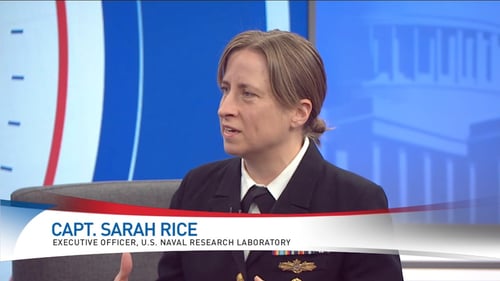
She highlights NRL’s focus on domain-centric AI, emphasizing that autonomy must be designed with the specific physics and challenges of each domain—sea, air, undersea, and space—from the very beginning. Rice points to successful experiments, including reinforcement learning demonstrations aboard the International Space Station, as proof that AI can perform reliably in extreme and contested environments. Close collaboration with industry, academia, and the warfighter ensures these technologies transition from research to operational use. The ultimate goal, Rice says, is to let machines handle speed and complexity while humans focus on judgment and command, giving the Navy a decisive operational advantage.
Three Key Takeaways:
- Autonomy and artificial intelligence are distinct but complementary, with AI enabling autonomous systems to learn, adapt, and act as true decision-support partners for the warfighter.
- The Navy’s domain-centric approach means AI and autonomy must be designed specifically for sea, air, undersea, and space environments from the start, not retrofitted later.
- Close collaboration with warfighters, industry, and academia is essential to rapidly transition autonomous technologies from research into reliable, operational capability.