

Original Broadcast Date: 04/12/2026
Presented by Workday Government
This episode of Fed Gov Today brings together top experts to unpack three major transformation efforts across government.
Asif Khan of the Government Accountability Office explains the Pentagon’s renewed push to achieve a clean audit by 2028. The Department of Defense is consolidating 28 separate audits into one unified effort and shifting to a top-down approach focused on financial statements. Khan notes this model has worked for other agencies, but warns it may not fix deeper issues with systems, processes, and long-term sustainability. He emphasizes that leadership alignment and department-wide coordination will be critical to success.
Cliff Purkey of Workday Government discusses the rapid expansion of artificial intelligence, now with more than 3,500 federal use cases. He introduces the concept of “lawless AI,” where poor-quality or ungoverned data leads to unreliable outcomes. Perkey stresses that clean, well-governed data is essential for building trust in AI, enabling automation while maintaining human oversight and accountability.
Jeff Neal, former Chief Human Capital Officer at DHS and DLA, weighs in on OPM’s plan to build a unified federal HR system. While he supports consolidation of core systems, Neal raises concerns about OPM acting as both policymaker and service provider, warning it could stifle competition and innovation.
The Pentagon’s $800B Audit Overhaul: One Shot to Fix Decades of Chaos
Francis Rose speaks with GAO’s Asif Khan about the Pentagon’s aggressive new strategy to finally achieve a clean audit by 2028. For the first time,  the Department of Defense is unifying 28 separate audits into a single, department-wide effort—signaling a major cultural and operational shift. Khan explains this top-down approach focuses on validating financial statements rather than fixing every underlying system first, a method proven successful in other agencies. However, he warns this strategy comes with tradeoffs: it may deliver a clean audit opinion without addressing long-term issues like broken processes, inconsistent data, and outdated systems. The Marine Corps’ success offers a model, particularly its extended audit timeline and all-hands-on-deck approach. Ultimately, success will depend on strong leadership, coordination, and sustained focus—because achieving a clean audit is just the beginning of building a truly reliable financial management system.
Key Takeaways:
- The DoD is consolidating 28 audits into one unified effort to reach a clean audit by 2028.
- A top-down approach may speed results but risks ignoring deeper system and process issues.
- Long-term success depends on leadership alignment, coordination, and system modernization.
Lawless AI’ Is Spreading Across Government And Bad Data Is Fueling It
Workday Government’s Cliff Purkey joins Francis Rose to break down the explosive growth of artificial intelligence across federal agencies—now exceeding 3,500 use cases. But with that growth comes a major risk: “lawless AI,” where systems generate unreliable or misleading outcomes due to poor-quality data. Purkey explains that AI is only as trustworthy as the data it’s trained on, and many agencies are still struggling with fragmented, 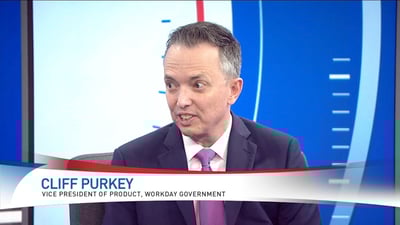 outdated systems that produce inconsistent information. He warns against simply layering AI onto legacy systems, arguing that true transformation requires integrated platforms with clean, governed data. These systems not only improve AI accuracy but also enable auditability—tracking who (or what) made decisions and why. While modernization requires significant change management and leadership commitment, Perkey emphasizes that agencies embracing unified, data-driven systems will be better positioned to scale AI safely and effectively
Key Takeaways:
- AI use in government has doubled, but poor data quality is creating “lawless AI” risks.
- Clean, governed data is essential for trustworthy, repeatable AI outcomes.
- Agencies must move beyond patching legacy systems and adopt integrated data platforms.
OPM’s HR Power Play: Fixing Federal Hiring—or Killing Innovation?
Former DHS and DLA Chief Human Capital Officer Jeff Neal joins Francis Rose to examine OPM’s plan to build a unified HR system for the federal government. Neal supports the idea of consolidating core HR systems, which could reduce costs and eliminate hundreds of outdated platforms. However, he raises serious concerns about OPM’s expanding role—not just as policymaker, but also as a provider of HR services and software. Neal  argues this creates an inherent conflict of interest and discourages private-sector innovation, especially in areas like talent acquisition and AI-driven HR tools. He warns that while standardization is valuable for core systems, agencies need flexibility in specialized tools to meet mission-specific needs. Success, he says, will depend on whether OPM can stay focused on its core mission—modernizing federal HR policy—while delivering a system agencies can actually use and trust.
Key Takeaways:
- A unified HR system could eliminate hundreds of outdated federal systems.
- OPM’s dual role as policymaker and service provider raises conflict-of-interest concerns.
- Balancing standardization with innovation is key to long-term success.