

Original Broadcast Date: 05/03/2026
Presented by Samdesk
This episode of Fed Gov Today dives into how defense and health agencies are racing to modernize in the face of evolving threats, with speed and adaptability at the center of it all. The Air Force is leading a major shift in acquisition strategy by launching Portfolio Acquisition Executives (PAEs), empowering leaders with greater authority to accelerate decision-making and deliver capabilities faster. The goal is clear: increase speed, scale, and competition while managing risk more intelligently—especially as the military embraces rapid innovation like unmanned systems and software-driven platforms.
The conversation then turns to artificial intelligence, where experts argue that a decades-old military concept—the OODA loop (Observe, Orient, Decide, Act)—may be the key to unlocking AI’s full potential. By leveraging AI to process massive volumes of real-time data, organizations can dramatically speed up decision cycles, gaining a strategic edge in both defense and enterprise environments.
Finally, ARPA-H is tackling one of the most urgent and overlooked challenges: cybersecurity in healthcare. With hospitals increasingly vulnerable to cyberattacks, new programs like DigiHEALS and UPGRADE aim to proactively identify weaknesses and respond faster. Innovations such as deployable “crash cart” systems can restore critical hospital operations in minutes after an attack, while digital twin simulations map entire networks to uncover hidden risks.
Speed Kills (in a Good Way): The Air Force’s Plan to Hack Its Own Acquisition System
The Air Force is taking a bold approach to overhaul how it buys and delivers technology, and Lieutenant General Luke Cropsey is at the center of it. In this segment, Cropsey explains the launch of Portfolio Acquisition Executives (PAEs)—a major structural shift designed to cut bureaucracy and dramatically speed up defense acquisition. Instead of routing decisions through layers of approval, PAEs now hold the authority over contracting, engineering, and financial decisions, enabling faster, more accountable program execution.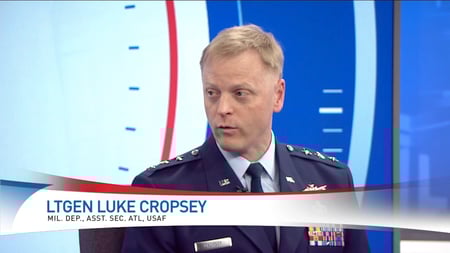
The initiative aligns with a broader push to increase speed, scale, and competition across the defense industrial base. Starting with five “pathfinder” portfolios—including fighters, software, propulsion, and nuclear systems—the Air Force is testing how this model performs before expanding it further.
Cropsey emphasizes that this transformation isn’t just structural—it’s cultural. Teams are being encouraged to take smarter risks and move faster, even if that means accepting occasional failures. The key is managing risk intelligently, as seen in recent unmanned aircraft testing, where setbacks didn’t derail progress.
Key Takeaways:
- The Air Force is shifting to Portfolio Acquisition Executives (PAEs) to centralize authority and dramatically speed up acquisition decisions.
- Success depends on balancing speed with “smart risk,” allowing faster innovation without compromising safety or mission outcomes.
- Cultural change is critical—leaders must reinforce risk-taking through action, not just policy, to drive real transformation.
AI vs. Time: How the Pentagon Is Weaponizing Speed with the OODA Loop
Steve Dirks breaks down how a decades-old military concept is becoming a game-changer in the AI era. The OODA loop—Observe, Orient, Decide, Act—was designed to give decision-makers a speed advantage over adversaries, and AI is now amplifying that advantage at an unprecedented scale.
Dirks explains that today’s battlefield isn’t just physical—it’s data-driven. With billions of signals generated ежедневно from phones, sensors, and open sources, the challenge is no longer access to information, but making sense of it fast enough to act. AI tools are already helping filter noise, verify data, translate languages, and assess threat severity, turning raw information into decision-ready intelligence.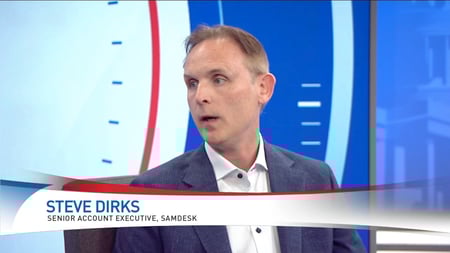
The real breakthrough comes with “agentic AI”—systems that don’t just analyze data but apply reasoning to deliver context and recommendations. These digital analysts can continuously monitor signals against mission objectives and push actionable insights directly to leaders, dramatically accelerating decision cycles.
But scaling this across the Department of Defense requires more than technology. Dirks highlights the importance of user adoption, training, and partnerships—combining cutting-edge AI with deep institutional knowledge—to ensure the tools deliver real operational value.
Key Takeaways:
- The OODA loop (Observe, Orient, Decide, Act) remains a powerful framework, with AI accelerating each step for faster decision-making.
- AI turns massive data streams into actionable insights by filtering, verifying, and contextualizing information in real time.
- Scaling AI across the Department of Defense requires strong user adoption strategies and partnerships with experienced domain experts.
Hack-Proofing Hospitals: The Government’s Plan to Stop Cyberattacks Before They Start
ARPA-H Director Alicia Jackson reveals how the agency is taking a proactive, high-tech approach to one of healthcare’s biggest vulnerabilities: cybersecurity. With hospitals increasingly targeted by ransomware and cyberattacks, Jackson explains that the sector is both highly complex and dangerously underprepared—often running outdated systems and lacking visibility into their own networks.
To address this, ARPA-H is launching ambitious programs like DigiHEALS and UPGRADE. DigiHEALS focuses on identifying and patching  vulnerabilities across medical devices and hospital systems, while UPGRADE goes even further—creating full “digital twins” of hospital networks to map every connected device and detect hidden risks in real time.
One standout innovation is the CRASHCART, a mobile system that can restore critical hospital operations within 30 minutes after a cyberattack—dramatically reducing downtime that can otherwise last weeks and threaten patient care and hospital finances.
Jackson emphasizes that ARPA-H’s model—borrowing talent and approaches from DARPA and the private sector—prioritizes speed, risk-taking, and breakthrough results. The ultimate goal: shift healthcare cybersecurity from reactive defense to proactive resilience, staying ahead of threats before they strike.
Key Takeaways:
- Healthcare is highly vulnerable to cyber threats due to outdated systems, limited funding, and lack of visibility into networks.
- ARPA-H programs like DigiHEALS and UPGRADE focus on proactively identifying vulnerabilities and strengthening defenses.
- Innovations like the “crash cart” can restore hospital operations quickly after cyberattacks, reducing disruption to care and revenue.