

Original Broadcast Date: 05/17/2026
Presented by EY
This episode of Fed Gov Today explores how major transformation efforts across the Defense Department are redefining military logistics, artificial intelligence strategy, and Navy readiness for the future fight.
Defense Logistics Agency Director Lt. Gen. Mark Simerly outlines DLA’s sweeping modernization strategy built around four pillars: data integration, divesting legacy systems, mission reassessment, and reviewing the agency’s global infrastructure footprint. He explains that data has become DLA’s “most decisive commodity,” but much of it remains trapped in outdated systems and disconnected processes. Simerly describes how DLA is modernizing its technology environment, improving interoperability with the military services, and embedding continuous reassessment into the agency’s operations to better support evolving combat requirements worldwide.
The program also previews The Four Futures of AI, a special series presented with EY examining how artificial intelligence could shape government by 2030. EY public sector AI lead Amy Jones discusses four possible AI futures — growth, transformation, constraint, and collapse — and explains how policy, infrastructure investments, and governance decisions made today will determine how AI impacts public sector modernization. She emphasizes that agencies must establish strong data foundations and clear governance strategies to keep pace with the accelerating AI innovation cycle.
Later, Admiral Karl Thomas, commander of Fleet Forces Command, discusses the Navy’s renewed focus on combat readiness, advanced training, unmanned systems, and data-driven warfare. He highlights how artificial intelligence, automation, and integrated information sharing with allies will shape the future of naval operations while ensuring sailors remain fully prepared for real-world combat missions.
DLA’s Biggest Transformation in Decades: AI, Data & the End of Legacy Systems
Defense Logistics Agency Director Lt. Gen. Mark Simerly details a sweeping transformation effort designed to modernize DLA at the pace of the evolving joint force. He explains that the agency’s strategy centers on four major priorities: leveraging data, divesting legacy systems, reassessing 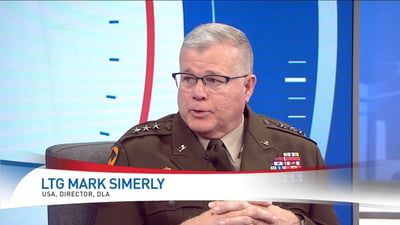 missions, and reviewing DLA’s global infrastructure footprint. Simerly describes data as DLA’s “most decisive commodity,” emphasizing the need to break down siloed systems and create continuous, automated data sharing across the military services instead of relying on outdated spreadsheet exchanges. He also discusses the cultural and procedural changes required to modernize long-standing systems and improve interoperability. Beyond technology, Simerly highlights how DLA is reevaluating its missions and worldwide logistics posture to better align with the National Defense Strategy and support combatant commands more effectively. He says the agency is embedding continuous reassessment into its operations to ensure DLA remains agile and combat-ready long into the future.
Key Takeaways:
- Lt. Gen. Mark Simerly says DLA’s transformation strategy is focused on data integration, divesting legacy systems, mission reassessment, and reviewing its global infrastructure footprint to better support the joint force.
- Simerly describes data as DLA’s “most decisive commodity” and says the agency is working to eliminate siloed systems and enable continuous, automated data sharing across the military services.
- DLA is embedding continuous reassessment into its operations to ensure its missions, systems, and global logistics posture remain aligned with evolving national defense priorities.
The 4 Futures of AI: How Government Decisions Today Could Reshape America by 2030
EY Public Sector AI Lead Amy Jones discusses the launch of The Four Futures of AI, a special series exploring how artificial intelligence could transform government operations by 2030. Jones explains that the project was designed to help public sector leaders think strategically about multiple possible AI outcomes instead of reacting to rapid technological change. She outlines four future scenarios — growth, transformation,  constraint, and collapse — each representing different ways AI adoption, policy, investment, and market forces could evolve over the next five years. Jones emphasizes that government agencies play a uniquely influential role because policy decisions, procurement strategies, and infrastructure investments made today will shape how AI develops across industries. She also warns that the pace of AI innovation is accelerating faster than many organizations can manage, making strong data foundations, governance frameworks, and long-term strategic planning critical for agencies trying to navigate an increasingly unpredictable AI landscape.
Key Takeaways:
- Amy Jones says government agencies have a unique opportunity to shape the future of AI through policy decisions, infrastructure investments, and procurement strategies being made today.
- The “Four Futures of AI” framework explores how AI could evolve through growth, transformation, constraint, or market collapse scenarios by 2030.
- Jones emphasizes that agencies need strong data foundations and clear governance strategies to keep pace with the rapidly accelerating AI innovation cycle.
The Navy’s AI-Powered Readiness Revolution Is Changing How Wars Will Be Fought
Admiral Karl Thomas, Commander of Fleet Forces Command, explains how the Navy is redefining readiness to prepare for future combat operations in an increasingly data-driven and technologically advanced battlespace. Thomas says maintaining combat surge readiness requires more than deploying ships quickly — it demands fully trained sailors, operational equipment, and integrated teams capable of fighting across 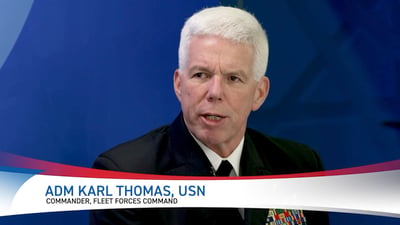 multiple domains. He discusses how the Navy is using live, virtual, and constructive training tools to improve efficiency while preserving rigorous readiness standards. Thomas also highlights the growing importance of unmanned systems, autonomous platforms, artificial intelligence, and sensor-driven warfare in the Navy’s future force structure. He stresses that advanced technology alone is not enough, emphasizing the need for training and sustainment to accompany every new capability introduced to the fleet. Thomas also describes the critical role of allied interoperability, real-time data sharing, and AI-enabled decision-making as the Navy prepares for future conflicts in increasingly contested global environments.
Key Takeaways:
- Admiral Thomas says true combat readiness depends on fully trained sailors, operational equipment, and integrated teams that can operate effectively across multiple domains.
- The Navy is accelerating the use of AI, unmanned systems, and advanced data analysis to improve decision-making and prepare for future warfare.
- Thomas emphasizes that every new technology introduced to the fleet must include proper training and sustainment to ensure sailors can effectively operate and maintain it in combat environments.