

Presented by Appian
Government technology partners face a clear expectation: explain what a capability can do, make its costs understandable, and show how it improves the mission. Matt Chong, Senior Vice President, Public Sector, Appian, and Joe Vidulich, Head of Government Relations, Appian, say those expectations are becoming more important as agencies consider wider use of AI.
In a Fed Gov Today Spotlight recorded at Appian Government, they connect acquisition, AI governance, and the practical work of delivering services.
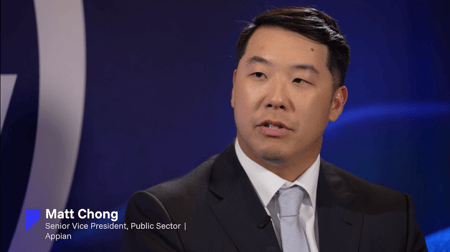 Chong identifies transparency as a recurring customer need. Agencies want clarity about technology capabilities, the guardrails around AI, and the financial implications of adoption. Predictability helps leaders understand what they are buying and how it will support an intended outcome.
Vidulich emphasizes the processes surrounding the technology. Improving service for a veteran, a service member, or a benefits recipient requires more than introducing a model. Agencies need a way to connect AI activity to work they can monitor and results they can assess.
Acquisition is a central example. Chong describes the need to modernize the full procure-to-pay process rather than improve isolated pieces without connecting them. An end-to-end view can help agencies understand how each step affects the delivery of capabilities.
Vidulich links that administrative work directly to operations. A contract may ultimately enable a submarine, a vehicle, or another resource needed in the field. The quality and speed of the process therefore matter beyond the contracting office.
Chong points to Army work as an example of efforts to shorten the path to delivery. He describes an enterprise agreement with a contract ceiling of $500 million and a munitions modernization effort that moved from a minimum viable product to production in 110 days.
Those are examples he offers of how a platform approach and a direct relationship can support speed. At VA, he describes a different challenge: helping connect visibility across multiple systems through a common approach to orchestration.
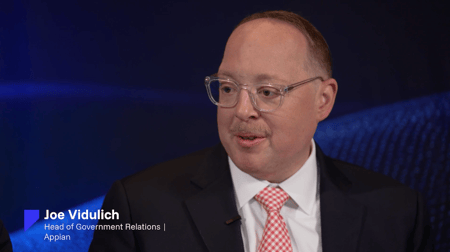 The goal is to reduce the fragmentation that can occur when programs address their needs separately. Shared architecture can help organizations coordinate activity across existing boundaries.
Both guests also address the controls needed around AI agents. Vidulich says agents are part of the solution, while human participation remains necessary. Agencies need to decide when work should go to a person and when an agent can appropriately handle it.
Chong compares the governance challenge to earlier cloud transitions. Moving sensitive work into a new environment requires a clear structure for managing the change. Wider agent adoption raises similar questions about oversight and boundaries.
Vidulich also advocates clearer rules for AI at a national level. He presents that as part of enabling responsible use in consequential government work.
Their broader argument is that adoption must be systematic. Testing and learning matter, but mission-critical activities need an orchestration layer and an understanding of the consequences. Transparent partnerships, connected acquisition processes, and deliberate governance can help agencies turn emerging capabilities into outcomes they can sustain and explain to the people relying on government services.
3 Key Takeaways
- Technology partners should provide transparency about capability, governance, pricing, and outcomes.
- Connecting the acquisition lifecycle can support faster delivery of mission capabilities.
- AI agents need orchestration, guardrails, and clear decisions about human involvement.