

Presented by Appian
Government agencies face different missions, but many encounter the same operational barriers: disconnected applications, manual research, and aging systems that make important work harder. Michael Beckley, Chief Technology Officer & Co-Founder of Appian, sees those challenges converging around three major opportunities for modernization.
In a Fed Gov Today Spotlight recorded at Appian Government, Beckley identifies case management, core operations, and legacy modernization as recurring priorities across government. Each involves connecting people and information so agencies can deliver services more effectively.
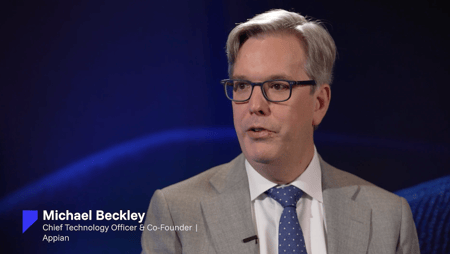 Case management includes investigations, benefits administration, and service support. These activities often require employees to search multiple systems, interpret changing policies, and assemble information manually. When that work overwhelms available capacity, backlogs grow and mission delivery suffers. Beckley sees opportunities to introduce AI agents into these processes with the safeguards their importance demands.
The second area involves the operational functions that keep agencies running. Executing contracts, making payments, managing personnel, and moving supplies all depend on coordination across systems. The technology challenge is closely tied to understanding how work moves through the organization.
Beckley cautions that agencies can become so focused on organizing data that they delay delivering useful capabilities. Trying to establish a perfect data lake, catalog, or shared model can consume years, particularly when multiple organizations have different priorities and constraints.
He describes Appian’s data fabric as a way to work with that complexity through a virtual data layer. In his view, agencies can connect existing systems and deliver functionality while continuing to improve their information environment. The goal is to make progress without requiring every participant to agree on a single structure first.
Unstructured information presents another opportunity. Documents often contain material that employees need but cannot easily search or incorporate into workflows. Beckley says advances in document processing are making it possible to extract and organize that information at much greater scale.
That capability can also support AI agents performing research and other tasks. Making documents accessible and useful expands the information available to support a decision or complete a case.
The third priority is replacing legacy systems. Beckley argues that security pressures and the availability of newer development tools strengthen the case for moving more quickly. He sees AI-assisted migration as a way to accelerate work that historically required lengthy analysis and manual effort.
Modernization should also improve the employee experience. Beckley emphasizes that conversational AI is one useful interface among several. People still need maps, diagrams, pictures, and other visual ways to understand information and act on it.
His recommendation is to use a modern platform that can continue evolving, rather than create isolated applications that depend on one developer to remain useful. A connected environment can give agencies access to new capabilities as their needs change.
Across the three priorities, Beckley’s focus is practical delivery: reduce manual effort, make information usable, and give employees tools that help them complete the mission. The common foundation is an approach that connects workflows, data, and modernization instead of treating them as separate projects with separate definitions of success.
3 Key Takeaways
- Case management, core operations, and legacy modernization share a need for connected workflows and data.
- Agencies can deliver useful capabilities while improving their data environment over time.
- Modernization should make unstructured information usable and support both conversational and visual interfaces.