

Presented by Appian.
Virtual care modernization is about more than updating applications. It is about helping veterans receive care and enabling clinicians to deliver it without navigating unnecessary complexity. Richard Garrison and Shane McNamee describe an approach that begins with those outcomes and works backward to the technology.
Richard Garrison, Acting Executive Director, Connected Health, Veterans Health Administration, and Shane McNamee, Industry Lead, Global Public Health at Appian, discuss that approach in a Fed Gov Today Spotlight recorded at Appian Government. Their conversation connects architectural flexibility with the daily experience of healthcare teams.
 Garrison says the pace of technological change has shortened the time between an emerging capability and a product ready for use. That places pressure on organizations to improve both their technical foundations and the processes that determine how quickly they can adopt something useful.
Rather than trying to predict every future feature, his team has focused on building modular layers. An orchestration layer, a unified user experience, connected data, and access controls can help the organization introduce new capabilities while preserving the ability to change direction.
That flexibility matters for AI. A model that works well today may become too expensive, unavailable, or less effective than another option. Garrison describes an architecture designed to replace components as needed instead of making the entire environment dependent on one choice.
McNamee emphasizes that portfolio modernization should begin with people and processes. Years of purchasing separate applications can leave employees responsible for manually connecting them. Updating each application individually may preserve that fragmentation.
His preferred starting point is a conversation with users, business owners, and technology leaders about the work that must happen from beginning to end. Teams can then identify the outcomes they need and determine which systems and data sources support them.
Garrison offers a concrete example of the burden. He says a clinician may have roughly 15 applications or tabs open to complete an encounter. The goal is to reduce that experience to one or two, giving teams a more coherent way to work.
Veterans have a similar expectation. Their experience should connect care across products and services rather than reflect the organizational boundaries behind those services. A more integrated workflow can support both the person receiving care and the employee delivering it.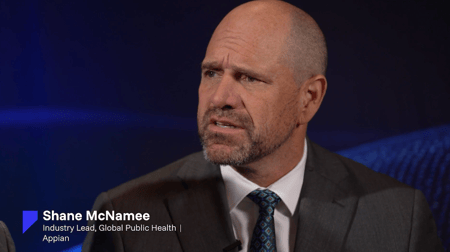 McNamee also cautions against introducing independent AI applications that create additional barriers. AI should fit the workflow, be transparent and auditable, and help employees accomplish a defined task.
Both guests stress the importance of involving actual users throughout development. Feedback should inform initial design, subsequent changes, and assessment after delivery. Leaders’ assumptions cannot substitute for observing how people perform their jobs.
Garrison says staged modernization is possible even in a large environment. He describes replacing a health data pipeline supporting 250,000 daily users without those users noticing the transition.
The larger lesson is that modernization can advance incrementally while maintaining service. Clear outcomes, modular architecture, connected information, and sustained user involvement provide a foundation for change that improves care delivery today while preserving room for the technologies that will become available tomorrow and the needs that emerge alongside them.
3 Key Takeaways
- Begin with veterans’ and clinicians’ needs, then map the workflows and data required to support them.
- Modular architecture can make it easier to replace AI models and other components as conditions change.
- Involving actual users throughout development helps reduce fragmentation and support staged modernization.