

Presented by Appian
The military’s growing access to data creates an opportunity and a challenge. Information can support better decisions, but it can also burden the people who must act on it. For Gen. Paul Funk (USA, ret.), Former Commanding General, Army Training and Doctrine Command, and Frank DeGeorge, Regional Vice President at Appian, the test of artificial intelligence is whether it makes that work simpler and more effective.
In their conversation with host Francis Rose on Beyond the AI Pilot: Turning Investment into Mission Outcomes, presented by Appian, they connect the promise of AI to the practical demands of training, application delivery, and operations.
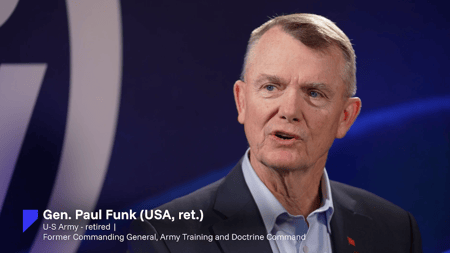
Funk describes a threat environment in which adversaries can alter the operational space through information and technology without moving conventional forces. The complexity has increased, but his prescription centers on clarity: tools should help service members make difficult decisions under demanding conditions.
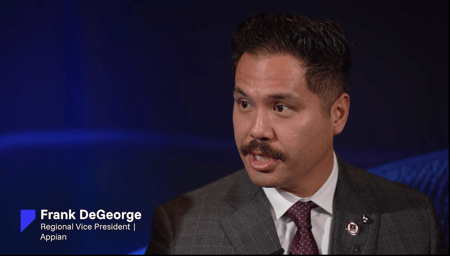
 DeGeorge sees the same requirement in the amount of information available to commanders. Data must be brought together and presented through applications that reflect how people work. Access alone is not enough. A useful capability helps a decision maker understand what matters and act.
He points to acquisition, personnel planning, and logistics as areas where AI can support faster decisions. These are different functions, but each depends on connecting information with a process and a specific operational need.
Trust is another recurring theme. Funk argues that service members should use emerging tools in training environments, gaining experience through repetition before depending on them during operations. Practicing with a capability gives users an opportunity to understand it and helps organizations see where it needs improvement.
DeGeorge connects that experience to an iterative development approach. Put tools into users’ hands, gather feedback, and make changes quickly. Funk emphasizes the value of having application developers work directly with soldiers, allowing the people building a system to understand the problem where it occurs.
That collaboration should include a willingness to reconsider the underlying workflow. DeGeorge cautions against taking an ineffective legacy process and simply rebuilding it in newer software. Teams should examine current requirements and determine what provides an advantage now.
 Funk relates that thinking to the Army’s mission-essential tasks and supporting individual skills. A tool’s usefulness should be assessed against what people need to accomplish. Technology becomes valuable when it improves performance in those tasks.
The conversation also considers how agencies move from an idea to a capability in production. DeGeorge describes configurable solutions, an Army enterprise agreement, and an accredited hosting environment as components that can help shorten delivery. He cites work to modernize a munitions planning and forecasting system as an example of replacing a harder-to-change legacy environment with a more configurable approach.
Across those examples, the shared priority is the person at the point of need. Whether supporting a warehouse task, a headquarters workflow, or a battlefield decision, AI should reduce friction and help users accomplish the mission. Progress beyond a pilot therefore requires attention to adoption, feedback, process design, and delivery alongside the technology itself. Simplicity remains a practical measure of whether that investment is paying off.
3 Key Takeaways
- Useful AI should simplify decisions and deliver relevant information to service members.
- Training and direct feedback help build trust and improve tools before operational use.
- Reconsidering workflows and reducing delivery friction can help move capabilities into production.