

Presented by HII Mission Technologies
Brig. Gen. Houston Cantwell, USAF (Ret.), Senior Resident Fellow for Airpower Studies at the Mitchell Institute for Aerospace Studies, says the current debate around autonomy may feel new, but the Air Force has been working through these questions for decades. Advanced aircraft have long depended on varying degrees of automation, and the service has spent years exploring how both manned and unmanned systems can operate more effectively in complex battlespace environments. What has changed is the urgency. The defense community is no longer treating autonomy as an abstract future capability. It is now asking how to integrate automation in ways that deliver speed, decision advantage, and protection for the warfighter.
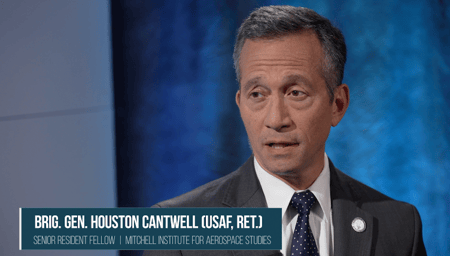 Cantwell frames the issue through the kill chain: find, fix, target, track, engage, and assess. Historically, humans have performed each of those steps. The question now is where machines can help accelerate the process without removing human judgment from the points where it is most important. He says the conversation often becomes too narrowly focused on whether a machine should ever be allowed to “push the button.” In reality, the larger issue is how automation can support every step before and after that moment.
That distinction matters because the pace and scale of modern threats are changing. Cantwell points to mass attacks involving large numbers of drones, missiles, or other small targets. In those scenarios, human operators may not have enough decision space to manually evaluate and respond to every inbound threat. Some defensive systems already have the technical ability to automate large portions of that process, but human-designed stops are built in so operators can apply judgment when circumstances are especially complex.
The challenge is not just speed. It is trust. Leaders must understand where automation improves performance, where it introduces risk, and how to design systems that preserve accountability. For Cantwell, the goal is not autonomy for its own sake. It is useful automation that helps warfighters survive and succeed when the tempo of combat exceeds traditional human decision cycles.
Data is central to that future. Cantwell says military leaders increasingly recognize that information is one of their most important assets. But the value of data depends on whether the right information reaches the right decision maker at the right time. In highly complex operations centers, enormous amounts of information flow in from different systems, sensors, and sources. The problem is filtering that data fast enough to support action.
 He also warns that data links can become a vulnerability. As unmanned systems rely on communications networks to stay connected to decision makers, adversaries may target those links. Some systems operating in conflict zones depend on commercial networks or commercial satellite services, raising difficult questions about resilience, policy, and control.
Cantwell’s message is direct: autonomy, airpower, and data are becoming inseparable. The future fight will reward forces that can automate intelligently, move information securely, and preserve human judgment where it matters most. Speed is essential, but speed without trust, resilience, and disciplined integration will not be enough.
This interview was recorded on location at DefenseTech Live presented by HII Mission Technologies. Click Here for more insightful interviews from the event.