

Presented by Legion Intelligence & Carahsoft
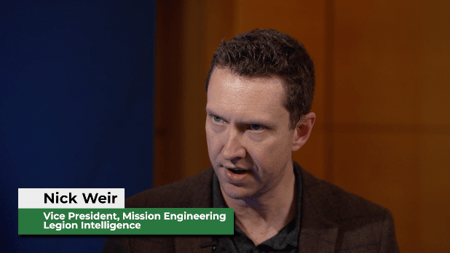
Speaking with Fed Gov Today at the Google Public Sector Summit, Weir described a gap between what AI can do and what a typical employee can accomplish through a blank prompt box. Turning that empty field into a useful mission output often requires knowledge about how the technology responds. Organizations cannot assume every employee will develop that expertise.
 Application design can reduce the burden. Weir advocated familiar interfaces that let users understand how to perform their work. Sometimes a chatbot is appropriate. In other cases, AI can operate in the background, assisting a process without requiring the employee to interact with the model directly.
He offered the example of intelligence reporting. An agent could help triage incoming reports, compare them with established priorities, and identify work requiring attention. The employee receives assistance within a recognizable workflow, rather than having to invent a prompting strategy for each new task.
Data architecture also affects how quickly agencies can make progress. Weir acknowledged that some use cases justify centralizing information. But moving everything into a single repository can require substantial time and staff effort before the organization sees a useful result.
His preferred starting point is a system that can use data where it already resides. That allows teams to prototype an application and evaluate its value without first completing a major consolidation effort. It can also preserve the existing data environment for employees and applications that depend on it.
The same emphasis on operational fit applies to model selection. Weir discussed military and intelligence settings where connectivity and computing resources are constrained. Work at the tactical edge may differ considerably from the analysis conducted at headquarters with access to larger systems.
An operator in an austere environment may need help reducing a specific cognitive or manual burden. Weir said smaller, purpose-built models can be effective for those tasks. He cited Google’s Gemma models as an example of capabilities suited to certain constrained environments and workloads.
More powerful frontier models have a different role. Weir pointed to higher-level analysis, integration, and sense making as work that can benefit from systems such as Gemini when the available infrastructure supports them. Model choice follows the task and operating conditions, rather than a single preference across every deployment.
Across the interview, Weir emphasized designing around the people and conditions an agency actually has. A useful system needs an understandable interface, access to relevant information, and computing demands appropriate to its environment. Those choices can help agencies evaluate value sooner and extend AI assistance to employees who are never going to become prompting specialists. At the tactical edge, they can also determine whether a capability remains useful when connectivity is limited. The mission sets the requirements for the application and the model supporting it, from the user interface through deployment.