

Original Broadcast Date: 7/26/2026
Sponsored by Udemy and Carahsoft
The Department of Defense's push to become an AI-first organization places new emphasis on one foundational element: data. At the Defense Health Agency (DHA), that effort begins with establishing the governance, quality, and accessibility needed to support artificial intelligence across one of the federal government's largest healthcare organizations.
On Fed Gov Today, Jesus Caban, Chief Data and Analytics Officer at the Defense Health Agency, discusses how the agency's data strategy aligns with the Pentagon's AI strategy and supports DHA's mission as a combat support agency. He explains why trusted data is essential for AI, how the agency is improving governance across more than 100 systems, and why workforce development remains just as important as technology adoption.
Building an AI-First Organization Starts with Data
Caban says DHA's data strategy was released shortly after the Department of Defense issued its AI strategy directing every component to become an AI-first organization. For DHA, that means ensuring data is reliable, secure, and available to support military operations and healthcare delivery.
"We can talk about all the AI efforts we're doing, but if the data is not flowing correctly, if there are issues with the data, with the quality, if there is misunderstanding about the meaning of the data, then we're not supporting our commanders out there in the field," Caban says.
As a combat support agency, DHA must balance data accessibility with patient privacy while delivering information commanders can use to make operational decisions. The agency's strategy establishes the framework needed to improve data management over the coming years.
Creating a Common Framework Across the Enterprise
Managing data across DHA is a significant undertaking. The agency supports more than 100 systems, including the MHS GENESIS electronic health record, operational medicine platforms, and systems for exchanging information with TRICARE. Data is distributed across numerous environments, making consistency and governance a priority.
Rather than addressing each system individually, DHA's data strategy creates a common framework for data stewards, IT custodians, and data domain owners. The goal is to improve data quality, establish consistent standards, and mature the agency's data environment over the next five years.
Governance Extends Beyond Headquarters
A major focus of the strategy is governance. Caban explains that governance begins with clearly defining roles and responsibilities throughout the organization. Every employee who creates, manages, or uses data contributes to its quality. That responsibility spans DHA's 47 medical centers, more than 550 clinics worldwide, and a workforce of more than 150,000 professionals.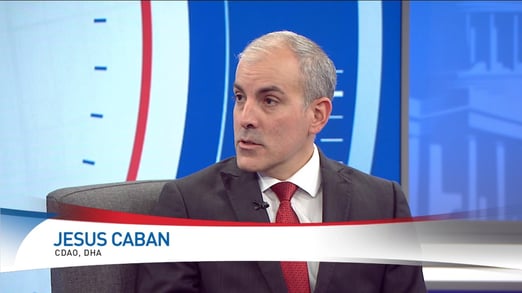
"It's not only headquarters that will fix the data," Caban says. "It's from scheduling a patient...all the way to the providers, all the way to the commanders." By establishing accountability throughout the enterprise, DHA aims to ensure information is both available and accessible to those who need it.
Sharing Lessons Across the Department of Defense
Although healthcare presents unique operational requirements, Caban says many of DHA's data challenges are shared across the Department of Defense. Through the Chief Digital and AI Office's council of chief data officers, leaders from defense organizations regularly exchange lessons learned related to governance, data quality, security, and access.
Those conversations allow organizations to learn from one another while adapting proven approaches to their own missions. Caban says DHA also contributes its own experience as a combat support agency responsible for providing health data that supports military readiness.
Leveraging the War Data Platform
Another important component of DHA's strategy is the War Data Platform. Caban explains that the platform is the department's primary means of sharing information with military services and combatant commands. By using an enterprise platform, DHA can improve efficiency, reduce costs, and accelerate data delivery.
He also points to the platform's governance capabilities, including data catalogs and quality checks that help users understand what information is available and how it can be used across organizations. Those features make it easier for agencies to discover trusted data while maintaining consistent standards across the department.
Expanding AI Across the Agency
As DHA strengthens its data foundation, AI adoption continues to grow. Caban says the agency recently completed its fiscal year 2026 AI inventory, identifying more than 400 AI use cases.
Examples include ambient listening technology that more than 30,000 providers use to assist with clinical documentation. According to Caban, more than half a million clinical notes have been generated using the technology this year. Other applications include readiness prediction models, mental health models, and chatbots supporting medical logistics.
The expanding portfolio reflects the agency's continued investment in both AI capabilities and the data infrastructure needed to support them.
Technology Alone Will Not Transform the Workforce
Despite the growing number of AI applications, Caban says technology is only part of the equation. He emphasizes that workforce development is essential to becoming an AI-first organization. Alongside improvements in data quality and technology, DHA is investing in education, upskilling, and reskilling to help employees use AI effectively.
"We can set the best technology out there, but technology alone will not transform an agency. It's the workforce," Caban says. For DHA, becoming AI-first means combining strong data governance, enterprise collaboration, and continuous workforce development to support AI adoption across the organization.