

Original Broadcast Date: 10/25/2026
Sponsored by Maximus
The Pentagon is exploring new technologies to improve how military forces generate, manage, and use energy, but Maj. Justin Shine says innovation must accomplish something more important than introducing new equipment.
It must make warfighters better at their jobs.
Shine, Military Deputy in the Pentagon's Office of Operational Energy Innovation, joins Fed Gov Today to explain how his organization evaluates emerging technologies, works with service members, and turns operational feedback into improvements.
For Shine, the distinction between something new and something genuinely innovative is straightforward.
A technology needs to improve the warfighter's ability to accomplish the mission.
That might mean helping a service member survive longer, remain operational for extended periods, or become more effective in combat.
The goal, he explains, is technology that makes military operations better, not simply different.
How the Pentagon identifies promising technology
Shine says his organization continuously searches for emerging technologies that could improve operational energy capabilities.
But identifying a promising concept is only the beginning.
The next steps depend on how mature the technology is when the office begins working with it.
Some projects involve first-of-a-kind technologies that still require significant scientific and engineering development.
Those efforts can take approximately three years.
During that period, researchers and engineers work to move concepts beyond the laboratory and determine how they can function in military environments.
Other technologies enter the process at a more advanced stage.
When a prototype already exists and the fundamental engineering work is complete, the focus shifts toward testing and operational evaluation.
Shine says that phase can take approximately one to two years.
The objective is to place technology into realistic environments and allow warfighters to evaluate its performance.
That means giving service members opportunities to use equipment the way they would during actual operations.
It also means allowing them to push the technology to its limits.
Why warfighter feedback matters
Shine says feedback from service members is one of the most important parts of the innovation process.
As an Army officer, he brings his own operational perspective to evaluating new technologies.
But he recognizes that different military communities have different requirements.
A Marine, airman, guardian, or medical service member may evaluate the same technology differently.
Those perspectives help developers understand how equipment performs across the joint force.
Shine says the most useful feedback addresses whether service members would actually use the technology in combat.
If they would not, he wants to understand why.
The problem might involve the equipment's weight, size, interface, or the information it provides.
Those details can determine whether a promising innovation becomes a practical military capability.
Because the Office of Operational Energy Innovation works across multiple domains, feedback can vary significantly between operational communities.
Shine says understanding those differences is essential to improving technology.
The advantage of military experience
Shine also discusses how his background as an infantry officer influences his work.
When he meets with warfighters in uniform, he says that shared military experience can help establish trust.
Service members recognize that he understands some of the operational challenges they face.
That connection can encourage more candid conversations about what works and what needs improvement.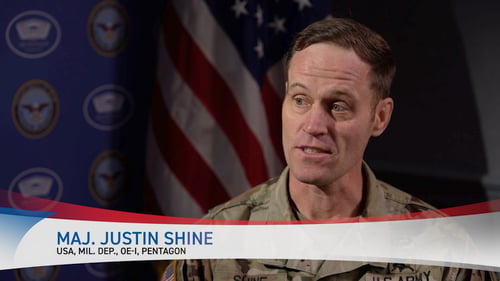
Shine also helps translate feedback between military users and technical teams.
He can ask follow-up questions, identify operational concerns, and help developers understand why certain requirements matter.
That role becomes especially valuable when a technology moves from a controlled testing environment into the hands of service members.
The Expeditionary Power Kit in action
One technology that particularly interests Shine is the Expeditionary Power Kit.
Drawing on his experience in infantry formations, he explains how soldiers constantly consider logistics while conducting operations.
Units need to understand how they will power equipment, support personnel, and maintain operations while moving between locations.
Those requirements can create challenges for small formations.
Shine says the Expeditionary Power Kit offers an opportunity to use military vehicles as power sources for additional operational needs.
Instead of relying on a separate generator for every requirement, service members could connect equipment directly to a vehicle.
That power could support an operational cell, living accommodations, or food preparation activities.
For Shine, the value comes from making better use of a platform that military units already operate.
Turning field experience into improvements
Shine says soldiers evaluating the Expeditionary Power Kit provide feedback on component placement, battery capacity, and available power.
Some want to understand why equipment is configured in a particular way.
Others suggest additional batteries or increased power capabilities.
Shine helps facilitate those discussions while allowing soldiers to communicate directly with technology providers.
The feedback does not disappear after a demonstration.
His organization collects responses through surveys, written observations, and broader summaries.
That information is entered into a system of record so teams can review it later.
The process creates a way to preserve operational lessons as technologies continue developing.
For Shine, the objective remains consistent throughout the innovation process.
Whether the office is evaluating an early concept or testing an advanced prototype, the question is whether the technology improves the warfighter's ability to perform the mission.
And the people best positioned to help answer that question are the service members expected to use it.