

Original Broadcast Date: 06/28/2026
Sponsored By Appgate
The State Department’s artificial intelligence strategy is moving into a new phase.
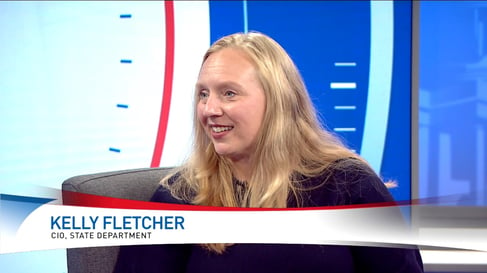
According to Chief Information Officer Kelly Fletcher, the department has progressed from encouraging experimentation with generative AI to helping employees maximize the technology's value while preparing for the next generation of AI-enabled services.
The foundation of that effort is State Chat, the department’s generative AI platform.
Nearly two years ago, the State Department launched State Chat to a pilot group of 3,000 users. The platform included State Department data and several evolving capabilities. While early versions experienced limitations and occasional performance challenges, users remained highly engaged and provided valuable feedback that helped shape development.
Today, adoption looks very different.
Fletcher says the platform is available across the department and now serves more than 50,000 users, including approximately 20,000 unique users each week. The department spent significant time encouraging adoption and building familiarity with generative AI. Having achieved broad usage, leaders now focus on helping employees use AI more intentionally and effectively.
One area where employees quickly demonstrated creativity was custom GPT development.
 Fletcher highlights examples where employees create GPTs to support major meetings and events. Rather than asking participants to search through extensive documentation, organizers load frequently asked questions, schedules, logistics, and reference materials into custom GPTs that attendees can access directly.
The department encourages this innovation.
Employees experiment with AI, develop useful tools, and share lessons learned with colleagues. As adoption expands, however, Fletcher says the department also needs to improve governance and ensure enterprise-facing solutions meet organizational standards. With thousands of custom GPTs now available, leaders are working to identify and elevate the most valuable implementations.
To support broader adoption, the department created an AI Champions program.
These champions serve as advocates and educators across embassies and domestic offices. They receive additional training and help colleagues understand how AI can support their work. Rather than relying entirely on organic growth, the department now uses these champions to intentionally spread successful practices and increase organizational knowledge.
The department also continues expanding its technical foundation.
Fletcher describes a model garden that allows users to access multiple AI models within State Chat. While many employees rely on default settings, advanced users increasingly experiment with different models based on specific tasks. Over time, the department hopes to automate model selection so prompts are routed to the most appropriate model based on requirements and cost considerations.
The next major milestone is Beacon.
Beacon is designed to serve as a personal administrative assistant, helping employees resolve common support and administrative issues. The capability aims to reduce administrative toil while improving the user experience. Initial deployment begins with a small testing group before broader expansion.
Fletcher says the biggest challenge is not infrastructure but training and process refinement. The department is using AI to identify inconsistencies and weaknesses in existing support scripts and to prepare Beacon to provide reliable assistance. Building trust remains essential to success.
Alongside AI modernization, Fletcher continues advancing the Tech for Life initiative.
Now entering its third year, the program allows employees to keep their devices as they move between assignments. The approach simplifies technology provisioning, reduces friction, and supports a more consistent employee experience. Fletcher says initial concerns raised in posts have gradually diminished as the program has demonstrated its effectiveness.
For Fletcher, the broader objective remains clear: deliver secure, simple technology while building trust across a global workforce. Whether through AI, device modernization, or operational efficiencies, the department continues focusing on practical improvements that help employees accomplish their missions more effectively.