

Original Broadcast Date: 09/13/2026
Sponsored by Deloitte
The Office of Personnel Management is expanding its centralized recruiting strategy, testing new uses of artificial intelligence and continuing to digitize federal HR processes as the agency moves ahead with its broader HR 2.0 effort.
OPM Director Scott Kupor tells Fed Gov Today that one of the agency’s newest efforts takes the infrastructure created for Tech Force and adapts it to the Pentagon.
The new initiative is designed around a position Kupor describes as a “forward deployed engineer.”
He says the job combines traditional software engineering abilities with the ability to go to a location and implement technology directly.
The Pentagon is looking to hire up to 250 people for those positions, Kupor says, and OPM has already issued its first certificate of candidates to the department.
The model closely follows the process OPM uses for Tech Force.
OPM acts as what Kupor calls the “top of funnel.” The agency recruits candidates, performs an initial evaluation and sends a vetted group of qualified applicants to the hiring organization.
Because the Pentagon effort is specifically designed for itself, Kupor says the department gets the first opportunity to hire from that candidate pool. If qualified candidates remain after the department completes its hiring, OPM could make them available elsewhere.
OPM is reaching potential applicants through social media, electronic recruiting platforms and broader outreach. Kupor says word of mouth has also proven particularly valuable.
The bigger challenge, however, may come after OPM finds the candidates.
Kupor says federal agencies are still developing the habit of using shared certificates rather than creating an entirely new recruiting process every time they need to fill a position.
He says OPM is also planning a broader early-career initiative that extends beyond technology jobs into fields such as finance and human resources.
The goal is to convince agencies that they do not always need to independently write a new job description, post a vacancy and run a separate recruitment effort when a broader candidate pool already exists.
Kupor describes the challenge more as inertia than resistance.
Senior executives and chief human capital officers often like the centralized model, he says, but individual hiring managers deeper inside large organizations may not know those candidate pools exist or may simply default to the hiring process they have always used.
OPM is responding by trying to communicate directly with hiring managers and encourage adoption from both the top and bottom of agencies.
Technology modernization is happening inside OPM at the same time.
Kupor points to the Guide to Processing Personnel Actions navigator as one example. The underlying information historically lives in a PDF that HR professionals must work through when processing employee actions such as onboarding, promotions or compensation changes.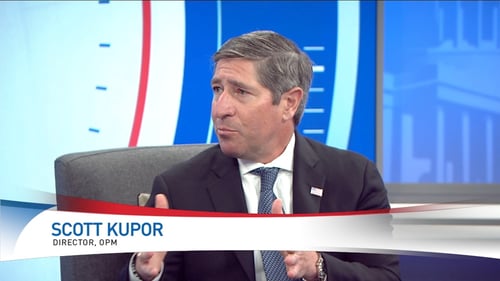
OPM turns that information into an electronic tool that allows users to select the type of action they want to complete and receive guidance about the necessary forms and process.
The agency is taking a similar approach with electronic official personnel folders.
Kupor says former federal employees historically lose direct access to those records after leaving government. OPM is creating an electronic request process that allows former employees to obtain information they may need without relying on phone calls or manual email processing.
Kupor says those efforts represent an incremental approach to modernization: identify individual processes that can become more efficient while continuing to build toward the larger HR 2.0 vision.
The interview also addresses Schedule Policy/Career.
Kupor says roughly 7,800 positions are part of the initial group moved into the classification. OPM begins by reviewing GS-15 positions and is preparing to examine GS-14 and GS-13 roles.
He emphasizes that grade level alone does not determine whether a position belongs in Schedule Policy/Career.
The question is whether the employee holds a role that affects or makes decisions involving administration policy.
Kupor says the initial review involves examining position descriptions individually, going back to agencies with questions and ultimately narrowing a larger list into the positions OPM determines belong in the classification.
OPM is now exploring how artificial intelligence can make parts of that review more efficient.
Kupor says AI can summarize large amounts of information and flag items for a human reviewer. He stresses that AI is not making the final decision.
That same human-centered approach is shaping OPM’s broader use of AI.
Kupor says agencies do not necessarily need to wait for OPM to build new AI functionality into USAJobs and related systems before experimenting with productivity tools.
He gives summarization as one example of how employees can use large language models to understand complex information more quickly.
OPM is also preparing a test of AI-supported interviewing using Tech Force applicants.
Structured subject matter expert interviews traditionally require professionals to repeatedly ask candidates the same questions. Kupor says AI could conduct that standardized portion of the process and create transcripts that hiring managers can review and compare.
The hiring manager still makes the hiring decision.
For Kupor, the objective is to give federal employees tools that reduce repetitive work and make the review process more efficient without transferring the final decision to artificial intelligence.
The agency is also changing how it approaches employee feedback.
Kupor says OPM will not return to a government-wide Federal Employee Viewpoint Survey model. Instead, OPM has developed a set of standard questions that agencies can use or supplement with questions relevant to their own organizations.
Across recruiting, HR technology, AI and workforce policy, Kupor describes an OPM strategy focused on changing not only the systems government uses, but also the everyday processes surrounding federal employment.