

Original Broadcast Date: 11/22/2026
Sponsored by Appian
The U.S. Army Corps of Engineers is taking on more than two decades of legacy data infrastructure, and Walton Cheung says the organization is approaching the challenge with an aggressive modernization strategy. During an interview on Fed Gov Today with Francis Rose, Cheung, Command Chief Data and Analytics Officer at the U.S. Army Corps of Engineers, explains how Castle VUE is helping the Corps consolidate information, improve visibility across its operations, and provide commanders with more reliable data. For Cheung, the initiative represents an opportunity to rethink how information moves throughout the organization. "For the first time in the Corps' history, we're going to modernize all those silos of excellence onto the Army platform," Cheung says.
Moving beyond 20 years of legacy infrastructure
Castle VUE, short for Vantage Unified Environment, builds on the Army's existing Vantage platform. Cheung explains that the Corps is following the broader Army strategy of leveraging capabilities that are already available rather than developing separate systems. The Corps has operated on a legacy enterprise data warehouse environment for approximately 20 years. Over that period, information has accumulated across different systems and organizational functions. The new initiative aims to bring those resources together. Cheung says the effort begins in August and involves more than 300 data sources across the organization. Not all of those sources represent authoritative information systems, but they contain data that could help the Corps better understand its operations. He expects the modernization effort 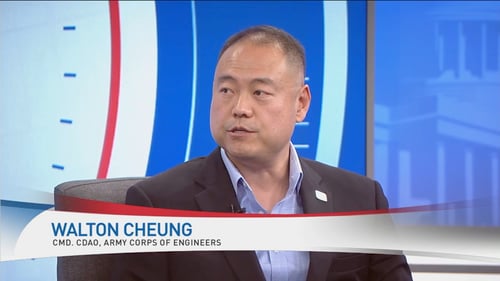 to reveal overlapping information and opportunities to improve efficiency. "We've never had a holistic capability to look across our left and right," Cheung says. That enterprise-wide perspective is particularly important for an organization responsible for engineering, construction, civil works, and military programs.
As the Corps' first chief data officer, Cheung faces the challenge of establishing an enterprise data strategy while navigating an existing organizational culture. He identifies four priorities guiding his work. The first involves establishing a baseline understanding of the Corps' data ecosystem. Before measuring modernization progress, Cheung wants the organization to understand its existing environment and identify opportunities for improvement. The second priority focuses on defining data stewardship roles and responsibilities. That means establishing clear expectations for the people responsible for managing information across the organization. The third involves identifying authoritative data sources and developing transparent criteria for determining which information can be trusted. Finally, Cheung wants the Corps to use those improvements to support better decisions. He explains that commanders must regularly assess risks, making confidence in the underlying information essential. Whether commanders receive information through reports, dashboards, or artificial intelligence tools, Cheung wants them to trust the processes producing those results.
Why an 80% solution can be enough
Modernizing a large organization requires balancing long-term planning with immediate operational needs. Cheung acknowledges that the Corps cannot stop its existing missions while rebuilding its data environment. Instead of insisting on a perfect plan, he favors flexibility. "I'm okay with 80% solution, and we pivot based on factors in the moment," Cheung says. He still considers establishing a baseline important because it provides a reference point for measuring progress. However, he recognizes that modernization priorities must evolve as circumstances change. Resources also present a challenge. For much of his time at the Corps, Cheung operates as what he describes as an "Army of One." A second team member joins approximately two months before the interview, expanding the organization's dedicated data leadership capacity. Cheung says the alignment between the Corps' priorities and broader Army modernization efforts helps create momentum.
Cheung also emphasizes the importance of involving people who understand the Corps' missions firsthand. His background is as an Army signal officer, and he acknowledges that he does not possess detailed expertise in every engineering and construction function. That makes feedback from commanders and employees especially valuable. He wants to understand whether proposed enterprise-wide changes actually help the people responsible for executing missions. Cheung recognizes that technology and data initiatives sometimes develop reputations for creating additional obstacles rather than solving problems. His approach involves asking commanders how proposed changes affect their operations and whether the long-term benefits justify potential short-term difficulties. That collaboration helps connect the modernization strategy to practical mission requirements.
Preparing data for artificial intelligence
Looking ahead, Cheung wants the Corps to simplify its underlying data infrastructure and make information easier to use. That includes cleaning and enriching data before introducing more advanced analytical capabilities. He sees opportunities to apply artificial intelligence and natural language processing so employees with less technical experience can interact with information more effectively. The objective is not simply to introduce new technology. It is to help commanders access reliable information and make better decisions while reducing unnecessary complexity. Cheung acknowledges that much of the foundational work may not attract significant attention. "It may not be glamorous. Again, very necessary," he says. He hopes the Corps can demonstrate meaningful modernization progress over approximately the next 10 months. For an organization managing two decades of accumulated data infrastructure, the immediate priority is building the foundation that allows future capabilities to deliver value.