

Broadcast Date: 6/7/2026
Presented by SolarWinds and Carahsoft
The U.S. Army is advancing a broad modernization agenda that combines artificial intelligence, cybersecurity reform, and faster technology adoption to support mission success across the force.
Speaking on Fed Gov Today, Gabe Chiulli, CTO of the U.S. Army’s Enterprise Cloud Management, describes continuity as a critical factor as the Army continues several major transformation efforts. While leadership transitions occur, he says the Army remains focused on maintaining momentum behind initiatives designed to modernize technology and improve how soldiers access and use digital capabilities.
Chiulli points to major efforts such as Project Aria and Operation Jailbreak as examples of the Army's commitment to modernization. He says continuity is essential when pursuing large-scale objectives because it helps preserve institutional knowledge, policy direction, and relationships across the force.
"We've been really big for us to make sure we keep driving that modernization," Chiulli says.
Cybersecurity remains one of the Army's top priorities as technology evolves and new threats emerge. Chiulli explains that the Army is increasingly focused on understanding and responding to AI-enabled threats. Rather than concentrating solely on documentation and compliance processes, the Army is working to develop a clearer technical understanding of the threat landscape.
The goal, he says, is to create a more consistent and informed approach to identifying and responding to cyber risks across a massive enterprise that serves more than one million users.
As artificial intelligence becomes more capable, the Army is also examining how AI can strengthen cybersecurity operations. Chiulli says leaders are evaluating how AI can support the workforce while also helping defenders better understand and respond to threats.
Another major focus is improving how industry partners work with the Army.
Chiulli acknowledges that companies often view the process of bringing technology into Army environments as lengthy and complicated. He says one of his priorities is reducing the amount of time it takes for vendors to engage with the Army and deploy capabilities that can support soldiers.
Historically, some companies have viewed the process as taking many months. Chiulli believes technology now evolves too quickly for that timeline to remain acceptable.
"My drive is to figure out how to get that down to weeks," he says.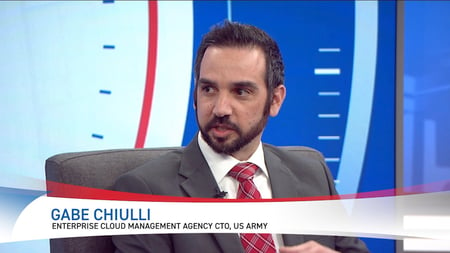
To accomplish that goal, the Army is looking at ways to make information easier for vendors to understand and consume. Chiulli says companies often struggle because they are unfamiliar with Army processes, points of contact, and requirements.
By providing clearer guidance, checklists, and engagement pathways, the Army hopes to remove barriers and create a more efficient process for onboarding new technologies.
At the same time, Chiulli emphasizes the importance of preserving the integrity of commercial technologies. He notes that organizations sometimes modify products in ways they were never intended to be used, creating cybersecurity challenges and operational risks.
The Army is working to better align technology adoption practices with the original design and purpose of products whenever possible.
Artificial intelligence at the tactical edge represents another significant area of focus.
Chiulli points to an Army AI tabletop exercise conducted last year that highlighted the need to extend AI capabilities beyond enterprise environments and into operational settings. The result was Project Aria, an initiative designed to help bring AI from centralized systems directly to warfighters operating in the field.
One of the key outcomes of that effort is a capability known as the Model Armory.
Chiulli describes the concept using a familiar military analogy. Just as a soldier can enter an arms room, receive equipment, and immediately begin using it, the Army wants AI to be just as accessible.
The objective is to eliminate many of the technical complexities traditionally associated with deploying artificial intelligence. Soldiers should not need to understand containerization, graphics processing units, or other technical infrastructure requirements. Instead, they should be able to access AI capabilities quickly and focus on mission execution.
The Army's vision is to make AI available even in denied, disconnected, intermittent, and limited environments where connectivity may be constrained.
By simplifying access to AI and delivering it closer to operational users, Army leaders hope to create new advantages at the tactical edge while ensuring technology remains aligned with mission needs.
As modernization efforts continue, Chiulli says the Army remains focused on delivering capabilities faster, strengthening cybersecurity, and ensuring AI becomes a practical tool for soldiers wherever they operate.