Original Broadcast Date: 1/18/26
Presented by Commvault & Carahsoft
Richard Breakiron, Senior Director of Strategic Initiatives for the U.S. Public Sector at Commvault, makes the case that data resilience is no longer a niche IT concern but a mission-critical priority for federal agencies. In his conversation on Fed Gov Today, Breakiron frames data resilience as an organization-wide responsibility that touches people, processes, and technology alike.
He begins by emphasizing that data resilience is “everywhere” and applies across the entire enterprise. Quoting a recent comment from the Army’s G-6, Breakiron notes that many organizations do not actually have a data problem, but rather a data management problem. Data now exists in enormous volumes, arrives at high speed, and comes in many forms, yet agencies often struggle to manage it in a way that makes it useful. Artificial intelligence, he explains, is accelerating this reality by increasing demand for clean, accessible, and well-managed data.
Breakiron describes the fragmented nature of federal data environments. Agencies maintain data on premises, in the cloud, in regional centers, and across internal networks. This sprawl creates challenges in visibility and control. From his perspective, data resilience starts with knowing where data lives and understanding its quality. Without that foundation, agencies cannot reliably use data for decision-making or advanced technologies.
He stresses that resilience goes beyond inventory and organization. It also means being prepared for failure, whether caused by accidents or adversarial attacks. Breakiron highlights the importance of being able to restore critical systems quickly, such as identity services and mission-essential applications. The ability to recover and continue operations is, in his view, a defining element of data resilience. It is not just about protecting data, but about ensuring continuity of mission when something goes wrong.
Throughout the discussion, Breakiron repeatedly ties data resilience to modernization. He positions technology as the foundational enabler that augments both people and processes. The pace and scale of data creation make it impossible for humans alone to manage modern environments effectively. Technology provides the architecture that allows agencies to integrate diverse data sources and interact with them in meaningful ways.
He describes how unified data management can provide a single, holistic picture of data across environments. Instead of treating on-premises systems and cloud platforms as separate silos, agencies can use technology overlays to manage them together. This unified view allows organizations to better understand risk, performance, and operational health.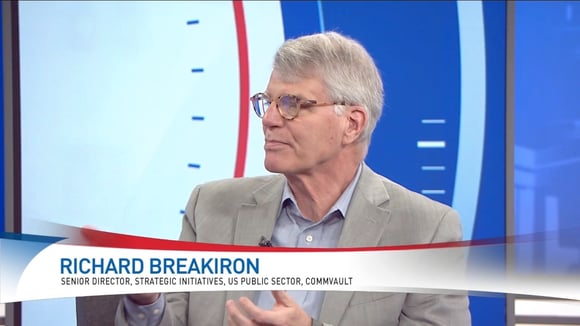
Breakiron also explains how artificial intelligence changes the way people interact with data. Rather than navigating complex dashboards or manual reports, users can ask natural questions such as how backups performed, which data is at risk, or what activity occurred over a given period. He sees this conversational approach as a natural evolution of technology, one that mirrors how people communicate with each other. In this way, AI enhances the individual and simplifies processes rather than adding complexity.
Security and compliance also play a central role in Breakiron’s view of data resilience. He connects resilience to zero trust architecture, arguing that strong data management supports broader security goals. He challenges the notion that compliance frameworks are merely burdensome requirements. Instead, he suggests they can become strategic advantages when integrated into systems from the beginning. When security controls align with business processes, agencies gain both protection and efficiency.
Breakiron points to FedRAMP High as an example of this mindset shift. Rather than seeing compliance as a constraint, he describes it as an opportunity to strengthen architecture and build trust. By embedding security and resilience into systems early, agencies avoid costly retrofits and reduce long-term risk.
People, process, and technology remain a consistent framework throughout his remarks. Breakiron emphasizes that none of these elements can succeed in isolation. Technology must support how people actually work, while processes must reflect real operational needs rather than idealized models. When all three move together, agencies are better positioned to handle data growth, cyber threats, and modernization demands.
Ultimately, Breakiron presents data resilience as a unifying concept. It brings together modernization, security, AI, and mission continuity under a single umbrella. For federal agencies facing increasing data volumes and evolving threats, resilience is not a future goal but an immediate necessity. By understanding their data, managing it holistically, and preparing for disruption, organizations can turn complexity into control and position themselves for sustained mission success.