Original Broadcast: 01/11/2026
In today’s military environment, logistics success depends less on any single commodity and more on something far less tangible: data. That is the core message Doug Noble, managing director for federal advisory at KPMG and former Director of Logistics Operations at the Defense Logistics Agency, shares during his conversation on Fed Gov Today with Francis Rose.
Noble frames supply chain visibility as the ability to see clearly across the entire logistics enterprise, from suppliers and sub-tier vendors all the way forward to the warfighter who depends on timely delivery. In a military context, that visibility extends beyond tracking a single item. It includes understanding demand signals, inventory levels, supplier capacity, transportation options, and storage constraints, all at the same time.
According to Noble, military logistics has always been complex, but today’s operating environment raises the stakes significantly. The United States maintains a unique ability to generate, project, and sustain forces anywhere in the world. Potential adversaries recognize that strength and are increasingly focused on disrupting it. As a result, future conflicts are likely to involve contested logistics environments, where supply chains may be targeted from the factory floor to the front lines.
That reality makes end-to-end visibility essential. Noble explains that planners cannot assume freedom of movement or uninterrupted access to transportation networks. Instead, they must be prepared to respond to disruptions quickly, shift to alternate suppliers or routes, and make informed decisions under pressure. Data enables that agility by giving logisticians the insight they need to understand what options are available and which ones carry the least risk.
Noble recalls a lesson from his time at the Defense Logistics Agency that underscores this point. When the DLA director asked employees to identify the agency’s most important commodity, many pointed to fuel, food, uniforms, or spare parts. The correct answer, however, was data. DLA manages enormous volumes of material for the military services, but the information describing those supply chains—where items are sourced, how they move, and where vulnerabilities exist—is what allows the organization to function effectively.
Supply chain visibility, Noble emphasizes, is not limited to knowing where inventory sits. It also means understanding what suppliers can produce, how quickly they can surge, and what constraints may slow production or delivery. When logisticians can see those factors together, they can 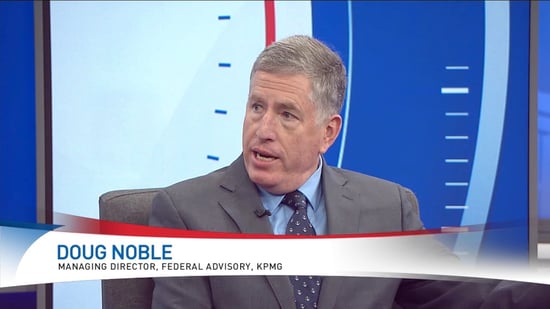 anticipate problems rather than react to them after the fact.
The need for this capability grows as adversaries seek to disrupt logistics networks across multiple points simultaneously. Noble notes that attacks or disruptions could occur anywhere along the supply chain, including manufacturing facilities, transportation corridors, ports, or storage locations. Visibility allows planners to recognize emerging risks and adjust plans before shortages affect operations.
Noble also highlights the importance of learning from the private sector. While military logistics has unique challenges, many of the fundamentals are shared with commercial supply chains. During major global disruptions—such as those experienced during the COVID pandemic—private companies faced port closures, transportation delays, and sudden shifts in demand. Those organizations were forced to reassess risk, find alternate suppliers, and adapt quickly to changing conditions.
The military can apply those same lessons, Noble says, particularly when it comes to assessing vulnerabilities and building resilience. Commercial supply chains have shown how data-driven planning supports faster recovery and continuity of operations during periods of uncertainty. Those approaches translate directly to military logistics, where the consequences of failure are far more severe.
Throughout the discussion, Noble returns to the idea that data enables better decision-making at every level. When supply chain information is integrated and accessible, planners can evaluate trade-offs, prioritize resources, and ensure sustainment efforts align with operational needs. Without that visibility, even well-resourced supply chains can falter under pressure.
Ultimately, Noble makes clear that logistics success in future conflicts depends on more than moving supplies efficiently. It depends on understanding the entire system that supports the warfighter and having the insight to adapt when conditions change. In an era of contested logistics, data is not just a support function—it is a strategic asset that underpins readiness, resilience, and mission success.
By elevating supply chain visibility and treating data as a core capability, the Department of Defense positions itself to sustain operations even in the most challenging environments. As Noble explains, seeing the supply chain clearly is no longer optional—it is essential to maintaining the military’s ability to fight and win.
%20copy.png)