Presented by Carahsoft
Open Source Intelligence has quietly become one of the most consequential shifts in how the U.S. government understands and responds to the world. In this episode of Innovation in Government, host Francis Rose brings together industry pioneers and senior government intelligence leaders to examine how OSINT is being transformed from a supplementary tool into a foundational mission capability — and what it will take to scale that transformation across the enterprise.
The Last Mile Problem: Why Cleaning Data Matters More Than the AI You Put on Top of It
Featuring Clay Hicks, Mission Director, Zignal | McDaniel Wicker, Senior Vice President, USG Solutions, Babel Street
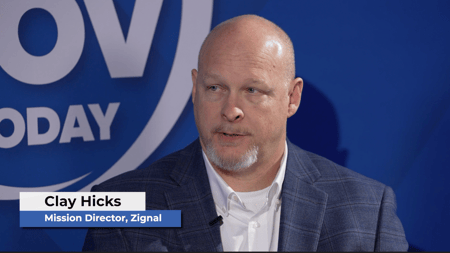 The promise of Open Source Intelligence has always been straightforward: the world is generating more information than ever before, and somewhere in that torrent of data lies the insight that changes a decision, prevents a crisis, or exposes a threat. The challenge, as Clay Hicks of Zignal makes clear, has never been access to data. It has been turning that data into something usable.
"Finished intelligence" — the term practitioners use for analysis that is ready to act on — requires far more than a pipeline of information. It demands collection, normalization, relationship-building between data points, validation, and connection to already-known facts within a given problem set. Hicks is direct about what that means for organizations tempted to shortcut the process: you cannot simply take a truckload of data, apply artificial intelligence, and expect actionable intelligence to emerge on the other side. The assumption that AI is a monolithic, all-purpose solution, he argues, reflects a fundamental misunderstanding of how these technologies actually work.
At the heart of that misunderstanding is the concept of the context window — the amount of data a language model can process in any single inference pass. When organizations attempt to feed massive, unstructured data sets directly into large language models, they are forced to break that data into chunks. And the moment data is chunked, relational connections between pieces of information are lost. The model sees only what is in front of it. The result, Hicks warns, is fragmented analysis, inconsistent outputs, and token costs that can quickly exceed whatever savings were anticipated by reducing human analyst workloads.
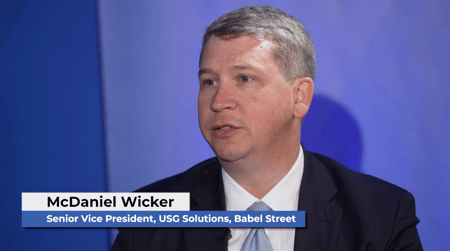 McDaniel Wicker of Babel Street frames the data challenge differently but arrives at the same conclusion. Data, he argues, is the oil powering the AI machine — and like oil, it must be drilled for carefully and refined before it can do useful work. What organizations need are not AI search tools but AI workers: agentic systems capable of doing sustained analytical work, trained and directed by people who understand both the mission and the data landscape.
The conversation between Hicks and Wicker points toward where the industry is heading: agent-to-agent communication, where government-built agents interact directly with vendor-side agents to deliver contextualized, noise-reduced, pre-processed data before it ever enters a government system. This model — eating the elephant one bite at a time, as Hicks puts it — allows organizations to apply AI where it genuinely excels: the last mile of turning good, clean, normalized data into finished intelligence, with a human analyst providing the final validation.
The warning against "vibe coding" — the temptation for individual practitioners to build their own AI-powered tools at will — runs throughout the segment. Both Hicks and Wicker agree that while practitioners should be empowered to build agents that interact with existing tools and capabilities, building platforms from scratch without governance is not where organizations want to go. What's needed, Wicker argues, is a framework: clear standards that define what practitioners are encouraged to do, where the boundaries are, and how flexibility and rigor can coexist. The lesson from fifteen years of building data capabilities at scale is clear — the goodness was always in the preparation, not the shortcut.
The INT of First Resort: How OSINT Earned Its Seat at the Table
Featuring Dr. Eric Miller, Senior Advisor for Open Source Intelligence, Defense Intelligence Agency | Dr. Dennis Eger, Senior OSINT Advisor, U.S. Army
If the first segment of this program is about what the technology can and cannot do, the second is about what it takes for large, complex government organizations to actually build OSINT into the fabric of how they operate. Dr. Eric Miller of the Defense Intelligence Agency and Dr. Dennis Eger of the U.S. Army have been doing exactly that work — and their conversation reveals both how far the community has come and how much foundational architecture remains to be built.
F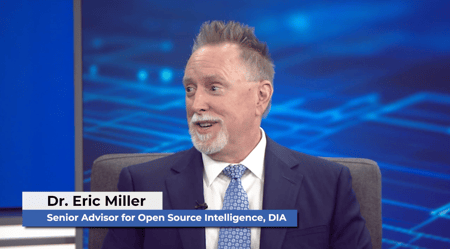 or Miller, the integration of OSINT into the broader intelligence enterprise is in many ways a natural evolution accelerated by crisis. When crises hit, organizations reach for every available intelligence discipline simultaneously, and OSINT — with its ability to deliver answers in minutes or hours rather than days — earns its place at the table in ways that other disciplines cannot always match. His first week in his current role at DIA coincided with the first Iran-Israel crisis of his tenure, and the lesson was immediate: senior leaders wanted to know what OSINT had to say, and they wanted to know now. No other intelligence discipline, Miller notes, can consistently deliver that kind of speed.
Eger echoes that trajectory from the Army's perspective, pointing to the Ukraine crisis as a pivotal moment that shifted how the service viewed open source intelligence. OSINT had been around and had been invested in for years, but crisis created genuine momentum — commanders on the ground discovered that open source data could provide volumes of intelligence they hadn't realized were accessible, while simultaneously reducing pressure on more expensive, exquisite collection assets. The publication of the first-ever OSINT strategy was the formal recognition of that shift: a document that told the Army community writ large that OSINT is a true intelligence discipline, one that would be professionalized, institutionalized, and integrated into how the force trains and operates.
At the governance level, Miller describes DIA's role chairing the Defense Open Source Council — not as a top-down authority dictating standards, but as a facilitation and collaboration body working to define what OSINT looks like as a profession. Collection policy, training, tradecraft, data acquisition, tool development — all of it is being examined and brought together. The approach he favors is attraction over promotion: building something the community finds genuinely valuable, so that participation becomes self-sustaining.
The challenge both leaders keep returning to is scale. The sheer volume of available open source data has outgrown what any number of human analysts can meaningfully process. That is where AI becomes not a convenience but a necessity. Eger describes a workflow that is already taking shape: AI systems directed against specific intelligence requirements, returning millions of data points that are then rank-ordered by reliability and credibility, transformed into draft reporting in the appropriate format, and routed through automated workflows — leaving the analyst at the end to apply judgment, validate for rigor, and authorize the product for release. The analyst's role does not disappear; it sharpens.
 On the challenge of misinformation and spoofing, both leaders are clear-eyed. The information environment is a contested space, and adversaries operate deliberately within it. Miller points to DIA's recent merger of its Open Source Center with its Media Exploitation Center as a structural response — combining capabilities to better understand how social media and technical tools are being weaponized. Eger reframes the problem entirely: rather than treating misinformation as noise to be filtered out, the Army tracks it back to its source, targeting the narrative itself, understanding adversary intent, and using metadata, network architecture, and deep fake detection tools to pursue the origin rather than simply manage the output.
Together, the two segments of this program make a compelling case: OSINT has arrived as a mission-critical discipline, but the work of scaling it — technically, organizationally, and culturally — is still very much underway.
Innovation in Government is presented by Carahsoft. Watch more episodes at InnovationInGov.com.