

Presented by Carahsoft
Open source intelligence has reached a turning point across the federal government. Once considered a supplemental input, OSINT is now widely recognized as a primary intelligence source—driven by an explosion of publicly available data and rapid advances in commercial technology. In this special Fed Gov Today program, Francis Rose brings together leaders from government and industry to explore how OSINT is transforming cyber operations, intelligence analysis, and mission outcomes. From proactive threat detection to the rise of AI-driven analysis, the conversation highlights both the opportunity and the urgency for agencies to modernize how they collect, analyze, and act on open source data.
The Inflection Point in Open Source Intelligence
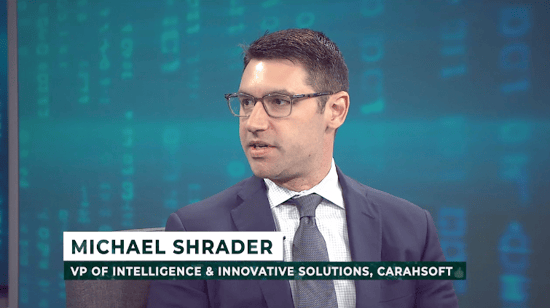 The rapid rise of open source intelligence is being fueled by two powerful forces: an unprecedented explosion of data and the accelerating pace of commercial innovation. Michael Shrader, Vice President of Intelligence and Innovative Solutions at Carahsoft, explains that government agencies are increasingly recognizing OSINT as a core intelligence discipline rather than a supplemental capability. The sheer volume of data generated across social media, the dark web, and commercial datasets has created both a challenge and an opportunity—one that industry has moved quickly to address with advanced tools for data collection, enrichment, and analysis.
Shrader emphasizes that government is becoming more open to adopting commercial capabilities rather than building them internally. This cultural shift is enabling agencies to integrate cutting-edge technologies into their mission environments more quickly and effectively. At the same time, clearer policy guidance around the use of open source data is reducing uncertainty and helping practitioners focus on mission execution.
Looking ahead, OSINT is evolving beyond situational awareness into a driver of predictive analysis. Instead of simply understanding what has happened, agencies are increasingly using OSINT to anticipate threats and inform decision-making in real time. This transition marks a significant step forward in how intelligence supports operational outcomes across government.
Key Takeaways
- OSINT adoption is driven by data growth and commercial innovation
- Government is shifting toward leveraging industry capabilities
- OSINT is evolving from awareness to predictive decision support
Watch Full Interview: https://fedgovtoday.com/the-osint-edge/the-inflection-point-driving-open-source-intelligence-across-government
OSINT and the Cyber Threat Landscape
 Open source intelligence is fundamentally changing how organizations approach cybersecurity, shifting the focus from reactive defense to proactive threat identification. Terry Roberts, Former Deputy Director of Naval Intelligence and CEO of WhiteHawk, and Charlie Stone, Vice President of North America at Penlink, highlight how commercial innovation has dramatically expanded visibility into cyber risks. Today, organizations can observe vast portions of the threat landscape—from the dark web to social media—without directly interacting with adversaries.
This expanded visibility allows analysts to identify vulnerabilities, monitor threat actors, and anticipate attack vectors before they are executed. OSINT provides insight into what adversaries are discussing, planning, and sharing, enabling organizations to take a more forward-leaning posture. AI and automation play a critical role in this process, helping analysts sift through massive volumes of data and identify relevant signals in real time.
The conversation also underscores the importance of combining human expertise with technology. While AI can process data at scale, experienced analysts are still essential for interpreting context, validating findings, and addressing challenges like misinformation. As OSINT capabilities continue to evolve, organizations must balance automation with human judgment to maintain accuracy and effectiveness.
Key Takeaways
- OSINT enables a shift from reactive to proactive cybersecurity
- Dark web and social platforms provide critical intelligence sources
- Human expertise remains essential alongside AI-driven analysis
Watch Full Interview:
https://fedgovtoday.com/the-osint-edge/how-open-source-intelligence-is-reshaping-the-cyber-threat-landscape
Operationalizing OSINT for Mission Impact
 As OSINT matures, agencies like NCIS are integrating it directly into both investigative and operational workflows. Special Agent Michael Woods of NCIS and Miguel Ramos, Chief Product Officer at Authentic8, discuss how OSINT has become a primary tool for driving mission outcomes. The growth of internet-based data has created new opportunities to proactively identify threats, disrupt adversaries, and support law enforcement and national security operations.
A key theme in this discussion is the importance of collaboration. Effective OSINT operations rely on strong partnerships between government, industry, and international stakeholders. Sharing information and coordinating efforts enables organizations to stay ahead of adversaries and respond more effectively to emerging threats.
The segment also highlights the importance of governance, auditability, and proper tradecraft. Mature OSINT programs must include clear processes for data collection, chain of custody, and compliance to ensure integrity and accountability. While automation and AI are essential for managing scale, human analysts remain critical for applying judgment and making informed decisions.
Key Takeaways
- OSINT is enabling more proactive and effective mission operations
- Collaboration across sectors is essential for success
- Governance and audit processes are critical to mature OSINT programs
Watch Full Interview: https://fedgovtoday.com/the-osint-edge/operationalizing-open-source-intelligence-for-mission-success
The Future of OSINT and AI-Driven Intelligence
 The future of open source intelligence is being shaped by rapid advances in artificial intelligence, particularly the emergence of agentic AI. Deric Palmer, Chief Technical Officer for OSINT at Asc3ndTech, and John Larson, President and Chief AI Officer at Babel Street, explore how AI is transforming the way analysts interact with data. As the volume of available information continues to grow, traditional methods of analysis are no longer sufficient.
AI agents are emerging as a powerful solution, capable of autonomously collecting, analyzing, and synthesizing data at scale. These agents can perform tasks that would otherwise require significant human effort, allowing analysts to focus on higher-level decision-making. The concept of a “swarm” of specialized agents—each performing different functions—represents a significant shift in how intelligence workflows are structured.
Despite these advancements, the importance of human oversight remains paramount. Leaders emphasize the need for mission clarity, governance, and human-centered design to ensure that AI is used responsibly and effectively. As technology continues to evolve, organizations must strike the right balance between automation and human judgment to fully realize the potential of OSINT.
Key Takeaways
- AI agents will transform how OSINT is collected and analyzed
- Automation is essential to manage growing data volumes
- Human oversight and governance remain critical for effective use
Watch the Full Interview: https://fedgovtoday.com/the-osint-edge/the-future-of-open-source-intelligence-in-the-age-of-ai