

Presented by IonQ
Turning quantum research into practical technology requires scientists, engineers, investors and customers to work together over time. Recorded at Quantum World Congress in College Park, Maryland, this conversation brings Dr. Darryll Pines, President of the University of Maryland, and Dr. Corey Stambaugh, Director of Capital of Quantum, together with Fed Gov Today Host Francis Rose to explore how those connections are developing—and what must happen next to bring emerging capabilities to market.
Their discussion examines progress across quantum computing, sensing, networking and communications, along with the research partnerships and workforce development needed to support commercial growth. Maryland’s experience offers a view of how sustained scientific investment can create a foundation for companies, attract new partners and open opportunities for people with a wide range of skills.
Understanding the Quantum 2.0 Transition
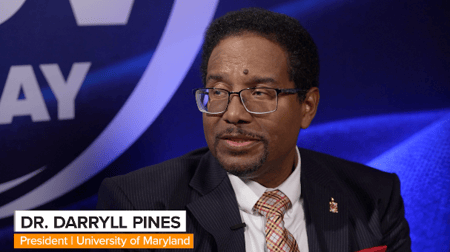 Pines introduces today’s developments by looking back to the invention of the transistor and the electronics revolution that followed. That earlier period helped enable the integrated circuits and digital devices people now use every day.
He describes the current transition as quantum 2.0, with technologies that operate at the atomic level creating new possibilities. Understanding that progression, he suggests, can help people connect an unfamiliar field with the technological changes that have already shaped their lives.
The transition is unfolding along several paths. Pines distinguishes the continuing work toward fault-tolerant quantum computers from developments in sensing, networking and communications that he says are already producing usable products.
Atomic clocks provide one example. Pines explains how GPS relies on clocks aboard satellites and points to newer quantum clocks with greater accuracy. He describes their use in military settings and anticipates eventual benefits for consumers. The example illustrates how advances in quantum technology can matter before fully mature quantum computers become available.
Connecting Research with Commercial Opportunity
Stambaugh describes an ecosystem built from several complementary contributions. Federal investment supports long-term research and development. Universities generate discoveries and expertise. Entrepreneurs move ideas into startup companies, while venture capital helps those businesses develop.
Established companies also participate, identifying opportunities to build on emerging technologies. End users provide another essential connection, helping link technical capabilities with practical needs.
In Maryland, Stambaugh points to the defense industrial base and pharmaceutical companies as examples of communities that can engage with the technology. Their participation helps connect research and commercial development with potential applications.
IonQ illustrates how those relationships can reinforce one another. Stambaugh describes a company that emerged from university research, grew in partnership with the surrounding ecosystem and became a larger organization capable of attracting additional partners. That growth can create opportunities beyond the company itself.
Recognizing Progress and the Challenges Ahead
 Stambaugh sees quantum development accelerating, but he cautions that viewing isolated moments can make progress difficult to recognize. He compares that challenge with the long development of artificial intelligence before its more visible growth.
In quantum computing, he highlights advances in error correction and logical qubits as important developments. He also points to Riverlane’s decision to establish its U.S. headquarters in Maryland as an example of an ecosystem partner contributing expertise in that area.
Those advances support the effort toward fault-tolerant quantum computers, but Stambaugh makes clear that the goal remains difficult. More basic science is needed, and companies value partnerships that keep them connected to research.
His perspective combines optimism about the pace of development with recognition that significant work remains. Maintaining connections among research institutions, technology companies and prospective users helps position the ecosystem to respond as capabilities advance.
Building on a Long Research Foundation
Pines traces Maryland’s position to its long-running collaboration with NIST. He describes a joint institute focused on measurement science and quantum physics that brought researchers together and helped attract expertise from around the world.
That foundation supported the relationships and discoveries that contributed to IonQ’s origins. Pines recounts the work of Chris Monroe and Jungsang Kim on trapped-ion technology and a scalable quantum computing architecture.
Engineering expertise became part of the progression when researchers sought help turning their work into a system. Pines describes that collaboration as an important step between a promising scientific approach and the development of working hardware.
The account demonstrates how commercial opportunities can emerge from sustained research. Scientific discovery, engineering and private investment each contributed to moving the technology forward.
Preparing People and Places for Growth
For Stambaugh, people are the ecosystem’s most important asset. Attracting a company also means considering where its employees will live, raise families and become part of a community.
He describes those questions as practical considerations for organizations deciding where to locate. A region’s ability to support quantum growth therefore includes the conditions that help attract and retain talent.
Spaces for collaboration also matter. Stambaugh points to the Discovery Center, with participants including Microsoft, as a place where people from different organizations can connect and work together.
Workforce preparation must extend beyond university research programs. As manufacturing develops, Stambaugh sees a need for technician training in skills such as soldering and welding. Those abilities can help support the systems and production processes needed for commercial growth.
Pines calls for more strategic coordination among suppliers, producers and workforce programs, alongside the development of scalable architectures and manufacturing capabilities. The next stage requires bringing those elements together to accelerate progress toward the market.
Both speakers return to a practical objective: helping companies succeed in developing technologies, commercializing them and finding users. Maryland’s research foundation provides a starting point, while continued collaboration and workforce investment will help determine what comes next.
This interview is part of The Quantum Advantage: From Breakthrough Technology to Mission and Market Impact, presented by IonQ. Watch the full series at QuantumAdvantage.TV.