

Presented by IonQ
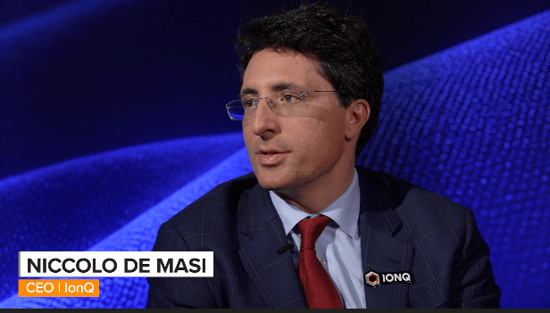
Quantum technology could give government employees and warfighters access to greater computing power through the devices they already use. Recorded at Quantum World Congress in College Park, Maryland, this conversation between Fed Gov Today Host Francis Rose and Niccolo de Masi, CEO of IonQ, explores how advances in computing, sensing and security could influence government missions—and what that transition might look like for users.
De Masi places quantum within a broader history of technological change, from the Industrial Revolution to the information age and today’s advances in artificial intelligence. He believes quantum technologies will help shape economic growth and national security throughout the twenty-first century. That perspective extends beyond computing to include networking, sensing and security.
Bringing Quantum Power to Familiar Devices
 For federal employees and warfighters, de Masi envisions a future in which laptops, phones and tablets call on quantum computers to address problems they cannot solve themselves. The results would return through conventional devices, making advanced processing available through interfaces users already understand.
That approach connects quantum hardware with everyday workflows. De Masi describes IonQ’s machines as equipment an organization could accommodate within a building, rather than something an employee would place on a desk. Accessing those machines through familiar tools could allow personnel to benefit from their capabilities without directly operating the underlying hardware.
He points to IonQ’s partnership with NVIDIA as an example of this direction. De Masi says an IonQ quantum computer will be placed in an NVIDIA data center, supporting research into hybrid workflows that combine different computing resources.
For the warfighter, he expects those workflows to provide substantially greater computing power while maintaining, and potentially improving, the user experience. The goal is to make new capabilities accessible in ways that fit how people already work.
Improving Positioning and Sensing
De Masi also describes potential mission benefits beyond processing information. He discusses IonQ’s work toward positioning technology that he expects to be significantly more accurate than today’s GPS.
He contrasts meter-level accuracy with the possibility of millimeter-level accuracy, explaining that greater precision could affect battlefield efficiency. He describes the technology as having both military and civilian applications.
His comments outline the capabilities IonQ is working toward. They also illustrate why government organizations may need to consider quantum’s potential across several functions, including computing, navigation and sensing.
Preparing for More Capable Cyber Threats
Security is another central part of de Masi’s outlook. As computing capabilities advance, he expects adversaries to pursue increasingly sophisticated tools as well.
He anticipates a future in which powerful artificial intelligence systems and quantum computers contribute to cyber threats. Government personnel will need to keep adapting the tools used to protect messages, communications and data centers.
The conversation connects quantum’s potential with the practical demands of government work. De Masi sees opportunities to deliver more processing power and greater precision, alongside a continuing need to strengthen cybersecurity. For mission leaders, the challenge is understanding how those developments could support personnel and improve the capabilities available to them.
This interview is part of The Quantum Advantage: From Breakthrough Technology to Mission and Market Impact, presented by IonQ. Watch the full series at QuantumAdvantage.TV.