

Presented by IonQ
Quantum’s importance to government will ultimately be measured by the missions it supports and the decisions it improves. Recorded at Quantum World Congress in College Park, Maryland, this conversation brings Maryland Gov. Wes Moore and Robert Cardillo, Executive Chairman of IonQ Federal and former Director of the National Geospatial-Intelligence Agency, together with Fed Gov Today Host Francis Rose to examine how quantum development can strengthen national security and economic growth.
Their discussion connects the urgency of international competition with the practical work of building partnerships, defining government needs and translating research into usable capabilities. Both see quantum as a foundation for broader progress, with success depending on the institutions and people that move technology toward real applications.
Connecting Technology with Better Decisions
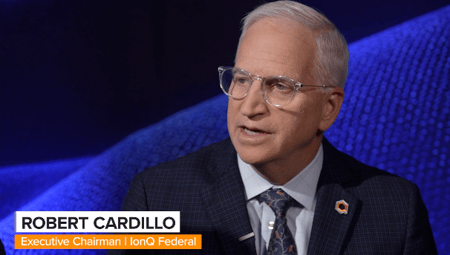 Cardillo approaches quantum through the perspective of nearly four decades in the intelligence community. The purpose of that service, he explains, was to advance national security, economic security and the country’s way of life. He sees quantum as the next phase in extending those protections into the future.
That future requires more than generating additional information. Cardillo describes an increasingly noisy world in which decision-makers are already flooded with data. Information becomes useful when it is presented in a way that helps leaders understand their circumstances and make better decisions.
He places quantum development within that transition from technical potential to practical value. The challenge is to turn emerging capabilities into something that advances a mission, whether that involves supporting government leaders or protecting deployed forces.
International competition adds urgency. Cardillo emphasizes that the United States is not alone in pursuing quantum capabilities and cannot assume its current position will endure without continued effort. His instruction is direct: “no coasting.”
Making Quantum a Foundation for Economic Growth
Moore connects quantum investment with Maryland’s economic priorities. His administration identified life sciences, information technology, aerospace and defense as areas where the state wanted to lead. He sees quantum processing and computing as capabilities that can support progress across those industries.
That is the purpose he describes for the billion-dollar Capital of Quantum initiative. The investment is intended to build a foundation for other objectives, helping Maryland develop the technological capabilities needed to compete and grow.
 Moore’s vision extends beyond establishing a successful quantum sector. He wants quantum to inform the way the state approaches its broader priorities. As the technology develops, he sees opportunities for it to become an enabling capability across research, industry and government.
He points to Maryland’s partnership with DARPA and the presence of companies such as IonQ and Microsoft as elements of that effort. Those relationships help connect technological development with an environment that can support long-term growth.
Building the Partnerships That Carry Research Forward
Cardillo describes the ecosystem around quantum as an important source of American competitive strength. His example begins with a public university developing research capabilities and attracting scientists whose discoveries can become the foundation for new companies.
Private investment then helps carry those ideas into commercial development. As companies grow, they can build new relationships with government and the region that supported their emergence. Cardillo sees that cycle of research, investment and partnership as something the country should continue strengthening.
IonQ illustrates that progression in the conversation. Cardillo points to the work of Chris Monroe and the research that helped provide the foundation for the company. The broader lesson is that scientific achievements become more consequential when institutions can connect them with capital, engineering and customers.
Moore highlights Maryland’s concentration of organizations that can contribute to those connections. He cites U.S. Cyber Command, the National Security Agency, Fort Meade, the Applied Physics Laboratory, the United States Naval Academy, the University of Maryland and Johns Hopkins University. He views the state’s quantum investment as contributing to a national security foundation that extends beyond Maryland.
Giving Industry a Clear Mission Challenge
For Cardillo, government partners have an essential role in identifying what needs to be accomplished. He asks for a clear demand signal: the mission outcomes agencies want and the challenges they need solved.
Scientific expertise and intellectual property are valuable resources, but his role at IonQ is to help translate science into practical capabilities. That work needs a defined purpose. Government organizations can help by explaining their problems and allowing companies to compete to address them.
Moore adds the perspective of his military service as a paratrooper with the 82nd Airborne Division and in Afghanistan. He recalls the importance of trusting training and equipment—requirements that become particularly relevant when emerging technologies are intended to support personnel in the field.
Cooperating on National Priorities
 Moore also recognizes the relationship between competition and cooperation. States and companies may compete intensely, but national security and technological development require organizations to work together on shared interests.
That balance runs throughout the conversation. Quantum leadership requires sustained technical progress and competitive drive, supported by partnerships that connect research with clear needs. For Moore and Cardillo, the opportunity is to build capabilities that strengthen economic growth, improve decisions and serve the people carrying out critical missions.
This interview is part of The Quantum Advantage: From Breakthrough Technology to Mission and Market Impact, presented by IonQ. Watch the full series at QuantumAdvantage.TV.