

Presented by Appian
Government agencies are working to turn artificial intelligence investments into capabilities that improve operations and advance their missions. In this special Fed Gov Today program, host Francis Rose speaks with leaders from Appian, the Department of Health and Human Services, and the military community about moving AI beyond experimentation. Recorded at Appian Government in Tysons Corner, Virginia, the program explores modernizing legacy applications, strengthening financial oversight, and helping warfighters make better decisions. Across three conversations, the focus is on connecting technology to trusted information, effective workflows, clear accountability, and the people doing the work.
Modernizing Government Applications for Secure, Governed AI
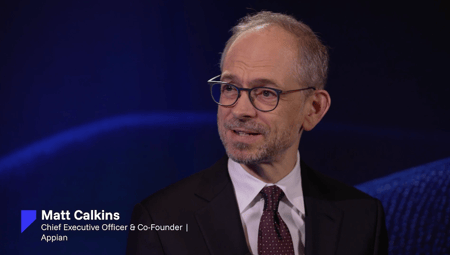 Matt Calkins, Chief Executive Officer & Co-Founder of Appian, says moving AI into mission-critical work requires agencies to rethink the applications, data connections, and controls supporting their operations. Modernization offers an opportunity to improve how an organization works while preparing it for a more dynamic technology environment.
Calkins argues that the case for replacing aging applications has grown stronger. Along with maintenance costs, difficult user experiences, and isolated information, he points to security concerns as another reason agencies should examine existing systems. His advice begins with prioritization: identify outdated applications and establish a clear modernization plan.
That plan should go beyond replacing each old application with a new version. Calkins encourages agencies to consolidate systems where possible, creating simpler access, consistent training, and a shared understanding of data. The opportunity is to improve the enterprise rather than reproduce its existing silos.
AI agents add another dimension to that challenge. As agents seek information and take actions across applications, agencies need confidence that they can reach current, authoritative data while observing access restrictions. Calkins says that environment demands deliberate architecture and controls.
He outlines four capabilities Appian considers essential for bringing AI into consequential work: a deterministic process layer, secure data access, governance, and efficient assignment of work to the appropriate agent or model. Governance includes tracking, guardrails, escalation, and validation to keep activity aligned with an agency’s intent.
Cost also matters. Calkins argues that agencies should match each task to the level of AI capability it requires instead of defaulting to the most advanced model. Managing token consumption becomes part of making AI adoption sustainable.
His broader message is that mission value depends on the structure surrounding AI. Modern applications, connected information, operational controls, and disciplined resource allocation can help agencies turn powerful technology into capabilities they can trust and use at scale.
3 Key Takeaways
- Modernization should consolidate and improve applications rather than reproduce existing silos.
- Mission-critical AI needs predictable processes, secure data access, governance, and appropriate task routing.
- Matching work to the right agent or model can help agencies manage costs as adoption grows.
How HHS Is Using AI to Strengthen Financial Oversight
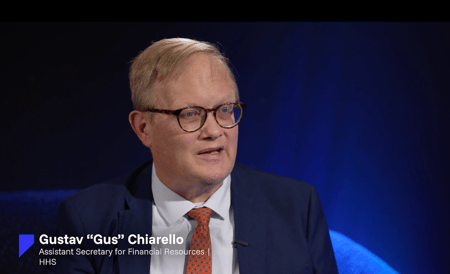 Gustav “Gus” Chiarello, Assistant Secretary for Financial Resources at the Department of Health and Human Services, describes how the department is developing an AI-supported approach to examining audit findings and identifying patterns that can guide closer oversight.
In his conversation with Francis Rose, Chiarello explains the Audit, Enforcement and Risk Oversight initiative, or AERO. He says the effort grew from questions about why recurring weaknesses in grant oversight had not prompted a more coordinated response. Findings could move through a federated organization without giving leaders a clear, timely picture of whether underlying problems had been resolved.
Large language models offer a way to review substantial volumes of audit material and compare findings over time. Chiarello emphasizes that the information was already available; the opportunity lies in making it more usable. Instead of treating reports as isolated documents, officials can look for recurring deficiencies and changes in how weaknesses are described.
Those findings can help determine where additional attention is warranted. Chiarello distinguishes indicators of potential fraud from evidence sufficient to establish it. AI-supported analysis can direct human review, but a pattern in the data does not itself prove wrongdoing.
He also emphasizes judgment in responding to missing audits or unresolved deficiencies. Funding decisions can affect vulnerable populations, particularly when a grantee is the only nearby provider of essential services. Effective oversight must account for those consequences while addressing risks.
Chiarello sees potential for the approach to extend to other departments with similar responsibilities. He describes broader implementation as a goal that depends on completing the model and the supporting instructions.
The interview illustrates a practical path beyond an AI pilot: begin with an existing oversight obligation, make longstanding information easier to analyze, and connect the results to accountable decisions. The technology supports the work of identifying risks, assessing circumstances, and determining an appropriate response.
3 Key Takeaways
- AI can help officials analyze existing audit records for recurring weaknesses and risk patterns.
- Risk indicators should guide further review; they do not independently establish fraud.
- HHS is developing the approach with a goal of broader use across government.
Turning AI and Data Into Decision Advantage for the Warfighter
 Gen. Paul Funk (USA, ret.), Former Commanding General, Army Training and Doctrine Command, and Frank DeGeorge, Regional Vice President at Appian, say the value of AI depends on whether it helps people perform demanding missions. Simplicity, training, and direct user feedback are central to turning technology into operational advantage.
Funk describes an environment in which adversaries can influence the operational space without moving conventional forces. As information becomes more abundant and threats more complex, he argues that tools must make difficult decisions easier for the people closest to the mission.
DeGeorge connects that requirement to the challenge of bringing data into useful applications. Commanders need relevant information presented in a way that supports how they work. AI can assist acquisition, personnel planning, and logistics, but its value depends on the workflows surrounding it.
Both guests emphasize trust developed through use. Funk advocates incorporating tools into training so service members gain experience before relying on them in operational settings. Repetition can help users understand a capability while revealing where it needs improvement.
DeGeorge highlights the importance of putting tools into users’ hands, collecting feedback, and making adjustments quickly. Funk adds that having developers work directly with soldiers can help teams solve the right problems faster.
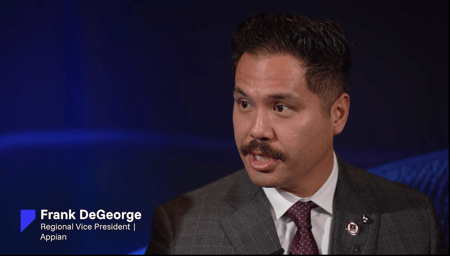 That approach also requires examining existing processes. DeGeorge cautions against rebuilding an ineffective workflow without reconsidering what has changed and what users now need. Technology should support current mission requirements rather than preserve unnecessary complexity.
The conversation addresses the path from an idea to a production capability. DeGeorge describes configurable solutions, an Army enterprise agreement, and an accredited hosting environment as ways to reduce delivery friction. He cites modernization of a munitions planning and forecasting system as an example.
Their shared measure of success is the user’s ability to accomplish the mission. Better information and faster delivery matter when they improve decisions at the point of need.
3 Key Takeaways
- Useful AI should simplify decisions and deliver relevant information to service members.
- Training and direct feedback help build trust and improve tools before operational use.
- Rethinking workflows and reducing delivery friction can help move capabilities into production.