Original Broadcast Date: 11/22/2026
Sponsored by Appian
Federal agencies have spent years deciding when and how to replace outdated applications. Matt Calkins says artificial intelligence is making those decisions more urgent. During an interview with Francis Rose at Appian Government 2026, Calkins, CEO and Co-Founder of Appian, explains how emerging AI capabilities are changing both the risks of maintaining legacy systems and the opportunities available through modernization. He argues that agencies face an unusual combination of circumstances: the cost of keeping older applications is increasing while the cost of replacing them is decreasing. "This is an extraordinary opportunity to change your legacy applications into something new and modern and future-proof," Calkins says.
Why legacy applications are becoming a security concern
Legacy technology creates familiar problems for government organizations. Older applications can be expensive to maintain, difficult to use, and complicated for employees to learn. They can also separate information across different systems, preventing organizations from using data effectively. Calkins says those challenges remain, but agencies must now consider another issue. Security vulnerabilities associated with outdated applications are becoming increasingly concerning as AI capabilities advance. He warns that the latest generation of large language models can potentially be used to exploit weaknesses in legacy technology. That changes the calculation for organizations that previously considered delaying modernization an acceptable option. According to Calkins, agencies can no longer evaluate outdated applications exclusively through operational costs and employee productivity. They must also consider the potential security liabilities associated with maintaining those systems.
Modernization should mean consolidation
Calkins says agencies beginning modernization efforts often identify extensive lists of outdated applications. Some organizations have thousands of systems that need attention. The first step, he explains, is determining where to focus. But identifying applications for replacement is only the beginning. Calkins argues that agencies should resist the temptation to replace every old application with a corresponding new one. Instead, they should use modernization as an opportunity to consolidate systems and simplify operations. "If you had 100 applications, maybe now it can be one," he says. That approach could allow agencies to introduce shared login experiences, unified interfaces, consistent data access, and simplified 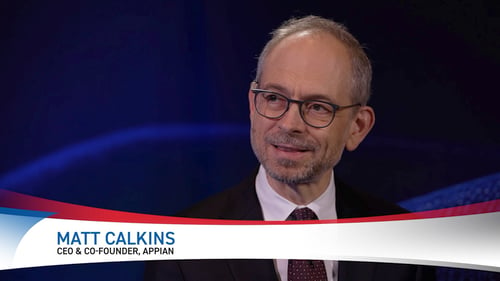 employee training. Rather than preserving existing organizational divisions through new technology, agencies can rethink how their applications support the enterprise. "This is an opportunity not merely to translate, but to transform," Calkins says.
For Calkins, one of the biggest opportunities involves changing how agencies think about their application ecosystems. He acknowledges that some applications may genuinely operate independently. However, he argues that most enterprise applications share information, users, or integrations with other systems. That interconnectedness creates opportunities for consolidation. Calkins says traditional application silos often develop as technology accumulates over time. Modernization allows organizations to reconsider whether those divisions remain necessary. He also believes emerging AI capabilities can help agencies rewrite applications that employees have relied on for years. The result, he suggests, could be systems that contribute more directly to productivity instead of creating frustration. But the growing role of artificial intelligence also introduces new challenges.
AI agents are changing enterprise technology
Calkins explains that the application ecosystem is becoming more fluid and less predictable as AI agents take on new responsibilities. Traditional integrations often follow established patterns. One application requests information from another, receives a response, and completes a defined task. AI agents can operate differently. They may explore multiple information sources, evaluate available data, and take actions based on what they discover. "An agent is like a person in the way that it explores and considers and then acts," Calkins says. That flexibility creates opportunities for more sophisticated automation. However, it also means agencies cannot always predict how applications will interact. Calkins says enterprise technology environments must be designed to accommodate that unpredictability.
Securing data in an AI-driven enterprise
As AI agents move across organizational systems, Calkins says agencies must pay closer attention to how those agents access information. Several questions become particularly important. Are agents retrieving information they are authorized to access? Are they using the most current data? Are they finding authoritative sources, or relying on outdated or unreliable information? And are the appropriate security controls applied as information moves between systems? Calkins emphasizes that agencies need to understand how agents evaluate their environments and determine where to retrieve information. Those considerations affect both cybersecurity and the reliability of AI-generated results. An agent that accesses the wrong information could create problems even when the underlying technology functions as designed.
Calkins sees legacy modernization as an opportunity to address several longstanding technology challenges simultaneously. Agencies can reduce the number of applications they maintain, simplify employee experiences, improve information sharing, and prepare their systems for AI-driven operations. But he argues that success requires thinking beyond individual applications. The larger objective is creating an enterprise environment where systems, data, and users can interact more effectively. As AI agents become more capable, that environment must also support secure and reliable access to information. For Calkins, modernization is no longer simply about replacing old technology. It is about preparing government systems to operate in a fundamentally different application ecosystem.