Presented by ServiceNow & Carahsoft
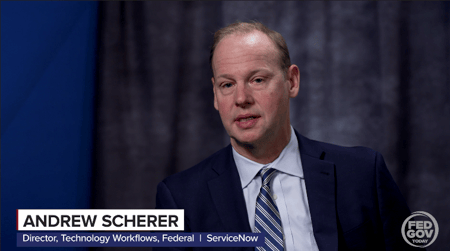
Artificial intelligence is often described as a solution to government’s most difficult problems. Andrew Scherer, Director, Technology Workflows - Federal at ServiceNow, agrees that AI can help agencies address complexity, but he warns that the technology will only succeed if agencies first build the right foundations.
In this Innovation in Government segment from the GovExperience Summit, Scherer says AI has the potential to help break down silos within agencies and across government. Cross-agency collaboration is difficult even before additional data sources, systems and stakeholders are introduced. AI can help manage that complexity, but only when agencies have the data and governance structures needed to support reliable decisions.
The first foundation is data. Scherer puts it plainly: agencies cannot do much with AI if they do not have good data. Incomplete data can cause AI agents to make bad decisions quickly. That is not modernization; it is acceleration without confidence.
Scherer says agencies need data from across the enterprise. That includes IT, procurement, HR and other systems that shape how work gets done. A narrow dataset will limit the value of any AI system. Agencies also need to account for third-party applications. Scherer notes that the average enterprise may have hundreds of third-party applications with different sources of truth. If those sources are left out, an agentic AI solution may not have the context needed to act effectively.
The second foundation is governance. Scherer says agency executives will not allow an “army” of AI agents to move across networks without oversight. Leaders need to know what agents are doing in real time, what data they are accessing, what actions they are taking and whether they are operating within approved boundaries. If an agent behaves unexpectedly, agencies need the ability to stop it.
 That is where Scherer introduces the idea of an AI control tower. The concept is a centralized view that allows organizations to govern AI agents, including agents connected to third-party systems. Agencies need to see not only their own agents, but how those agents interact with others across the technology environment. Governance is not simply a policy document; it is operational visibility and control.
The conversation also points to a broader challenge in government AI adoption. Agencies are under pressure to deploy AI, show return on investment and demonstrate progress. But rushing into deployment can create risk if the organization has not built the necessary foundation. Data quality, system integration, governance and control are not secondary issues. They determine whether AI produces value or creates new problems.
Scherer’s message is especially relevant for agencies exploring agentic AI. These systems are not just generating content or analyzing information. They may be taking actions, coordinating workflows or making recommendations that affect real processes. That raises the stakes for data quality and governance.
The promise of AI in government is significant. It can help agencies connect information, automate workflows, support better decisions and reduce friction across service ecosystems. But Scherer’s segment makes clear that AI should not be treated as a shortcut around hard modernization work. It depends on that work.
For agencies beginning or expanding their AI journey, the priorities are clear: understand the data ecosystem, make sure the data is complete and reliable, govern agents in real time and create controls that leaders can trust. Only then can AI help government move faster without losing accountability.
Key Takeaways
- AI depends on complete, high-quality data across the enterprise.
- Agencies need governance that provides real-time visibility and control over AI agents.
- Strong data and governance foundations are required before agencies can scale AI confidently.