Presented by Atlassian & Carahsoft
Federal agencies are moving beyond the first wave of generative AI experimentation. Instead of relying exclusively on separate chatbots, technology leaders increasingly want AI embedded within the software and workflows employees already use. Matthew Graviss, Public Sector CTO at Atlassian, sees that shift as an important evolution in government AI and DevSecOps.
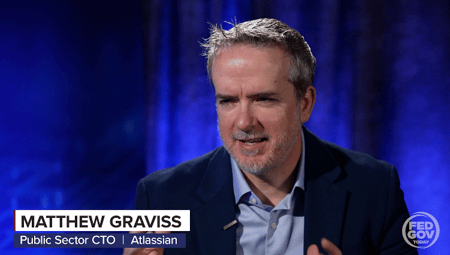 Before joining Atlassian, Graviss spent nearly 20 years in federal service and served as Chief Data and AI Officer at the Department of State. That experience gives him insight into both the organizational challenges agencies face and the opportunities available through more integrated technology.
Early AI programs often focused on providing employees with access to a government-approved chatbot. Although useful, that model can force workers to move information between operational tools and a separate AI interface. Embedding AI directly into daily workflows reduces this context switching and makes the capability easier to use at the point of need.
The same principle applies across DevSecOps. AI coding assistants receive significant attention, but writing code is only one part of the software-development lifecycle. Developers also spend substantial time in discovery, meetings, requirements development, design and testing. Graviss says specialized AI agents can support each of those stages, freeing technologists to devote more time to the work that requires their expertise.
Technology will not solve collaboration problems by itself. High-performing teams also connect everyday work to strategic goals. Government strategies may clearly state an agency’s priorities, yet employees often struggle to see how their individual tasks contribute to those objectives. Connecting senior-level strategy to the epics, stories and tasks development teams manage helps employees understand how their work supports a citizen service, mission priority or leadership commitment.
The combination of embedded AI and strategic alignment can improve the entire organization. AI reduces friction across the lifecycle, while visible goals ensure that acceleration is directed toward meaningful outcomes. The objective is not simply to make an individual developer faster, but to improve how the agency turns strategy into working mission capability.
Key Takeaways
- Agencies are shifting from stand-alone chatbots toward AI embedded in daily operational workflows.
- Discovery, requirements, design and testing offer major opportunities for AI-assisted improvement beyond coding.
- Connecting development work to agency strategy helps teams direct greater speed toward meaningful mission outcomes.