Presented by Carahsoft
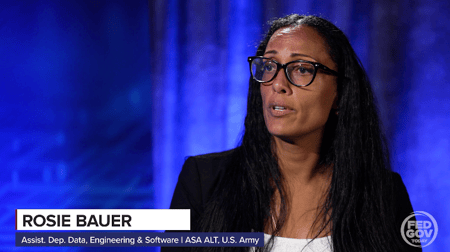
DevSecOps helped the Army move away from slow, monolithic software releases and toward continuous delivery. Rosie Bauer, Assistant Deputy for Data, Engineering, and Software in the Office of the Assistant Secretary of the Army for Acquisition, Logistics and Technology, explains that the service is now extending those principles beyond software and across the broader engineering and acquisition lifecycle.
 The DevSecOps pipeline remains the foundation. Continuous integration, automation and security built into the process allow teams to deliver updates rapidly. Applying that model across acquisition, however, requires a digital engineering ecosystem that can connect data and models throughout the lifecycle and make traditionally separate activities part of a continuous mission-delivery process.
Modular open systems architecture, or MOSA, is another essential element. A mature modular architecture allows the Army to swap individual components in and out rather than replacing or retesting an entire system. That flexibility can accelerate integration, procurement, testing and security assessment while making it easier to introduce new commercial and government capabilities.
Modularity depends on stable interfaces and clearly defined boundaries. When those elements are visible, industry partners understand what they need to build toward. Army teams can isolate the component that changed, test and validate it, and avoid recertifying the complete enterprise following every upgrade. This narrows the scope of authorization work and reduces the distance between procurement and operational use.
Digitization makes continuous delivery possible across acquisition processes that have historically relied on documents and organizational silos. Requirements, architectures and test artifacts created as static files are difficult to integrate into an automated pipeline. Converting them into machine-readable data and code allows information to flow through a digital engineering environment where teams can automate processes, integrate continuously and embed security earlier.
Operation Jailbreak demonstrated the potential of exposed interfaces and API-driven integration by allowing multiple vendors and solutions to connect in a compressed timeframe. The broader lesson is that digital data, modular architectures and stable interfaces can help the Army move emerging technology into soldiers’ hands with greater speed, security and adaptability.
Key Takeaways
- The Army is extending DevSecOps principles across engineering and acquisition, not only software delivery.
- Modular architectures and stable interfaces allow individual components to be integrated, tested and authorized more quickly.
- Machine-readable acquisition data can replace siloed, document-heavy processes and support continuous delivery.