Presented by MANTECH & Carahsoft
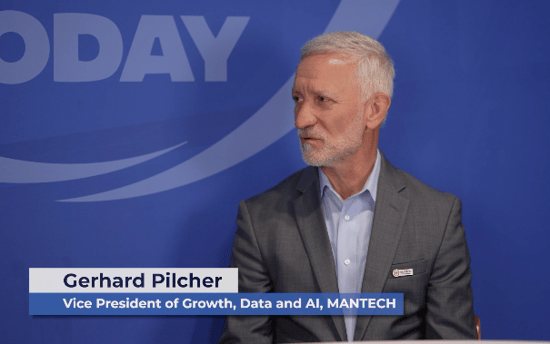
Gerhard Pilcher, Vice President of Growth for Data and AI Practice at MANTECH, believes organizations often approach artificial intelligence from the wrong direction. Rather than starting with the technology itself, he argues that successful AI adoption begins with a clear understanding of mission objectives and operational challenges.
Pilcher compared AI to any other military tool. Just as commanders select equipment based on mission requirements, organizations should determine where AI can provide measurable operational value instead of searching for places to apply the latest technology. This mission-first mindset helps ensure that AI investments produce meaningful outcomes rather than becoming technology experiments.
 One of the most promising applications of AI is helping organizations manage increasingly complex information environments. Modern military and government organizations generate enormous amounts of data from countless sources. The challenge is no longer gathering information but making sense of it quickly enough to support effective decision-making.
Pilcher explained that traditional machine learning capabilities have already improved data analysis, but recent advances in large language models and reasoning agents are creating new opportunities. These technologies allow leaders to interact with information more naturally, asking questions and receiving insights without navigating hundreds of dashboards and reports.
As operational environments become more dynamic, AI also has the potential to shorten decision cycles. Reasoning agents can identify patterns, surface alternatives, and help decision-makers consider options that might otherwise be overlooked. This capability becomes particularly important as adversaries operate at greater speed and seek to create confusion within the battlespace.
AI is also expanding toward the tactical edge. Pilcher described how intelligent systems can adapt more quickly than traditional rule-based technologies as conditions change. These capabilities can improve targeting, decision support, and operational awareness while helping organizations maintain an advantage against rapidly evolving threats.
The conversation also addressed workforce readiness. Pilcher emphasized that successful AI adoption requires more than providing access to technology. Personnel must understand how to interact effectively with AI systems, formulate useful prompts, and interpret results. At the same time, organizations need highly skilled engineers and data scientists to design and maintain these capabilities behind the scenes.
Ultimately, Pilcher believes the best AI systems are those that become nearly invisible to the operator. When designed correctly, AI simply becomes another capability that helps users achieve mission success without requiring them to focus on the technology itself.
Key Takeaways
• AI adoption should begin with mission requirements rather than technology.
• Large language models and reasoning agents help simplify complex information environments.
• Workforce training and AI expertise remain essential to operational success.