Presented by Carahsoft
Special Operations, Emerging Technology, and the Future Fight
The security challenges facing the United States and its allies are evolving at unprecedented speed. At SOF Week 2026, military leaders, government officials, educators, and industry innovators gathered to discuss the technologies, strategies, and partnerships shaping the future of national defense. From autonomous warfare and artificial intelligence to cyber resilience, military education, data management, and secure communications, these conversations explored how organizations are adapting to increasingly complex operational environments. Together, they reveal a common theme: success in future conflicts will depend on the ability to integrate people, technology, and information faster and more effectively than ever before.
Building Autonomous Advantage Across the Hemisphere
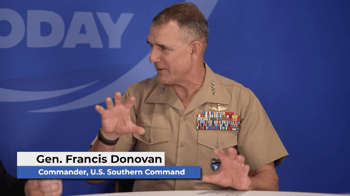 As Commander of U.S. Southern Command, Gen. Francis Donovan is responsible for overseeing military operations and partnerships throughout Latin America and the Caribbean. At SOF Week, Donovan discussed how autonomous systems are becoming an increasingly important component of military operations and how SOUTHCOM is positioning itself to take advantage of these capabilities through the creation of a new Autonomous Warfare Command.
Donovan explained that autonomous warfare must be approached as a truly joint endeavor. Historically, operational requirements generated by combatant commanders have not always connected effectively to technology development and acquisition processes. SOUTHCOM is working to change that dynamic by strengthening collaboration with the Defense Autonomous Warfare Group and ensuring that requirements generated in operational environments directly influence technology investments and capability development.
The new Autonomous Warfare Command is designed to move quickly and leverage capabilities already being developed across the services. Rather than creating a large headquarters structure, the organization will focus on synchronizing efforts across the Army, Navy, Air Force, Marine Corps, and Space Force while helping operational commanders identify and integrate emerging autonomous capabilities.
A key priority is improving domain awareness across the Western Hemisphere. Donovan noted that many partner nations face challenges monitoring vast maritime, air, and land regions. Autonomous systems can provide persistent surveillance, improve visibility into ungoverned spaces, and help identify illicit activity ranging from drug trafficking operations to unauthorized airfields and maritime movements.
Equally important is the development of a data architecture capable of connecting information from multiple sources. Donovan emphasized that the true value of autonomous systems is not the platform itself but the data it collects and the ability to share that information with partners and decision-makers. Establishing common architectures will allow new technologies to be integrated rapidly while supporting mission requirements across the theater.
The discussion also highlighted the growing overlap between criminal organizations and geopolitical competitors. Donovan observed that transnational criminal organizations, designated terrorist organizations, and malign state actors often exploit the same ungoverned spaces. Improved domain awareness allows military and partner organizations to better understand these activities and respond more effectively.
Looking ahead, logistics will remain a major factor in determining which autonomous capabilities can be deployed successfully. Questions about sustainment, maintenance, launch locations, and partner support will shape future operational decisions. Donovan believes autonomous systems will become a foundational capability for SOUTHCOM, but success will depend on integrating technology with operational realities.
Key Takeaways
• SOUTHCOM is establishing an Autonomous Warfare Command to accelerate joint autonomous operations.
• Domain awareness and data architecture are critical to maximizing autonomous capabilities.
• Logistics and partner integration will shape the future deployment of autonomous systems.
Putting Mission Outcomes First in Artificial Intelligence
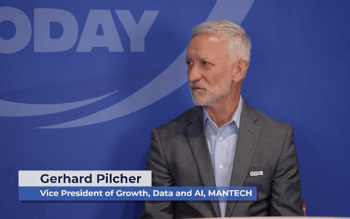 Gerhard Pilcher, Vice President of Growth for Data and AI Practice at MANTECH, believes organizations often approach artificial intelligence from the wrong direction. Rather than starting with the technology itself, he argues that successful AI adoption begins with a clear understanding of mission objectives and operational challenges.
Pilcher compared AI to any other military tool. Just as commanders select equipment based on mission requirements, organizations should determine where AI can provide measurable operational value instead of searching for places to apply the latest technology. This mission-first mindset helps ensure that AI investments produce meaningful outcomes rather than becoming technology experiments.
One of the most promising applications of AI is helping organizations manage increasingly complex information environments. Modern military and government organizations generate enormous amounts of data from countless sources. The challenge is no longer gathering information but making sense of it quickly enough to support effective decision-making.
Pilcher explained that traditional machine learning capabilities have already improved data analysis, but recent advances in large language models and reasoning agents are creating new opportunities. These technologies allow leaders to interact with information more naturally, asking questions and receiving insights without navigating hundreds of dashboards and reports.
As operational environments become more dynamic, AI also has the potential to shorten decision cycles. Reasoning agents can identify patterns, surface alternatives, and help decision-makers consider options that might otherwise be overlooked. This capability becomes particularly important as adversaries operate at greater speed and seek to create confusion within the battlespace.
AI is also expanding toward the tactical edge. Pilcher described how intelligent systems can adapt more quickly than traditional rule-based technologies as conditions change. These capabilities can improve targeting, decision support, and operational awareness while helping organizations maintain an advantage against rapidly evolving threats.
The conversation also addressed workforce readiness. Pilcher emphasized that successful AI adoption requires more than providing access to technology. Personnel must understand how to interact effectively with AI systems, formulate useful prompts, and interpret results. At the same time, organizations need highly skilled engineers and data scientists to design and maintain these capabilities behind the scenes.
Ultimately, Pilcher believes the best AI systems are those that become nearly invisible to the operator. When designed correctly, AI simply becomes another capability that helps users achieve mission success without requiring them to focus on the technology itself.
Key Takeaways
• AI adoption should begin with mission requirements rather than technology.
• Large language models and reasoning agents help simplify complex information environments.
• Workforce training and AI expertise remain essential to operational success.
Managing Wireless Threats in an Increasingly Connected World
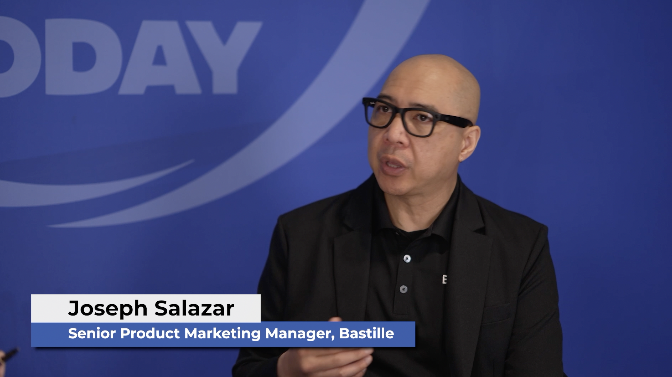
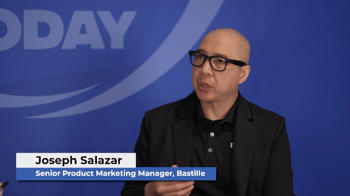 Joseph Salazar, Senior Product Marketing Manager at Bastille and a retired military cybersecurity professional, discussed how wireless technologies are creating new security challenges for military installations and sensitive environments.
Over the past decade, wireless devices have become nearly ubiquitous. Smartphones, smart watches, Bluetooth earbuds, health monitors, and other connected technologies accompany people everywhere they go. While these devices offer tremendous convenience, they also introduce new vulnerabilities that organizations must address.
Salazar explained that traditional security measures such as guards, gates, and physical barriers are ineffective against wireless signals. Wireless communications move freely through facilities and across boundaries, creating opportunities for unauthorized access, surveillance, and intelligence collection.
Many organizations are now confronting challenges associated with devices that would have been unimaginable in secure environments just a few years ago. Bluetooth-enabled health devices, hearing aids, smart glasses, and wearable technologies all create potential pathways for information leakage or exploitation. Even seemingly harmless devices can become tools for collecting sensitive information.
Wireless threats are no longer limited to close-range attacks. Salazar described how adversaries have demonstrated the ability to leverage neighboring networks and wireless infrastructure to gain access to target organizations. These attacks highlight the growing sophistication of wireless threat actors and the need for greater visibility into the wireless environment.
To address these challenges, organizations are increasingly adopting Wireless Intrusion Detection Systems. Modern solutions monitor Wi-Fi, Bluetooth, cellular communications, and a variety of Internet of Things protocols. These systems provide visibility into activity that would otherwise remain hidden and allow security teams to identify suspicious devices before they become larger threats.
The conversation also explored the security implications of connected medical devices. Technologies such as glucose monitors and pacemakers often rely on wireless connectivity. While these innovations improve quality of life, they also create new attack surfaces that adversaries may attempt to exploit.
Artificial intelligence is amplifying these concerns. Salazar noted that adversaries can now use AI to build detailed target profiles, analyze social media activity, and identify vulnerabilities at unprecedented speed. As a result, organizations must think more broadly about cybersecurity and recognize that wireless security has become an essential component of protecting people, facilities, and operations.
Key Takeaways
• Wireless technologies create new attack vectors that traditional security measures cannot address.
• Wireless Intrusion Detection Systems provide critical visibility across multiple wireless protocols.
• AI is accelerating the speed and sophistication of wireless targeting and attacks.
Preparing Strategic Leaders for Future Conflict
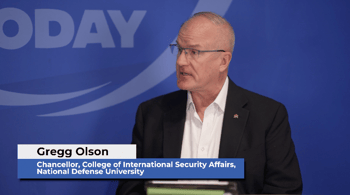 Gregg Olson, Chancellor of the College of International Security Affairs at the National Defense University, is helping shape the next generation of military, government, and industry leaders. During this discussion, Olson outlined how NDU is adapting its educational programs to address the rapidly changing character of warfare.
Olson emphasized that while the nature of war remains fundamentally human, the character of warfare continues to evolve. Conflicts in Ukraine, the Middle East, and other regions have demonstrated how quickly technological innovation can reshape the battlefield. As a result, strategic education must evolve alongside these changes.
NDU is increasingly focused on preparing students for all-domain operations and joint warfighting concepts. Future leaders must understand how capabilities across land, sea, air, space, cyber, and information environments interact to create operational advantage.
Cyber operations and information warfare have become especially important areas of study. Olson highlighted the growing significance of the cognitive domain, where information and influence operations can shape decision-making and affect outcomes without traditional kinetic action.
Artificial intelligence is also becoming a critical component of strategic education. Olson views AI not as a separate discipline but as another tool available to military and national security professionals. Understanding how AI interacts with traditional capabilities will be increasingly important for future leaders.
To support these efforts, NDU is investing in advanced simulation and war-gaming environments. These capabilities will allow students to explore realistic scenarios and better understand the interactions between emerging technologies and operational decision-making.
The university is also expanding its academic offerings with the addition of the National Intelligence College, strengthening connections between defense and intelligence communities. At the same time, NDU is increasing engagement with industry partners, recognizing the growing importance of the defense industrial base in national security planning.
Olson believes strategic education must bring together military officers, government leaders, international partners, and industry professionals to create a shared understanding of future challenges. By combining theory with practical application, NDU aims to prepare leaders capable of succeeding in increasingly complex environments.
Key Takeaways
• NDU is expanding education focused on cyber operations, information warfare, and all-domain operations.
• Advanced simulations and war gaming will help prepare future strategic leaders.
• Industry engagement strengthens strategic education and national security planning.
Enabling Secure Operations Through Modern Cryptography
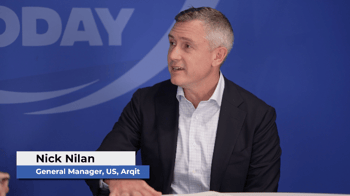 Nick Nilan, General Manager, U.S. at Arqit, believes cyber resilience has become fundamental to every mission conducted across the defense community. At SOF Week, Nilan discussed how changing operational environments, growing interoperability requirements, and increasingly sophisticated adversaries are driving new approaches to cybersecurity and encryption.
According to Nilan, cybersecurity is no longer a standalone function operating behind the scenes. Instead, it has become an essential component of mission success. As adversaries improve their cyber and electronic warfare capabilities, organizations must ensure security measures are integrated directly into operational planning and technology design.
One of the most significant challenges facing defense organizations today is the increasing emphasis on interoperability among joint forces, allies, and mission partners. Modern operations require information sharing across organizations, nations, and security domains at a scale that was unimaginable just a few years ago. While these partnerships are critical to mission success, they also create new cybersecurity complexities.
Nilan explained that traditional encryption methods often struggle in mission partner environments. Public Key Infrastructure, which forms the foundation of much of today's secure communications, can be cumbersome when organizations need to exchange certificates and cryptographic credentials across multiple partners. Hardware-based encryption solutions can also present limitations because they may not be easily shared across coalition environments.
Arqit's approach focuses on software-based encryption designed specifically to provide greater flexibility in complex operational settings. By removing some of the barriers associated with traditional cryptographic models, organizations can maintain security while enabling faster collaboration and information sharing among mission partners.
A central theme of the discussion was the concept of secure-by-design. Nilan believes organizations are increasingly recognizing that security should not be viewed as an obstacle to mission accomplishment. Instead, cybersecurity should function as an enabler that allows operators to accomplish objectives more effectively and confidently.
Recent conflicts around the world have reinforced this mindset. Lessons learned from operations in Eastern Europe and the Middle East demonstrate that organizations must be willing to challenge longstanding assumptions and adopt new approaches when existing methods no longer meet operational requirements.
The emergence of unmanned systems, artificial intelligence, and highly distributed operational environments is further accelerating the need for change. Traditional security architectures often struggle to scale effectively in these environments. As organizations deploy increasing numbers of autonomous and software-driven capabilities, cybersecurity solutions must evolve to keep pace.
Key Takeaways
• Cybersecurity is increasingly becoming a mission enabler rather than a mission constraint.
• Mission partner environments require more flexible approaches to encryption and secure communications.
• Software-based cryptography can help organizations adapt security faster than traditional approaches.
Modernizing Acquisition for a Faster Technology Cycle
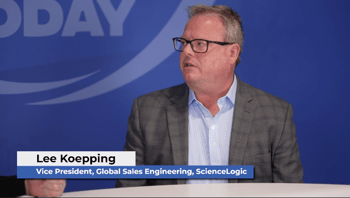 Lee Koepping, Vice President of Global Sales Engineering at ScienceLogic, believes the growing mismatch between technology innovation and government acquisition processes is one of the most important challenges facing public sector organizations today. At SOF Week, Koepping discussed how government and industry can work together to ensure innovation reaches mission operators more effectively.
Technology is evolving faster than ever before, particularly as software increasingly replaces hardware as the primary driver of innovation. At the same time, acquisition organizations face growing pressures related to oversight, justification, compliance, and workforce turnover. These competing realities often create friction between the speed at which new technologies emerge and the pace at which organizations can adopt them.
Koepping noted that traditional procurement models were often built around detailed feature specifications and rigid requirements. While those approaches may have worked in slower-moving environments, they can create challenges in today's technology landscape. By the time a solution is procured, the underlying technology may already be outdated.
To address this issue, many government organizations are shifting toward outcome-based acquisition strategies. Rather than prescribing specific technical features, agencies are increasingly focused on defining the operational results they want to achieve. This creates greater flexibility for industry partners while helping ensure investments remain aligned with mission objectives.
The move toward outcome-based requirements also encourages organizations to think differently about how success is measured. Koepping explained that defining outcomes is only part of the challenge. Agencies must also determine how they will measure progress and validate that objectives have been achieved.
Another positive development is the growing dialogue between government and industry. Historically, communication opportunities were often limited once formal acquisition processes began. Today, agencies are engaging more actively with vendors to understand available technologies and explore possible solutions before requirements are finalized.
Industry also has a responsibility to support this shift. Koepping argued that vendors should focus less on individual product features and more on the measurable outcomes their solutions enable. By emphasizing mission results rather than technical specifications, industry can help educate customers and improve acquisition strategies.
Looking ahead, Koepping sees artificial intelligence playing an increasingly important role within acquisition itself. AI may help streamline procurement processes, improve efficiency, validate results, and support better decision-making.
Key Takeaways
• Outcome-based acquisition strategies help align technology investments with mission needs.
• Increased dialogue between government and industry improves procurement outcomes.
• AI has the potential to improve efficiency and decision-making throughout the acquisition process.
Transforming Military Education for the Future Fight
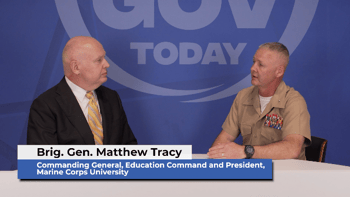 Brig. Gen. Matthew Tracy, Commanding General of Education Command and President of Marine Corps University, believes military education is entering a new era. At SOF Week, Tracy discussed how Marine Corps University is fundamentally transforming its curriculum and teaching methods to prepare future leaders for increasingly complex operational environments.
Tracy described the current period as the beginning of a fourth epoch in professional military education. While previous generations focused on developing leaders through traditional academic models, today's environment requires new approaches that account for emerging technologies, evolving adversary capabilities, and the growing complexity of all-domain operations.
The driving force behind these changes is the increasingly contested nature of modern warfare. For decades, the United States maintained significant advantages across individual domains. Today, adversaries have developed capabilities that challenge freedom of action in land, sea, air, space, cyber, and information environments simultaneously.
As a result, future military leaders must understand how actions in one domain affect operations in others. Tracy explained that tomorrow's joint task force commanders will need to coordinate capabilities from cislunar space to subsurface environments while integrating logistics, intelligence, cyber operations, and kinetic effects into unified campaigns.
One of the most significant changes underway is the transition to a top-secret educational environment. Beginning with the next academic cycle, portions of Marine Corps University's curriculum will be conducted within secure facilities using classified information and instruction. This transformation requires new facilities, new faculty qualifications, and substantial investments across the education enterprise.
The university is also rethinking how students learn. Traditional approaches based primarily on reading, lectures, and written analysis are being supplemented with advanced war gaming and simulation technologies. These tools allow students to practice decision-making in realistic operational environments while competing against adaptive opponents.
According to Tracy, these simulations create the cognitive repetition necessary to develop military judgment. By repeatedly confronting complex challenges, students gain experience that better prepares them for future leadership responsibilities.
Recent operational demands have already provided opportunities to test portions of the new curriculum. Tracy noted that students trained in all-domain operations were called upon to support real-world activities and performed beyond expectations, providing confidence that the educational transformation is moving in the right direction.
Key Takeaways
• Marine Corps University is transforming its curriculum to support all-domain operations.
• Classified education environments will provide students with more realistic learning experiences.
• Advanced war gaming and simulation tools are becoming central to military education.
Accelerating Data to Mission Outcomes
 Will Layton, Senior Advisor for Public Sector at Senzing, believes one of the biggest challenges facing government organizations today is not simply acquiring data but turning that data into actionable intelligence quickly enough to support mission outcomes. At SOF Week 2026, Layton discussed how organizations can bridge the gap between rapidly advancing technology and slower acquisition and implementation processes.
Layton explained that many organizations are overwhelmed by the sheer volume of information available to them. Intelligence analysts, investigators, and operational teams often have access to enormous datasets, but deriving value from that information depends on how quickly it can be onboarded, integrated, and analyzed. In mission environments where timing is critical, delays in data preparation can directly impact operational effectiveness.
Senzing focuses on entity resolution, helping organizations determine who is who and how people, organizations, and entities are connected across large datasets. A major advantage of the company's approach is the ability to process information in real time rather than relying on lengthy machine learning training cycles that can delay operational use.
Many competing approaches require weeks or months to prepare and train systems before data becomes usable. By contrast, Senzing's architecture allows organizations to onboard properly formatted data and begin generating insights almost immediately. This capability significantly reduces the time required to move from acquisition to analysis and ultimately to operational action.
The increasing scale of data presents another challenge. Twenty years ago, organizations often dealt with millions of records. Today, many are processing billions. Layton explained that innovation efforts have focused heavily on scalability, allowing systems to operate effectively across cloud and on-premises environments while maintaining performance at significantly larger volumes.
As data sources continue to proliferate globally, organizations face additional challenges related to language differences, varying formats, aliases, and inconsistent identifiers. Resolving those inconsistencies is essential to creating a complete picture of individuals, organizations, and activities.
Looking ahead, Layton expects the amount of available data to continue growing rapidly. New datasets are becoming available from regions around the world, creating additional opportunities for insight while increasing the need for scalable solutions that can process information quickly and accurately.
Key Takeaways
• Real-time data onboarding accelerates the path from acquisition to mission outcomes.
• Entity resolution helps organizations understand relationships across massive datasets.
• The continued growth of global data sources will increase the need for scalable analytics solutions.