Presented by Cloudera & Carahsoft
Rob Gilman, Federal Account Executive at Cloudera, joined host Francis Rose at TechNet Cyber 2026 to discuss how AI is transforming cybersecurity data architecture — and what it means to extend zero trust protection to war fighters operating in the most austere and contested environments on earth.
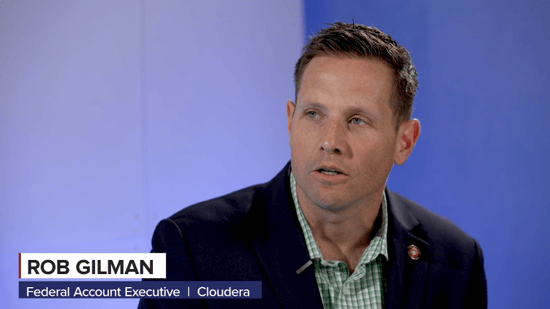 Gilman set the stage by explaining why the Department of War's cybersecurity challenge is unlike any other regulated industry. It's not just personally identifiable information at stake — it's classified, top-secret, intelligence-grade data. That reality demands a zero trust architecture built to the highest standards, governed by frameworks including FedRAMP and FIPS compliance, and now augmented by artificial intelligence.
Historically, cybersecurity data — ICAM logs, network telemetry, threat indicators — was collected into large repositories like SIEMs, where human analysts would manually sift through it, sometimes taking hours or days to identify a threat. That timeline is no longer acceptable. AI is changing the equation by parsing that data in real time, filtering out noise, surfacing genuine anomalies, and — through AI agents — acting on threats the moment they're detected. The shift, Gilman explained, is from identification to autonomous response.
The more complex challenge lies at the tactical edge. As the department pushes capabilities forward to give war fighters access to the data they need wherever they are, the same adversaries those war fighters are facing are actively attempting to breach those forward-deployed systems. Gilman argued that the zero trust philosophies governing enterprise environments must follow the mission into the field — C4IT tactical edge solutions need to apply the same rules, the same guidelines, and the same protective architecture as their stateside counterparts. He closed by highlighting the Department of War's mandatory generative AI training for all service members as a promising model for preparing the force — and called for continued collaboration between the best minds in government and the best capabilities in industry.
Key Takeaways:
- AI agents are shifting cybersecurity from reactive analysis to autonomous real-time threat response — dramatically compressing the detection-to-action timeline.
- Zero trust architecture must extend to tactical edge environments; the adversary doesn't stop trying to breach systems just because they're forward-deployed.
- Mandatory generative AI training across the force, paired with deep government-industry collaboration, is essential to keeping pace with an adversary that is also rapidly adopting AI.