Presented by Oracle
Federal agencies are moving beyond isolated artificial intelligence experiments and toward enterprise approaches that can scale AI securely, responsibly and repeatedly across the mission. AI Factories: In Depth, sponsored by Oracle, explores how government and industry leaders are building the infrastructure, data foundations, governance models and organizational cultures necessary to turn AI from a collection of individual use cases into a sustainable enterprise capability. Leaders from the Department of Transportation, Department of the Air Force and Oracle examine what an AI factory looks like in practice—and how agencies can use the model to accelerate mission outcomes while maintaining trust, accountability and control.
Building the Foundation for AI at Enterprise Scale
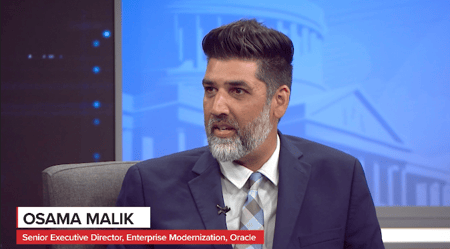
The promise of artificial intelligence across government is substantial, but realizing that promise requires agencies to think beyond individual applications. Pavan Pidugu, Chief Information Officer at the Department of Transportation, and Osama Malik, Senior Executive Director for Enterprise Modernization at Oracle, explain why the AI factory model starts with creating a repeatable enterprise foundation rather than simply pursuing the latest AI technology.
 Pidugu says DOT is deliberately avoiding an environment filled with redundant AI platforms and disconnected solutions. Instead, the department is developing a common framework that can support AI across multiple missions and use cases. A critical part of that effort is data. Agencies need clean, reliable and well-governed data before AI can consistently produce trustworthy results.
DOT is also emphasizing governance around both data and AI use cases. Understanding how information is created and modified, who is responsible for it, and why changes are made helps establish a reliable source of truth. AI itself must also be governed so agencies can reduce problems such as hallucinations and ensure responsible use.
That foundation changes how agencies select AI projects. Rather than implementing AI because the technology is new or compelling, Pidugu argues agencies should begin with a meaningful operational problem and determine whether AI is the appropriate tool to solve it. The objective is mission efficiency—not technology for technology's sake.
Malik compares the AI factory concept to a traditional manufacturing environment. A factory invests heavily in its underlying facility, equipment and processes so that the first product and the ten-thousandth product can be produced with consistent quality. AI factories apply the same discipline to technology. Common infrastructure, governance, security and quality controls create an environment where agencies can repeatedly develop and scale solutions without reconstructing the foundation for every new project.
But Malik cautions that agencies need both foundation and execution. Building infrastructure without demonstrating useful outcomes can cause mission stakeholders to lose interest. Moving immediately into AI use cases without the supporting foundation can create promises that cannot be sustained. The two must advance together.
Pidugu adds that the factory model allows teams to reuse the portions of a process that are common across many projects and concentrate their effort on the elements unique to a particular mission problem. As that model matures, agencies can accelerate development while increasing consistency.
 Technology alone, however, will not create an AI factory. Culture and leadership support are equally important. AI may change processes employees have used for years, requiring organizations to rethink established ways of working. Successful transformation therefore requires commitment from senior leadership and participation throughout the workforce.
Looking ahead, Malik sees governance tools and enterprise marketplaces becoming increasingly important. Agencies could discover existing AI capabilities, templates and trusted components rather than beginning every project from scratch. Pidugu also sees AI accelerating technology delivery itself, including using AI to dramatically shorten traditional software development timelines.
Together, their perspectives illustrate an AI factory as more than a technology platform. It is an enterprise operating model designed to make AI faster to deploy, easier to govern and more repeatable across the mission.
Key Takeaways
- Build the foundation before chasing individual AI solutions. Common infrastructure, trusted data and strong governance allow agencies to scale AI consistently across the enterprise.
- Start with the mission problem. AI should be applied where it creates measurable efficiency or mission value rather than implemented simply because the technology is available.
- Create repeatability without ignoring culture. AI factories can reuse common processes and accelerate development, but leadership support and workforce adoption are essential to making the model work.
Turning an AI-First Strategy Into Mission Execution
For the Department of the Air Force, becoming an AI-first organization means moving artificial intelligence into every major mission area while building an enterprise structure capable of managing that expansion. Susan Davenport, Chief Data and AI Officer for the Department of the Air Force, and Osama Malik, Senior Executive Director for Enterprise Modernization at Oracle, explore how strategy, domain ownership, data accountability and governance can transform AI from experimentation into operational capability.
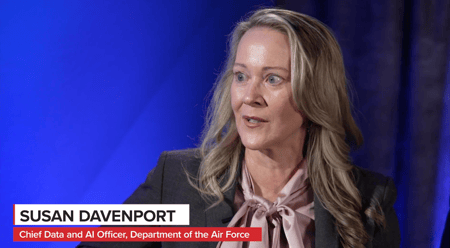 Davenport explains that AI-first is a central principle of the Department of the Air Force's AI strategy, which focuses on accelerating AI across missions in both the Air Force and Space Force. But the strategy does more than establish a broad direction. An accompanying addendum identifies “north stars” for individual mission areas, giving organizations specific outcomes to pursue.
To operationalize the strategy, the department established domains with leaders responsible for advancing AI within those areas. Quarterly showcases bring those domains together to examine progress, identify gaps and overlaps, assess risk and uncover opportunities for collaboration.
That structure is already producing benefits beyond individual domains. Davenport says the department began identifying cross-domain opportunities during its first showcase—areas where work taking place in separate missions could potentially inform or accelerate other parts of the enterprise.
Malik sees that as an important advantage of an AI factory. While individual domains develop specialized expertise and mission-specific capabilities, enterprise infrastructure makes it possible to identify reusable AI patterns. An agent or capability created for one type of unstructured data, for example, could potentially be adapted across several different domains with relatively little additional work.
A foundational organization capable of seeing across those boundaries becomes increasingly important as AI activity expands. Davenport notes that individual mission areas may not recognize common opportunities while focused on their own execution. Enterprise visibility helps identify those connections and accelerate adoption.
Data ownership is another central component. Davenport says an organization with approximately 750,000 people cannot execute an enterprise AI strategy from a single central office. Mission owners must have responsibility for outcomes and for the data supporting them.
The department's data strategy supports decentralized data management and treats data as a product. General officers and Senior Executive Service leaders are being placed over domains and held accountable for data availability, quality and usability. That ownership creates an incentive to produce data that other users—and increasingly AI systems—can confidently consume.
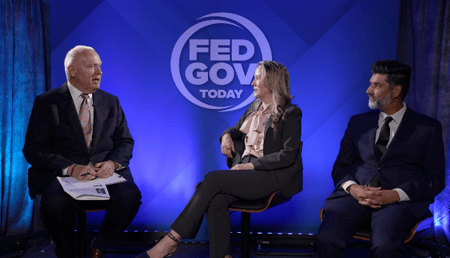 Malik says this product mentality is powerful because a product is never truly finished. Owners must continue asking what users need, gathering feedback and improving what they deliver. That creates the feedback loops required as organizations learn where AI provides the greatest value and how it can be deployed efficiently at scale.
Responsible AI is being addressed through what Davenport describes as centralized guardrails and decentralized execution. Enterprise organizations establish policies, standards and boundaries while mission organizations retain the ability to execute inside them. The next step is increasingly automating those guardrails so organizations can maintain responsible controls without sacrificing speed.
Ultimately, Davenport defines success in mission terms rather than technological sophistication: trusted data reaching humans and machines at the speed of relevance, AI producing measurable mission outcomes, and the Department of the Air Force developing the workforce required to sustain those capabilities.
Key Takeaways
- Translate enterprise AI strategy into mission ownership. Domains, mission-specific north stars and accountable leaders give organizations a structure for turning AI-first principles into execution.
- Treat data as a product. Clearly defined ownership for data quality, availability and usability creates the trusted foundation AI systems require.
- Centralize guardrails while decentralizing execution. Enterprise standards can provide responsible AI boundaries while allowing mission organizations to innovate and move quickly.