Presented by Carahsoft
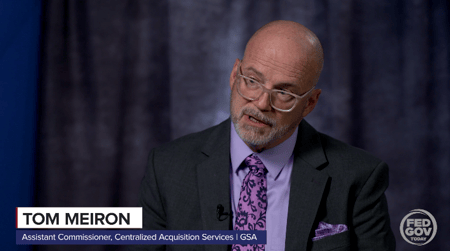
Federal acquisition is often described in terms of process, compliance and contract vehicles. But in this Innovation in Government segment from the GovExperience Summit, Tom Meiron, Assistant Commissioner for the Office of Centralized Acquisition Services in the Federal Acquisition Service at GSA, frames acquisition modernization as a mission enabler.
Meiron explains that OCAS is still a relatively new organization. It was created to support federal procurement consolidation priorities, with a focus on reducing duplication and achieving cost savings. The mission has two related parts: consolidation and centralization. Consolidation means working with agencies to examine where requirements can be realigned, combined or supported through better acquisition pathways. Centralization means moving certain common acquisition needs to GSA so agencies do not have to manage all of that work themselves.
The distinction matters because agencies are under constant pressure to deliver mission outcomes while also handling the administrative burden that comes with acquisition. Meiron says OCAS is focused on common goods and services, an area where agencies often have similar needs and where significant labor is attached to procurement work. By shifting that work to GSA, agencies can focus more of their internal capacity on highly complex, mission-specific requirements.
That model also has implications for industry. Meiron acknowledges a long-standing frustration among vendors: doing business with one agency can look very different from doing business with another. Each agency may have different stakeholders, requirements, templates, timelines and forms. For companies trying to support multiple federal customers, that creates friction and uncertainty.
By consolidating common goods and services through one organization, GSA can help create more standardization. That includes standard templates, standard processes and a smaller group of acquisition professionals for industry to work with. Meiron also points to industry days and pipeline reviews as ways OCAS is engaging with vendors earlier and more openly. Industry has deep relationships with agencies, and Meiron says GSA cannot build this model in a vacuum.
 For agencies, the challenge is trust. Meiron notes that agencies are understandably protective of their acquisition work. Their contracts support mission priorities, and giving up direct control can create apprehension. OCAS has to prove that it can fill a gap that previously existed in GSA’s acquisition support. Historically, agencies could turn to GSA for large, complex assisted acquisitions or use multiple award schedules for self-service needs. But there was a middle area of smaller, less complex acquisitions where agencies needed more support than the self-service model provided.
Meiron says OCAS is designed to fill that space. Early work with agencies such as the Small Business Administration and the Office of Personnel Management helped demonstrate the model. Since then, GSA has expanded support to additional agencies and components, including pilot efforts and broader portfolio support. Meiron says OCAS is now providing direct acquisition portfolio support to 36 agencies or components and managing roughly 1,000 contracts.
The long-term value of that portfolio is not just volume. As OCAS supports more contracts across more agencies, GSA can aggregate spending and develop a broader view of federal requirements. That can help identify where new or improved acquisition vehicles are needed, where cost savings may be possible and where timelines can be improved.
The segment shows that acquisition modernization is not only a back-office reform. It affects how agencies allocate workforce capacity, how industry engages with government and how quickly common needs can be met. If OCAS succeeds, agencies can spend less time duplicating routine acquisition work and more time focusing on the mission requirements that only they can define.
Key Takeaways
- OCAS is helping agencies centralize common goods and services acquisition.
- Standardization can make federal acquisition easier for both agencies and industry.
- Building trust with agencies is essential to shifting acquisition work into a shared support model.