Building Better Government Experiences Through Data, Trust, AI and Service Delivery
Presented by Carahsoft
Government agencies are under pressure to deliver services that are easier to access, faster to complete, more secure and more responsive to the people they serve. This episode of Innovation in Government, recorded at the GovExperience Summit, explores how federal, state and industry leaders are approaching that challenge through acquisition modernization, communications, data governance, artificial intelligence, trusted security practices, collaboration platforms and accessible digital service delivery.
Across the program, the core message is clear: better government experience is not just about adding new technology. It requires strong data foundations, clear governance, workforce readiness, trusted security, front-line empowerment and a deeper understanding of the people who rely on government services. Guests discuss everything from GSA’s centralized acquisition work and Maryland’s One App to NIST’s AI security guidance, the future of AI agents, proactive constituent communications, and the role of accessibility in building public trust.
Centralizing Acquisition to Help Agencies Focus on Mission
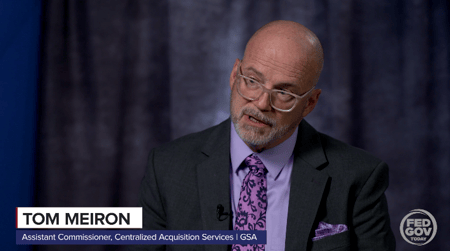 Tom Meiron, Assistant Commissioner for the Office of Centralized Acquisition Services in the Federal Acquisition Service at GSA, explains how OCAS is helping agencies manage common goods and services acquisition more efficiently. Meiron describes OCAS as a relatively new organization, created in response to federal procurement consolidation priorities, with a mission focused on both consolidation and centralization. The goal is to help agencies reduce duplication, achieve cost savings and shift more routine acquisition work to GSA so agency teams can spend more time on complex requirements that directly advance their missions.
A major theme of the conversation is standardization. Meiron notes that industry has long faced the challenge of working with different agencies that each have their own stakeholders, requirements, forms, templates and timelines. By consolidating common goods and services in one place, GSA can reduce complexity for vendors and give industry a longer-range view of upcoming requirements. That benefits agencies as well, because it creates greater transparency across the acquisition portfolio.
Meiron also discusses the trust-building required to move agencies toward a more centralized model. Agencies have good reason to be protective of their acquisition work, especially when it supports unique mission needs. OCAS has to demonstrate value by filling the gap between large, complex assisted acquisition work and self-service schedules. Meiron says agencies are beginning to rely on OCAS because it is now staffed and organized to support those middle-ground acquisitions. He also notes that OCAS is supporting 36 agencies or components and managing roughly 1,000 contracts as it continues to grow its portfolio.
Key Takeaways
- OCAS is focused on consolidating and centralizing common goods and services acquisition so agencies can concentrate on mission-specific work.
- Standardized processes, templates and acquisition pathways can make it easier for industry to work with government.
- Trust is essential as agencies shift from decentralized acquisition models toward shared support from GSA.
Communications as the Backbone of Customer Experience
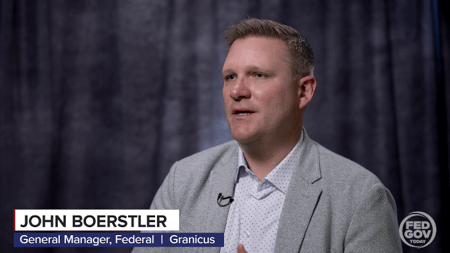 John Boerstler, General Manager of Federal at Granicus and former Chief Veterans Experience Officer at VA, makes the case that communications are essential to customer experience, user experience and employee experience. Boerstler explains that government agencies cannot deliver a world-class customer experience without also investing in the employee experience, because communications are woven through every service delivery journey. He says communications help educate citizens about benefits and services, manage expectations and provide updates at key milestones.
Boerstler draws on his VA experience to show how communications can directly affect outcomes. He describes VA’s weekly outreach to millions of veterans and the role of communications in supporting implementation of the PACT Act. Working with Granicus, VA built campaigns to reach unenrolled veterans who may have been newly eligible for health care and benefits. As data came in, the campaign could be adjusted based on what was working with different audiences. Boerstler says that from 2022 to 2024, VA enrolled 3 million of the 5 million veterans it was targeting, showing how communications can become part of service delivery rather than simply promotion.
The segment also connects CX to fraud and scam prevention. Boerstler describes the V-SAFE initiative, created to help veterans identify and report scams without having to understand which enforcement agency had jurisdiction. His point is that good service design should not force citizens to navigate government complexity on their own. Whether helping someone apply for benefits, understand a health care journey or report a scam, agencies should provide clear front doors, proactive information and routing that works behind the scenes.
Key Takeaways
- Communications are not separate from CX; they are part of the service delivery journey.
- Data-informed outreach can help agencies reach eligible populations and improve outcomes.
- Fraud prevention is a CX issue because citizens should not have to navigate enforcement complexity alone.
Preparing Agencies for AI with Better Data and Governance
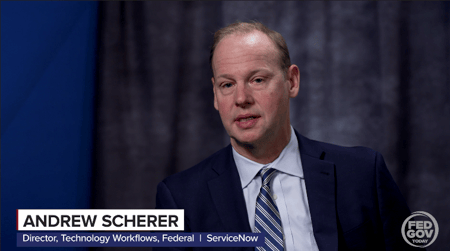 Andrew Scherer, Director, Technology Workflows - Federal at ServiceNow, focuses on the foundational work agencies need before they can get full value from AI. Scherer says AI can help break down organizational silos and support cross-agency collaboration, but only if agencies first address the data and governance requirements that make AI useful and safe. In his view, agencies sometimes rush toward AI deployment before they have built the foundations needed for successful adoption.
The first foundation is data. Scherer argues that AI depends on complete, high-quality data across the enterprise. He says agencies need visibility not just into IT data, but procurement, HR and other mission and business systems. He also notes that organizations often rely on hundreds of third-party applications, each with its own source of truth, and that AI solutions will be limited if they cannot draw on the full data ecosystem. The risk is clear: incomplete data can lead AI agents to make poor decisions quickly.
The second foundation is governance. Scherer says no executive will allow AI agents to move freely across a network without rules, visibility and the ability to intervene. Agencies need a way to see what agents are doing in real time, control individual agents, manage third-party agents and stop activity that does not align with policy or mission. He describes this as an AI control tower concept: a centralized view of agents, data and actions. The segment positions AI not as a plug-and-play solution, but as a capability that depends on enterprise readiness.
Key Takeaways
- AI can help agencies break down silos, but only if the underlying data is complete and usable.
- Agencies need visibility across enterprise and third-party systems to support effective AI.
- Governance, control and real-time oversight are essential for agentic AI adoption.
Building Trustworthy AI Through Standards, Security and Workforce Readiness
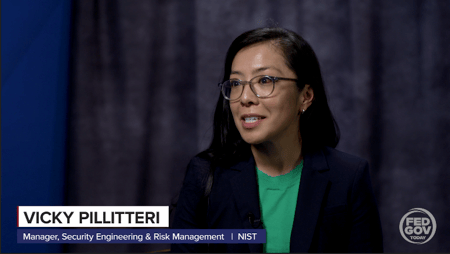 Vicky Pillitteri, Manager of the Security Engineering and Risk Management Group at NIST, explains how NIST supports trusted technology adoption through standards, guidelines, best practices and security outcomes. She describes NIST’s role as providing a “Rosetta Stone” for good security practices that can translate across IT systems, including AI systems. That shared language is important for federal agencies, industry and international partners working to manage technology risk.
Pillitteri emphasizes that trusted AI is not only a technical question. It also requires a people strategy. Agencies need to leverage the workforce they have, retrain employees to use AI tools effectively and help people move into higher-value work. In that sense, AI adoption is connected to workforce development and culture. The goal is not simply to insert AI into agency operations, but to help public servants use these tools to deliver more for the people they serve.
Data security is another major theme. Pillitteri says data is essential to training AI models and producing useful, reliable outputs, but that data must be protected throughout the AI lifecycle. NIST is developing resources for different types of users and organizations, including security controls for predictive AI, generative AI and agentic AI, as well as resources for AI software developers. She also notes the challenge of building guidance while AI is evolving rapidly. Good security outcomes may remain consistent, but implementation examples and communication approaches will continue to change. Agencies also need to recognize that AI can be embedded in products that are not marketed primarily as AI tools, creating new risk management questions.
Key Takeaways
- NIST helps agencies and industry use common security outcomes and practices across IT and AI systems.
- Trusted AI depends on workforce readiness as much as technical controls.
- AI security requires lifecycle thinking, especially as AI becomes embedded in more tools and systems.
Balancing Security, Usability and Modernization
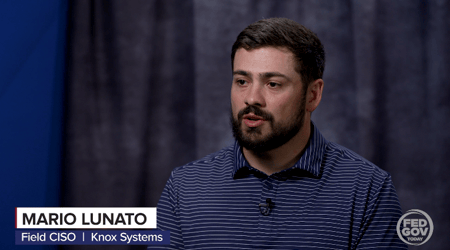 Mario Lunato, Field CISO at Knox Systems, discusses the tension between cybersecurity and usability. He says organizations often struggle to design products that are both secure and easy for people to use. If security is ignored, data protection and trust are at risk. But if security controls are too burdensome, users may work around them, which weakens the overall security posture.
Lunato argues that security and usability should be designed together from the beginning. He points to DevSecOps as an example of bringing development, operations and security closer together, but says user experience and design should also be part of that process. UX professionals, security teams and developers need to work together before products are shipped so that security supports the user experience rather than undermining it.
The segment also connects modernization, AI and public trust. Lunato says AI and automation can speed up usability and efficiency, but users must feel confident that the products they rely on are secure. A breach of trust can damage public confidence and an organization’s reputation. One way to reduce friction is to rely on cloud-native services and inherited security controls that allow developers to build on secure foundations rather than reinvent every control at the user level. Lunato also advocates automating compliance. Instead of treating compliance as a point-in-time checkbox exercise, organizations can automate security checks and preserve evidence that systems were secure at specific moments. That allows developers to move faster while maintaining confidence that products remain compliant and secure.
Key Takeaways
- Security controls that are too hard to use may encourage workarounds and weaken protection.
- UX, security and development teams should collaborate early in the product lifecycle.
- Automated compliance can help organizations modernize faster while maintaining security and trust.
Using Unified Data and AI to Move From Reactive to Proactive Service
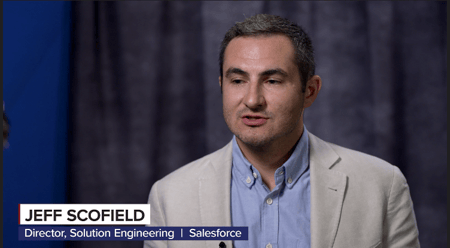 Jeff Scofield, Director of Solution Engineering at Salesforce, discusses how unified data can help agencies create more seamless service experiences. He explains that agencies need to understand the people they serve, connect the different systems those people interact with and stitch together profiles and identities so the experience feels consistent across departments or programs. Unified, accessible and actionable data is central to that goal.
Scofield says AI can help agencies turn large volumes of data into answers public servants can use. As data grows wider, deeper and more complex, agencies need the ability to ask questions of that data and get responses that help them take action. But the bigger change is not just analytical; it is a shift from reactive to proactive communication. In many government journeys, such as applying for a grant, qualifying for benefits or pursuing a government job, the intake may be straightforward, but the middle of the process can involve waiting, uncertainty and many actions. Scofield says agencies can use data and AI to personalize communications before citizens have to ask for updates.
He also discusses the role of AI agents in government experience. Natural language tools can answer questions, triage needs and resolve issues, but Scofield stresses the importance of keeping humans in the loop. AI should help route people to the right support at the right time and allow public servants to focus on more strategic work. The segment frames AI as a way to unlock the service vision many agencies already have: experiences that are more personal, timely, consistent and connected.
Key Takeaways
- Unified data can help agencies make service delivery feel consistent across programs and systems.
- AI can support proactive communication during complex service journeys.
- Human oversight remains essential as agencies use AI to answer questions, triage needs and resolve issues.
Applying Data Once to Deliver Multiple Benefits
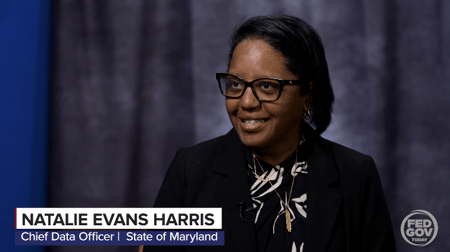 Natalie Evans Harris, Chief Data Officer for the State of Maryland, explains how the democratization of data is changing. Rather than treating data modernization as a push to centralize all data in one place, she says agencies should focus on understanding the data landscape, knowing where data lives and making the right data accessible for the right purpose. AI and other emerging technologies make that awareness even more important, because those tools depend on quality data to answer the questions agencies need answered.
Evans Harris emphasizes that public sector data is collected for a purpose. Government agencies collect data to deliver benefits, comply with statutes and serve constituents, not simply to market to them. That distinction matters because government must protect personal information while still making services easier to access. She describes the ideal as “apply once” or “access once,” where the constituent does not have to understand which agency needs which data. Instead, the back end should handle the routing and reuse of data in ways that are efficient, authorized and protective.
Maryland’s One App is the central example. Evans Harris says the state launched a single application that allows people to apply for multiple benefits in one place, rather than submitting separate applications for programs like SNAP, education grants or other benefits. By recognizing similarities in eligibility processes and data needs, the state could collect information once and use it to activate multiple processes. That saves time for constituents and improves business process efficiency for the state. Evans Harris also connects AI adoption to data quality and workforce development. Agencies need trustworthy data, strong governance, proper tagging and training that helps employees understand what to question when using data and AI.
Key Takeaways
- Data democratization is increasingly about awareness, accessibility and connection, not only centralization.
- Government data should be used in ways that match the purpose for which it was collected.
- Maryland’s One App shows how collecting data once can improve service access and process efficiency.
Bringing AI Agents Into the Government Workforce
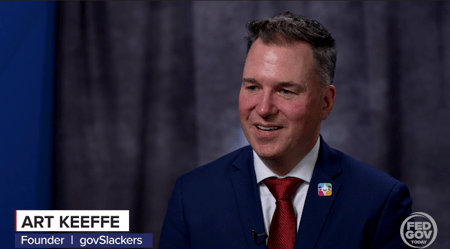 Art Keeffe, Founder of govSlackers, discusses how collaboration tools can help government move from consolidating data to consolidating expertise. He explains that govSlackers implements Slack for government and that the company’s name reflects the enthusiasm of government users who adopt the platform.
Keeffe says much of the current AI conversation focuses on foundational data work, including the consolidation of siloed data into data lakes. That work matters, but the next step is bringing together the expertise of government employees. He argues that data itself does not serve veterans or health care users. People do. That means AI should work alongside public servants rather than replace them. Collaboration tools can bring people, processes, tools and expertise together in one environment where agents can support the workforce.
The segment also looks ahead to the management of AI agents. Keeffe says organizations will likely use multiple agent tools from multiple providers, which creates the need for a common place to manage them. He describes collaboration platforms as natural integration points where agents can sit alongside employees. But he also stresses the importance of guardrails. Agencies need to define how agents are used, what data they can access and which repeatable tasks they should support. He points to low-hanging fruit such as personal assistants and employee onboarding, where agents can reduce the burden of repetitive work and allow government experts to focus on higher-value responsibilities.
Key Takeaways
- The next phase of AI adoption is not only consolidating data, but connecting expertise.
- AI agents should work alongside government employees and support repeatable tasks.
- Guardrails are needed to define agent use, data access and role boundaries.
Designing the Future of Accessible Government Interactions
 Chris O’Rourke, Customer Experience Executive and Account Executive at Zoom, describes a future government service experience that moves from disconnected contact channels toward “conversation to completion.” He says today many interactions still rely on phone calls, web forms, mail or in-person visits. Those channels matter, but they are not always designed around the full constituent journey from first contact to resolution.
O’Rourke emphasizes that trust must come first. Government interactions need to protect information, use zero trust architecture and support secure delivery of AI, chat and other digital services. Accessibility is central to that vision. He discusses 508 compliance, closed captioning, sign language translation and support for people who speak languages other than English. In his view, accessible service delivery means meeting constituents where they are, regardless of disability, language or comfort with digital tools.
He gives an example of a service journey that starts with AI chat, escalates to a live agent, moves to a phone call if needed and then shifts to video support for someone who needs help navigating a website. If the issue cannot be resolved immediately, the agency should clearly provide action items, ownership, expectations and contact information. O’Rourke also describes how real-time sentiment analysis could improve contact center operations. Instead of relying only on post-call surveys, agencies could use real-time analysis to understand whether an interaction is positive or negative, support agents during difficult conversations and identify common points of confusion.
Key Takeaways
- The future of government CX should move from isolated contact channels to full “conversation to completion.”
- Accessibility, security and trust must be designed into digital service delivery.
- Real-time sentiment analysis can help agencies improve service quality during and after interactions.