

Industry Insights from the Google Public Sector Summit
Presented by Carahsoft
Government AI adoption depends on the systems and decisions surrounding the models. In conversations with Fed Gov Today at the Google Public Sector Summit, nine industry leaders examined how agencies can use existing information, establish effective controls, and connect technology investments to mission results. Their perspectives span legacy records, application development, workforce needs, and the security requirements of autonomous software. Together, the interviews offer a practical view of the work involved in making AI useful across government.
Using AI to Unlock the Value of Legacy Government Records
 Alex Adamczyk, Vice President, Sales Engineering & Rapid Prototyping at LMI, sees an opportunity in government records that have been retained for decades but remain difficult to use. Advances in AI image analysis are making maps, engineering drawings, and other unstructured documents more accessible.
At the Google Public Sector Summit, Adamczyk described a customer using AI to identify critical minerals in equipment headed for disposal. Engineering drawings already contained information about the materials in those systems. Reviewing the drawings manually at scale had been too expensive. AI analysis could help identify recoverable components before they entered the scrap stream.
The example shows how a change in processing cost can make an established mission opportunity practical. Agencies can begin by identifying an operational question and examining whether their existing records contain the answer.
Adamczyk also emphasized the work required to introduce emerging technologies into federal and classified environments. He described adapting familiar cybersecurity controls to agent connections and explaining those controls to government customers as review practices evolve.
His central message was that useful AI applications can emerge from information agencies already own. Realizing that value requires both a clear mission use case and the federal security expertise to put the capability into operation.
Turning Government AI Policies Into Enforceable Controls
 John Dvorak, CTO, Public Sector at Red Hat, argued that AI agents need enforceable controls tied to the policies governing their work. Rules written for employees do not automatically become effective restrictions on software that can take action autonomously.
At the Google Public Sector Summit, Dvorak emphasized placing guardrails outside the agent. Training a model on policy cannot replace technical limits on what it may access or do. Agencies need a traceable relationship between those limits and the written requirements behind them.
He discussed asago, an open source initiative involving Red Hat and other participants, as an effort to connect policy translation, control testing, and observation of deployed agents. That work aims to make governance usable across different tools and environments.
Dvorak also connected agent security with unfinished data management work. Agencies may still have unresolved questions about where information resides and who should be able to access it. Agents can discover and expose those weaknesses faster than traditional workflows.
His message was that governance requires implementation. Agencies must translate expectations into boundaries they can enforce, test, and monitor. Reviewing data access alongside agent deployment helps establish whether autonomous activity remains within the authority the organization intended to provide in the first place.
Modernizing Compliance Workflows for Government AI
 Johann Dettweiler, Chief Information Security Officer at stackArmor, a Quantum Sky Company, urged agencies to modernize the processes surrounding AI adoption. Introducing new technology into an unchanged approval workflow can limit the value of automation.
At the Google Public Sector Summit, Dettweiler questioned whether every human review step provides meaningful oversight. An overworked employee cannot realistically evaluate an enormous AI-generated report simply because the process requires an approval.
He encouraged agencies to identify the points where human judgment affects a decision and concentrate oversight there. Compliance work provides a practical example. AI can help collect telemetry, correlate findings, and assemble evidence that security professionals otherwise gather manually.
That changes how employees spend their time. Instead of taking screenshots to document controls, they can assess the evidence, evaluate risk, and decide what requires action. They may also have more opportunity to recognize patterns across multiple systems.
Dettweiler emphasized those security benefits even as he acknowledged potential financial savings. The goal is to make better use of an experienced technical workforce.
His message was to examine the full workflow when adopting AI. Effective oversight requires a clear decision, manageable evidence, and enough time for the responsible person to apply judgment to the organization’s actual risk.
Building Mission AI for Everyday Users and the Tactical Edge
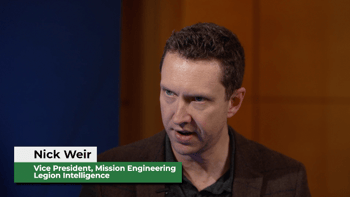 Nick Weir, Vice President, Mission Engineering at Legion Intelligence, said agencies should design AI applications for the users and operating conditions they actually have. Employees should be able to benefit without becoming experts in prompting.
At the Google Public Sector Summit, Weir emphasized familiar interfaces and workflows. AI might appear as a chatbot, but it can also work behind the scenes, helping triage reports or identify information that needs attention.
He also advocated evaluating systems that use data where it already resides. Although some workloads justify centralization, a major consolidation effort can delay the point when an agency learns whether an application delivers value. Working with existing sources can support faster experimentation while preserving other users’ access.
For disconnected and resource-constrained settings, Weir said model selection should reflect the actual task. Smaller models can help operators reduce specific manual or cognitive burdens at the tactical edge. More powerful models can support higher-level analysis when infrastructure and connectivity allow.
His message was that useful AI depends on operational fit. Interface design, data access, and computing requirements all shape whether the system helps someone accomplish the mission. Agencies can expand adoption by making those choices around the employee’s work and the environment in which it occurs.
Protecting Government Data With Cryptographic Agility
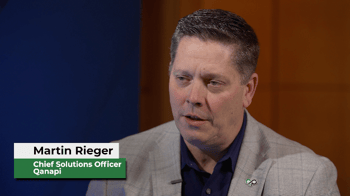 Martin Rieger, Chief Solutions Officer at Qanapi, emphasized the importance of cryptographic agility for government information that must remain protected as technology changes. Agencies need ways to update encryption without rebuilding every system around a single approach.
At the Google Public Sector Summit, Rieger connected that need to concerns about information being collected now for possible decryption in the future. His discussion focused on protecting data as it moves across applications, services, and organizational boundaries.
AI creates additional questions about what information a system should be allowed to see. Rieger described trust as involving the data, the person using it, and the AI processing it. Agencies need to consider each part when evaluating sensitive workflows.
He also discussed Qanapi Flow for Google Workspace. The capabilities he described included client-side encryption and controlled sharing that allows recipients to view different information within the same document. Those tools are intended to make secure collaboration more practical for government and its partners.
Rieger’s message connected long-term security planning with daily work. Agencies need adaptable protections and tools employees can use effectively. Applying controls at the data layer can help maintain restrictions as information moves while supporting future changes to the cryptographic protections around it.
Making Government AI Investments Accountable for Results
 Erin Hawley, Chief Revenue Officer at Red Cell Partners, urged agencies to connect AI spending with measurable operational results. Her starting point is a specific job that consumes time or money and can be improved within a manageable scope.
At the Google Public Sector Summit, Hawley described an outcome-based, shared savings approach under an agreement with a $100 million ceiling. She emphasized that the ceiling was not an amount charged to any single agency. In the model she outlined, the vendor seeks a share of savings after demonstrating the outcome.
Hawley identified manual processes, cost overruns, and budget management as potential areas to examine. She also stressed the need to account for integration, governance, and security monitoring when evaluating an AI initiative.
For implementation, she advocated leaving data where it already resides and giving agents clearly defined responsibilities. Her analogy was onboarding an employee: assign tasks, establish expectations, and monitor performance. Human oversight remains part of the process.
The discussion framed AI adoption as an operational and acquisition decision. Agencies need a use case with understandable value, a shared definition of success, and the workflow discipline to determine whether the technology actually delivers the expected benefit to the mission.
Securing AI Agents Through Identity and Workflow Controls
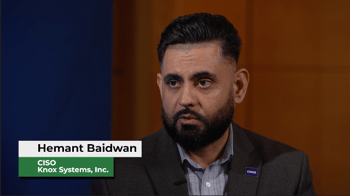 Hemant Baidwan, CISO at Knox Systems, identified agent identity as a growing cybersecurity challenge. When software acts using an employee’s credentials, agencies need a reliable way to distinguish the person’s actions from those of the agent.
At the Google Public Sector Summit, Baidwan explained that agents can work across environments and perform actions beyond the familiar scope of a service account. He encouraged CIOs and CISOs to examine whether their identity practices and monitoring provide sufficient visibility into that behavior.
Defining the workflow comes first. Agencies should establish the agent’s responsibilities and guardrails before deployment, giving security teams a clear basis for evaluating its actions.
Baidwan also described AI as a force multiplier for the workforce. Drawing on his government experience, he discussed analyzing large information volumes and supporting policy and procurement work. In cybersecurity operations, AI can help analysts sort through alerts and identify meaningful threats.
That defensive need grows as adversaries use AI to connect vulnerabilities and misconfigurations into attack paths. Baidwan also discussed Knox’s landing zone partnership with Palantir FedStart as an approach to secure technology adoption.
His central point was that speed and visibility must advance together. Agencies need to understand who or what is acting and how that activity supports the intended mission.
Modernizing Government Data Systems Without Disrupting the Mission
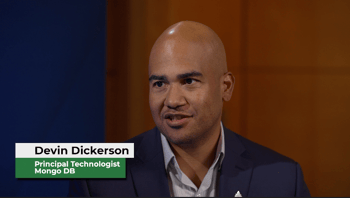 Devin Dickerson, Principal Technologist at MongoDB, described government modernization as work that must happen without interrupting the mission already underway. The biggest obstacles, he said, often appear where systems, teams, and operating environments meet.
Drawing on his experience integrating a military electronic health record, Dickerson explained that individual components could work well while the handoffs between them created difficulty. He encouraged agencies to evaluate platforms that absorb common complexity and let developers focus on mission applications.
The same principle applies to data. Dickerson discussed how aligning stored information with the structures developers use can reduce transformation work and simplify application development.
For AI agents, he said the focus has shifted toward measurable mission value. An agency’s unique information is often its most important contribution to an AI application. Connecting that information to agents also requires decisions about security, governance, and the tools an agent can use.
Dickerson emphasized deployment choices across cloud, on premises, and disconnected settings. Agencies need approaches that account for those operational differences while supporting a broader modernization effort.
His message was to examine the complete system. Reducing friction between components can matter as much as improving any individual piece of technology, particularly when existing services must continue operating.
Preparing Government Data for More Effective AI
 Dan Kinney, EVP, Field CTO at Lightning IQ, emphasized that effective AI depends on selecting information suited to the task. Giving a system an entire data estate can introduce duplicate records, outdated material, and sensitive information that does not belong in the workflow.
At the Google Public Sector Summit, Kinney used a maintenance example to explain the distinction. An initiative focused on recent repairs might need five years of records for a particular vehicle model. Adding decades of unrelated information can increase processing without improving the result.
He encouraged agencies to evaluate their holdings by relevance, date, and sensitivity before expanding AI use. Identifying personally identifiable information is part of that preparation, with the organization deciding whether to include, flag, or exclude particular records.
Kinney also discussed Lightning Recall, introduced at the summit for organizations managing Google Workspace archived-user data. He said it supports exporting that information to Google Cloud storage while retaining search access for legal and compliance purposes.
Both topics point to the same operational need: agencies must be able to find and evaluate the information they retain. Better visibility into that information can support AI readiness, more useful search, and informed decisions about retention and processing costs.