Original Broadcast Date: 09/20/2026
Sponsored by Carahsoft
Artificial intelligence is accelerating the cyber threat landscape, and Mike McCalip says federal agencies cannot afford to wait for threats to materialize before responding.
“A lot of our cyber today is done in a reactive or passive manner,” says McCalip, vice president of Government Programs and Strategy at Carahsoft. “We’ve got to get to a point where we’re being proactive.”
Speaking with Fed Gov Today at the Billington Cybersecurity Summit, McCalip outlines what that shift requires. His focus spans three areas: building the cyber workforce, keeping pace with rapidly evolving technology and using AI to turn growing volumes of information into better decisions.
“If you’re reacting to something, it’s too late,” McCalip says.
Getting ahead of cyber threats
Moving from reactive to proactive cybersecurity requires agencies to identify threats earlier.
McCalip says organizations need to work farther upstream in the cyber kill chain and intelligence pipeline. The objective is to recognize and address potential threats before agencies find themselves responding to an incident.
But technology is only part of the equation.
McCalip identifies workforce development as one of the most important steps government can take to strengthen its cyber posture. He says the federal government needs to invest in cyber training and education pipelines that prepare the next generation of cybersecurity professionals.
“We’ve really got to make some investments at the federal level,” McCalip says.
The challenge extends to the existing workforce. Technology is advancing quickly, and McCalip says agencies and their employees need to keep pace even as government staffs become smaller.
That creates a fundamental question for government: How does it keep its workforce relevant as technology and threats continue to evolve?
McCalip sees partnerships with industry as an important part of the answer. Bringing emerging technologies to government and helping agencies navigate their adoption can give federal organizations new tools to stay ahead of cyber threats.
AI raises the stakes
Artificial intelligence makes that need for speed even more important.
McCalip says U.S. adversaries are moving quickly with emerging technology. He expresses concern that overly restrictive AI policy could slow American innovation while countries such as China and Russia continue to advance their capabilities.
He argues that industry, scientists and technical experts need the opportunity to develop technologies that can support federal agencies and the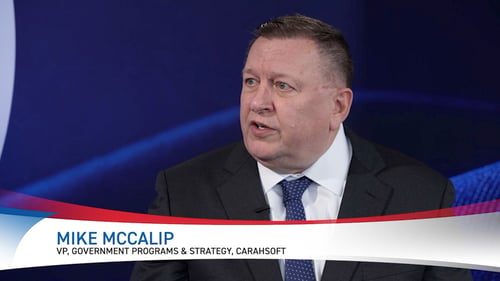 warfighter.
For government, that creates a challenge: addressing the risks surrounding AI without preventing agencies from accessing capabilities that could help them respond to rapidly evolving threats.
Breaking down information barriers
McCalip also points to information sharing as a persistent challenge for government.
He references the communication failures surrounding Sept. 11 to illustrate the consequences when information does not move effectively among agencies or between different levels of government.
More than two decades later, he says government must remain focused on how organizations share and coordinate information.
Technology can play a role in improving that exchange. McCalip describes platforms that can serve as central repositories or agents, allowing organizations to bring information together and make it accessible across agency boundaries.
AI could make those capabilities even more powerful.
AI helps humans make sense of the noise
For McCalip, one of AI’s biggest advantages is its ability to process an amount of information that would overwhelm an individual.
Government and defense organizations continuously generate information from numerous sources. Bringing all of that content together, understanding it and turning it into a decision can be difficult for people working at operational speed.
AI can help.
McCalip pushes back on the idea that artificial intelligence simply replaces the human. Instead, he describes AI as a technology that can process massive amounts of content and put people in a better position to make decisions.
“Artificial intelligence can take that content and help the human,” McCalip says.
That distinction is particularly important for mission environments. AI can help surface and organize relevant information so a person can make a decision that supports a command, battle group or other organization.
The technology accelerates the process. The human makes the decision.
McCalip’s message ultimately comes back to speed. Cyber threats are evolving. Adversaries are moving quickly. Technology is advancing faster than many organizations can absorb it.
Keeping pace requires more than deploying another cyber tool. It means investing in people, improving information sharing, strengthening partnerships and using AI to help government understand threats sooner.
For federal agencies, the objective is to move cybersecurity from reacting to what has already happened toward anticipating what comes next.
%20copy.png)